
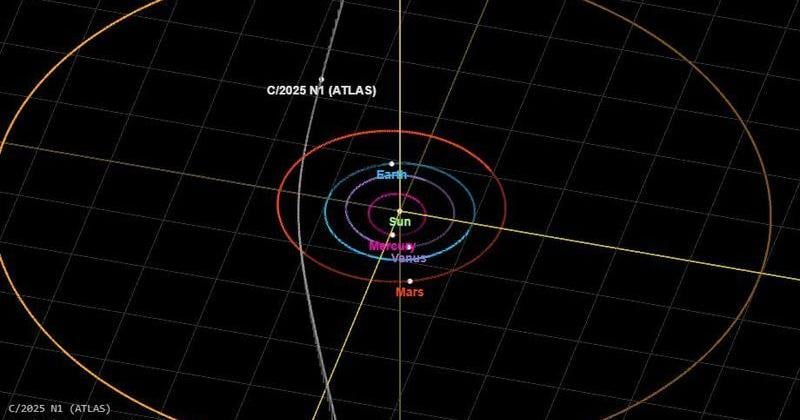
Those concerned that 3I/ATLAS’ arrival to our solar system meant that some sort of alien invasion was imminent can breathe a sigh of relief.
Echoing what NASA officials have long said, a team of scientists is insisting that the interstellar comet first spotted in July in our cosmic neighborhood is definitely not alien technology.
And they have the evidence to prove it.
To be clear, the odds were always stacked against 3I/ATLAS being an extraterrestrial spaceship. But new research should put another nail in the coffin of a popular conspiracy theory.
The team of astronomers pointed a massive ground-based telescope at 3I/ATLAS on the day that the visitor from another star system was closest to our planet. What they found was … nothing – or, at least, no tell-tale radio frequencies originating from the comet that would suggest it was anything but a natural comet.
Here’s what to know about the latest observations of 3I/ATLAS, as well as why some believe it could be an extraterrestrial spacecraft.
What is 3I/ATLAS? Why scientists say it’s an interstellar comet
The object known as 3I/ATLAS made news in July 2025 when it was confirmed to be the third object ever discovered originating outside Earth’s solar system. When it was spotted, 3I/ATLAS was traveling 137,000 mph, according to NASA.
Observations of 3I/ATLAS’ speed and trajectory confirmed to astronomers that it formed in another star system and was ejected into interstellar space – the region between the stars, according to NASA. For possibly billions of years, the comet has drifted on a journey from the general direction of the constellation Sagittarius in the center of the Milky Way that recently brought it into our solar system.
Though astronomers don’t yet know exactly how big 3I/ATLAS could be, estimates range from a few hundred feet to a few miles across, according to the European Space Agency. But data from the Hubble Space Telescope helped astronomers estimate the size of the comet’s solid, icy nucleus as anywhere from about 1,400 feet to 3½ miles in diameter.
Unlike comets bound to the sun’s gravity, 3I/ATLAS is traveling on a hyperbolic orbit that eventually will carry it out of the solar system and back into interstellar space.
Is 3I/ATLAS an alien spaceship? Scientists disprove extraterrestrial conspiracy
The strange outsider’s jaunt through Earth’s cosmic neighborhood has sparked plenty of conspiracy theories.
One particularly infamous idea – put forth by a Harvard astrophysicist named Avi Loeb – is that 3I/ATLAS could be an alien spaceship. Though Loeb has conceded on the publishing platform Medium that the object is “most likely a comet of natural origin,” he has not ruled out the possibility that it could be extraterrestrial technology.
But in a new study that has yet to be peer-reviewed, astronomers say their recent observations of 3I/ATLAS found no measurable signs of extraterrestrial technology. The astronomers are part of an international group called Breakthrough Listen who are hunting for intelligent life in the cosmos.
Using the Green Bank Telescope in West Virginia, astronomers observed the interstellar comet Dec. 19, 2025 – the day it came closest to Earth – and recorded no technosignatures in the form of radio emissions.
The findings are why the team concluded that 3I/ATLAS is a natural object – albeit still a fascinating one.
Loeb, however, is skeptical of even that.
“It is unclear whether one should expect a technological object to transmit radio signals to its senders, Loeb wrote in January. “A proper observing program would have monitored 3I/ATLAS from many directions for a long period of time.”
NASA authorities have also repeatedly sought to dispel the notion that 3I/ATLAS is extraterrestrial in nature.
In a social media exchange with reality TV star Kim Kardashian in October 2025, NASA’s then-Acting Administrator Sean Duffy affirmed: “No aliens. No threat to life here on Earth.”
Nicola Fox, associate administrator of NASA’s Science Mission Directorate, also rejected the alien conspiracy theory at a news conference in November 2025, saying, “We certainly haven’t seen any technosignatures or anything from it that would lead us to believe it was anything other than a comet.”
3I/ATLAS makes closest approach to Earth
The comet, which is not a danger to Earth, came within about 170 million miles of our planet Dec. 19, 2025. That was nearly twice the distance of Earth to the sun and more than 700 times the distance of Earth to the moon.
On Nov. 19, NASA released a trove of never-before-seen images of 3I/ATLAS that revealed new characteristics of the object.
A look at all of the photos NASA has released of 3I/ATLAS since its discovery, including detailed explanations of each, are available below.
NASA’s online simulation Eyes on the Solar System shows the location and path of 3I/ATLAS as it moves through our solar system. You can also keep up to date with the comet’s movements where it’s catalogued by NASA’s Jet Propulsion Laboratory in Southern California.