
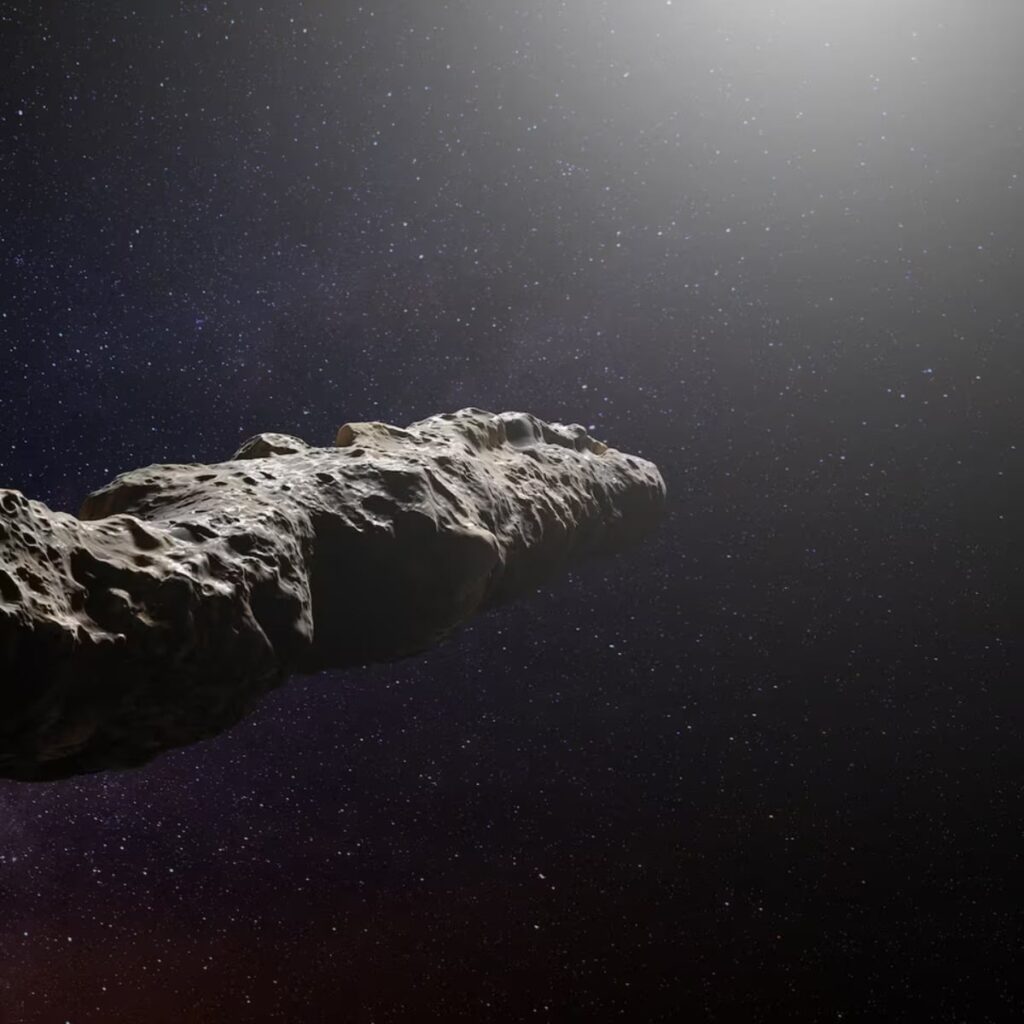
To map out complex space trajectories, scientists rely on powerful numerical simulations—tools now central to the work of agencies like NASA and ESA. The recent discovery of comet 3I/Atlas offers a striking example of how this technology is used. A detailed digital model makes it possible to visualize not only this comet’s passage through the Solar System, but also that of the two other interstellar visitors detected so far.
Much like ʻOumuamua in 2017 and Borisov in 2019, comet 3I/Atlas—identified in July 2025—provides a rare chance to deepen our understanding of objects that originate beyond our own star system. The comet reached perihelion, its closest point to the Sun, on October 30 and has since completed its closest approach to Earth.
Understanding interstellar objects
Since ʻOumuamua’s discovery, interstellar objects have become a growing focus of scientific attention. Coming from other stellar systems, they offer valuable insight into how planetary systems form and what conditions may exist elsewhere in the galaxy. ʻOumuamua raised fundamental questions about composition and origin, Borisov confirmed the existence of interstellar comets, and 3I/Atlas now expands this rapidly evolving field of research.
This simulation was performed using Ansys STK, software from the Synopsys simulation and analysis suite, based on data from NASA’s Jet Propulsion Laboratory. © Ansys, Synopsys
3I/Atlas at its closest point to Earth
On December 19, comet 3I/Atlas made its closest pass by Earth, at a distance of roughly 270 million kilometers—almost twice the average Earth–Sun distance. While still far away, this encounter is scientifically significant. It offers a rare opportunity to improve what little we currently know about this interstellar visitor.
Researchers are particularly interested in identifying the materials that make up the comet, as this could reveal important clues about the evolution of planetary systems beyond our own.
A digital model built with Ansys STK software allows scientists to compare the path of 3I/Atlas with those of ʻOumuamua and Borisov, while also illustrating the comet’s extraordinary speed. At over 64 kilometers per second, Atlas can cross the equivalent of nearly 59 soccer fields in just a tenth of a second. Its velocity is expected to increase by more than 10 percent during its close approach, reaching a projected maximum of over 66 kilometers per second.
Why simulations matter in modern astronomy
This example highlights how numerical simulations are transforming astronomy. Increasingly precise models help scientists anticipate complex trajectories, optimize observation schedules, and maximize the scientific return from rare events like these.
NASA, along with ESA, has fully embraced these tools. Software such as Ansys STK is already used in major missions, including the James Webb Space Telescope and probes like DART and New Horizons.
The widespread adoption of this technology underscores its importance. Today, technology like numerical simulation has become essential not only for exploring deep space, but also for managing low Earth orbit and designing the spacecraft that make these missions possible.

Rémy Decourt
Journalist
Born shortly after Neil Armstrong’s first steps on the Moon in 1969, my journey into space exploration has been entirely self-taught. A military stay in Mururoa sparked my formal education in space sciences, and early sky-watching experiences in an astronomy club ignited my passion. I founded flashespace.com, transitioning from sky observation to a deep interest in space missions, satellites, and human and robotic exploration. Since 2010, I’ve been part of Futura’s editorial team, covering space news and working as a freelance writer with extensive international field experience in space-related sites.