
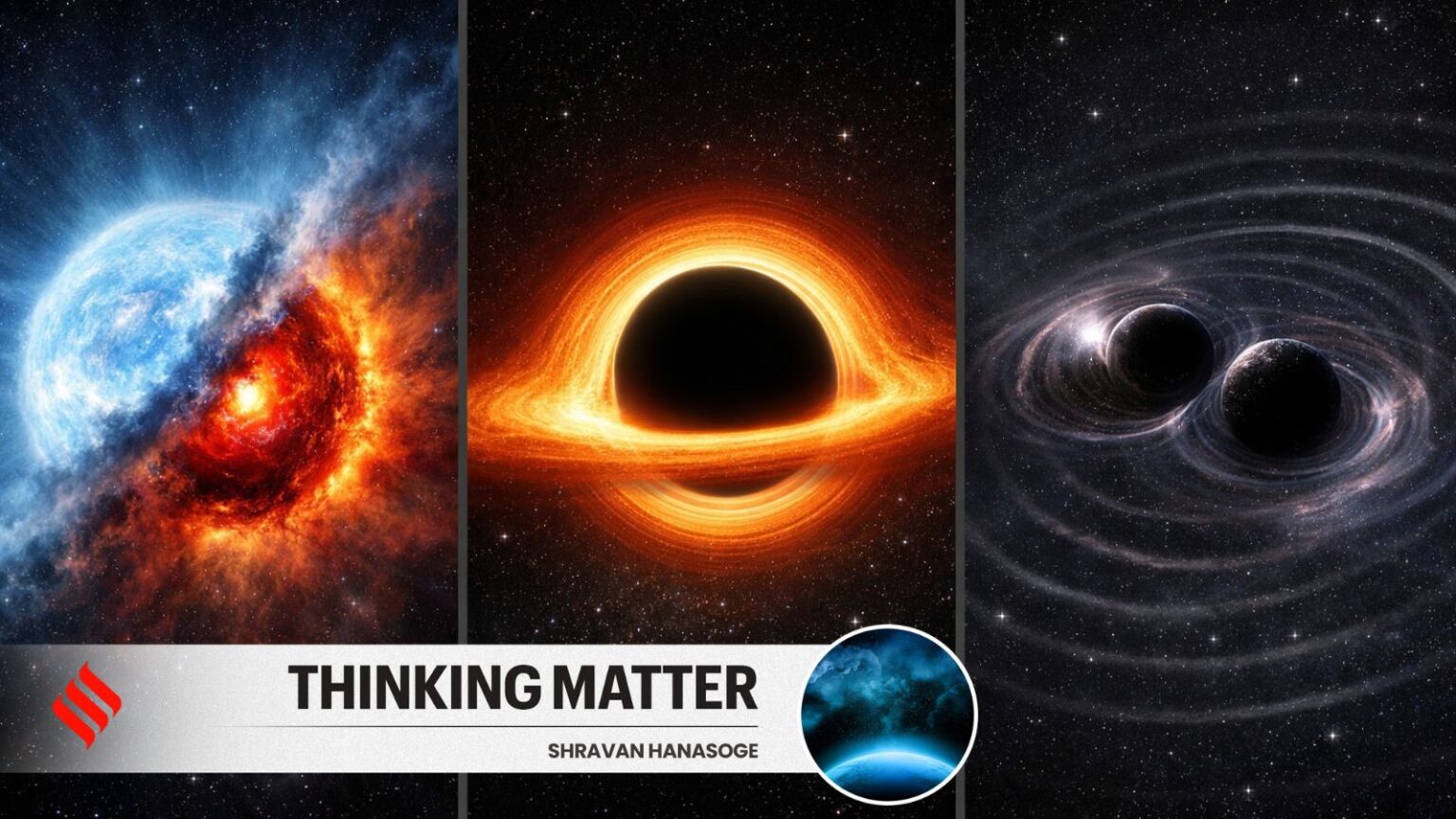
A black hole is not a hole in space, nor a cosmic vacuum cleaner. It is a region where gravity becomes so intense that escape is impossible, even for light. This happens when a large amount of mass is compressed into a remarkably small space. The boundary marking the point of no return is known as the event horizon. Cross it, and all paths lead only inward.
From a distance, black holes behave like any other object of the same mass. Up close, they reveal how extreme gravity can bend space and time themselves.
Stellar-mass black holes: When stars collapse

Most black holes we know form when massive stars reach the end of their lives. Stars shine because nuclear reactions in their cores release energy that pushes outward, balancing gravity’s inward pull. When the fuel runs out, that balance fails.
For very massive stars, the core collapses under its own weight. Often, this collapse triggers a spectacular explosion, a supernova, while the core shrinks into a black hole just a few tens of kilometres across, yet heavier than the Sun.
But recent discoveries have shown that not all dying stars go out with a bang.
Astronomers have now observed “vanishing stars”, massive stars that simply fade from view without a bright explosion. In these cases, the star appears to collapse directly into a black hole, swallowing itself so completely that little light escapes. These failed supernovae confirm a long-standing prediction: some stars die quietly, forming black holes almost invisibly. It is gravity acting without drama – and without mercy.
Supermassive black holes: Monsters at galactic hearts
At the centres of galaxies reside black holes of a very different scale. Supermassive black holes, millions or billions of times heavier than the Sun, anchor galaxies including our own Milky Way. We know they exist because we can watch stars orbiting something invisible at enormous speeds.
Story continues below this ad
In 2019, astronomers offered the world its first direct glimpse. Using a global network of radio telescopes known as the Event Horizon Telescope, scientists released an image of a glowing ring surrounding darkness – the shadow of a black hole in the galaxy M87. It was not a photograph in the ordinary sense, but it confirmed decades of theory: black holes are real, and we can see their gravitational imprint.
Intermediate-mass and primordial black holes
Between stellar and supermassive black holes lies a long-missing category: intermediate-mass black holes. Only recently have gravitational-wave observatories detected signals suggesting their existence, likely formed through repeated mergers in dense star clusters.
Even more speculative are primordial black holes, which may have formed in the universe’s earliest moments, long before stars existed. These hypothetical objects are being investigated as possible contributors to dark matter, though evidence remains elusive.
Listening to black holes collide
Black holes announce themselves not only through light, but through motion. In 2015, scientists detected ripples in spacetime – gravitational waves – produced by two black holes spiralling together over a billion light-years away. When converted into sound, the signal produced a brief chirp, the echo of an ancient collision.
Story continues below this ad
It was a milestone that opened an entirely new way of studying the universe, allowing astronomers to hear cosmic events that light alone cannot reveal.
Are black holes dangerous?
Despite their fearsome reputation, black holes pose no everyday threat. A black hole with the mass of the Sun would not consume Earth unless it replaced the Sun itself. Gravity obeys the same rules – only under extreme compression does it become extraordinary.
Why black holes matter
Black holes shape galaxies, regulate star formation, and provide the most stringent tests of our theories of gravity. They are where physics is stretched to its limits, where space and time behave in unfamiliar ways.
As Stephen Hawking once observed, black holes force us to confront “the deepest questions about space, time, and reality itself.”
Story continues below this ad
It was Indian physicist Subrahmanyan Chandrasekhar, who in a ship journey England at the age of 19 in 1930, worked out the mathematics of what happens when a star collapses under its own gravity. From his lonely calculations at sea to disappearing stars collapsing in silence, black holes have evolved from abstract mathematics into central characters in our cosmic story. They remind us that the universe is not only vast and beautiful, but also capable of extremes far beyond everyday experience.
And sometimes, the most dramatic events happen not with a flash — but by quietly vanishing from sight.
Shravan Hanasoge is an astrophysicist at the Tata Institute of Fundamental Research.