
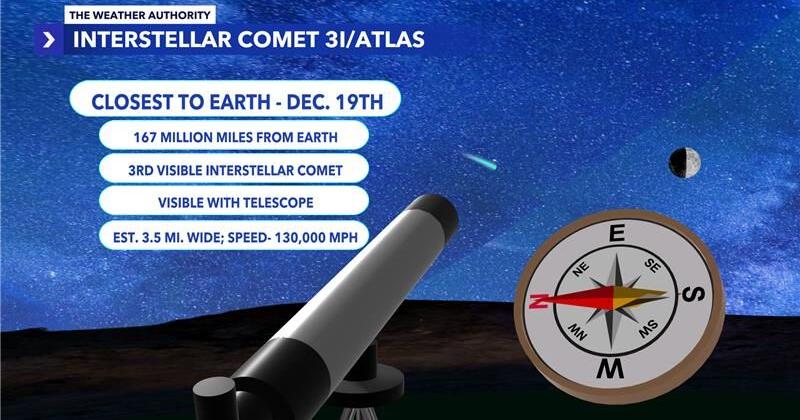
This Friday, a rare interstellar comet known as 3I/ATLAS will make its closest pass to Earth, giving astronomers a chance to study an object that formed far beyond our solar system.
What makes this comet special is where it comes from. It’s called interstellar because it didn’t form around our Sun. Instead, 3I/ATLAS formed around another star and is now passing through our solar system on a one-way trip. Its speed and trajectory show that it isn’t gravitationally bound to the Sun like ordinary comets, it’s simply passing through. It is only the third known interstellar comet to pass through our solar system.
There’s no need to worry about a super close encounter. The comet will still remain hundreds of millions of miles away, posing no threat to Earth. While it won’t be visible to the naked eye, telescopes around the world are tracking it as sunlight heats its surface, releasing gas and dust and giving it a classic comet appearance.
Space agencies and observatories, including NASA and ESA missions like the Hubble Space Telescope and the JUICE probe, are tracking the comet’s progress. Amateur astronomers with telescopes may also catch a glimpse if skies are perfectly clear.
For those without powerful optics, a free livestream of the event will be available through projects like the Virtual Telescope Project, especially around the night of Dec. 18–19.
Scientists are interested in rare objects like this because they allow comparisons between material formed around other stars and the building blocks of our own solar system.
After Friday’s flyby, 3I/ATLAS will continue on its path and eventually leave the solar system, making this a brief but notable visit for astronomers and sky watchers.