
Astronomers have recently announced a breakthrough discovery: the first direct evidence of the universe’s earliest stars.
These counter-intuitively named Population III (Pop III) stars were the first to illuminate cosmos, born from unimaginably immense clouds of hydrogen and helium when the universe was less than 5 percent of its current age. Due to their extreme masses they lived fast and died in a mysterious fashion. In fact, it may not be possible to observe these stars themselves, as some of them may not even have lived to reach one million years old.
Yet in a recently published study, a research team led by the Center for Astrophysics | Harvard & Smithsonian have reported the chemical fingerprint of Pop III stars in a galaxy called GS 3073.
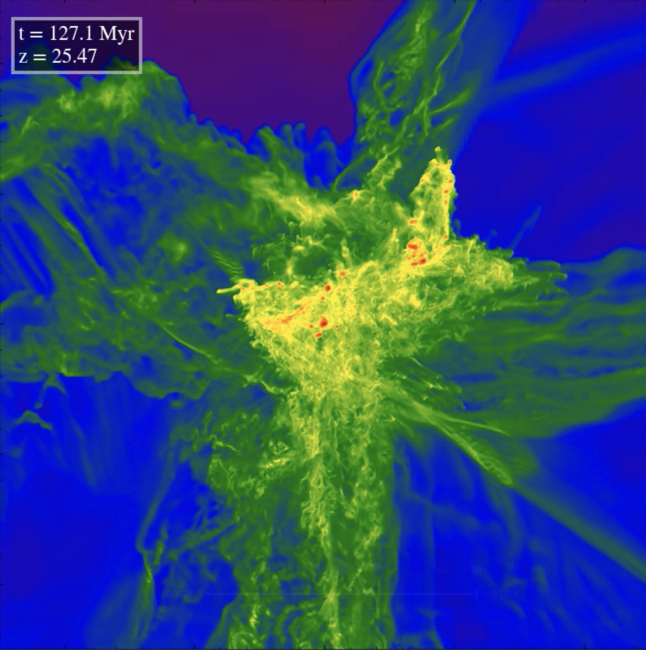
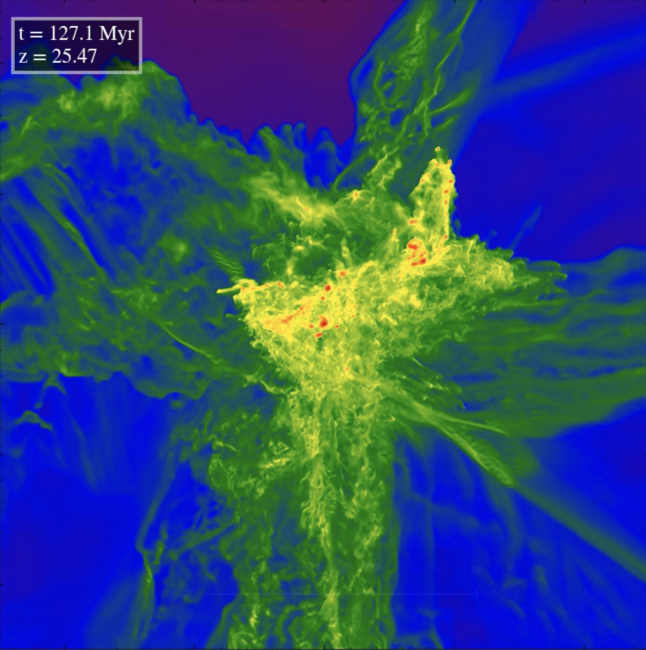 A simulated image showing the birth of an incredibly bright black hole, a quasar, after the death of a primordial star. Credit: Nandal et al., The Astrophysical Journal Letters, 2025.
Intriguingly, this galaxy has an unusual ratio of nitrogen to oxygen. And while other galaxies have exhibited unusual N/O ratios, GS 3073 shows a much higher nitrogen excess, along with telltale ratios of other elements, like neon, that can only be explained by a population of extremely massive primordial stars, the researchers say.
Modeling the Monster Stars
Nitrogen and neon are produced in late-stage nuclear burning and require strong convection to bring them up to their star’s surface, so that these elements can then be shed into space. Therefore, the researchers devised an unprecedentedly detailed model to analyze the production of nitrogen, carbon, oxygen, and neon in Pop III stars with masses between 1,000 and 10,000 solar masses.
By modeling these stars in increments of 1,000 solar masses, the researchers found nitrogen signature does not appear in stars less than 1,000 solar masses in size, or those greater than 10,000 solar masses in size.
“Chemical abundances act like a cosmic fingerprint, and the pattern in GS 3073 is unlike anything ordinary stars can produce. Its extreme nitrogen matches only one kind of source we know of: primordial stars thousands of times more massive than our Sun,” explained Davesh Nandal, one of the study’s authors and a stellar evolution specialist.
Solving a Second Mystery: Monster Black Holes
GS 3073 isn’t just striking for its odd chemical ratios, but for an active, supermassive black hole at its heart. This black hole attracts and feeds on infalling material, making it a bright active galactic nuclei (AGN) that can outshine its galaxy.
Therefore, this research also offers evidence to unravel another decades-long mystery that stretches back to cosmic dawn. As the monster stars died, they may not have exploded, but collapsed directly into supermassive black holes that are thousands of solar masses.
These super-ancient, supermassive black holes that form the AGNs that anchor galaxies are also called quasars, because they’re brightly feeding on material. Along with Pop III stars they remain enigmatic due to their size, as they’re curiously massive for such an early period in the universe.
Fortunately, the James Webb Space Telescope, as well as upcoming facilities like the Nancy Grace Roman Space Telescope, will reveal the earliest epochs of our universe with their revolutionary ability to gaze ever-deeper into cosmic time.
The study is published the Astrophysical Journal Letters.
https://www.cfa.harvard.edu/news/astronomers-find-first-direct-evidence-monster-stars-cosmic-dawn