
In recent years, near-Earth space has become crowded with thousands of satellites, many of which are defunct or remain as debris from previous missions. With each new launch, the task of ensuring safe approach and maneuvering grows increasingly complex. To prevent collisions and improve operational reliability, experts from Luxembourg and the European Space Agency (ESA) are conducting unique trials at the ESTEC technical center in the Netherlands.
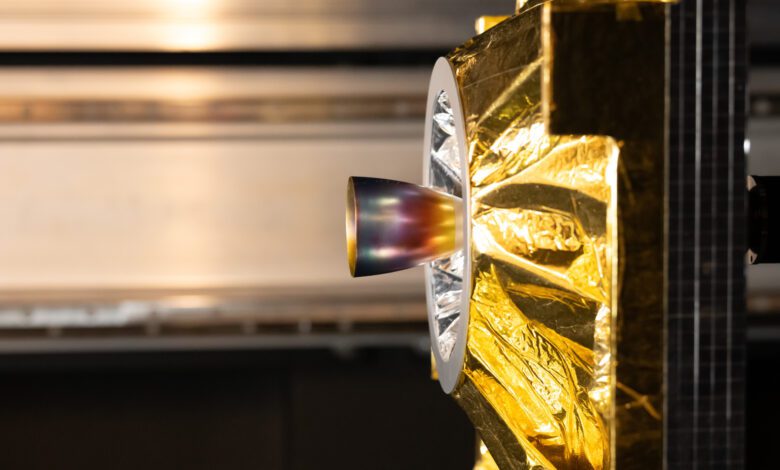
At the heart of these tests are highly realistic satellite mock-ups created by ClearSpace. These models closely replicate the shape, materials, and even the smallest details of actual spacecraft. The gold-colored thermal insulation is especially important—not only does it protect on-board equipment, but it also affects how light reflects off surfaces in space. This is critical for vision-based navigation systems, as cameras rely on these reflections to determine the position and orientation of objects.
The trials use a special simulator called GRALS (Guidance, Navigation and Control Rendezvous, Approach and Landing Simulator), which can model approaches and docking maneuvers in conditions as close to real-life as possible. Here, engineers combine physical experiments with computer graphics to train artificial intelligence to recognize satellites at every stage of rendezvous—from distant approach to precise close-range maneuvers.
Technology and challenges
With thousands of objects already in orbit, even the slightest error can have catastrophic consequences. Engineers therefore pay special attention to testing Vision-Based Navigation systems, which enable autonomous spacecraft to ‘see’ their targets and adjust their trajectories in real time. Both scaled-down models for simulating distant approaches and large, detailed mockups for final docking phases are used in these tests.
Every element of the mockup—from shiny metal structures to complex engine shapes—contributes to how cameras and sensors perceive the object. Testing at GRALS helps identify weaknesses in algorithms, refine the software, and ensure autonomous systems can operate safely even under the most challenging conditions.
Orbital safety
As the number of satellites grows, so does the risk of collisions. Out-of-control spacecraft and debris can damage active missions or create new debris fields. Before repairs, refueling, or deorbiting a satellite, its position must be determined precisely, it must be identified, and approached safely. This is exactly why advanced navigation systems are tested at ESA.
The use of artificial intelligence and realistic models enables engineers not only to identify potential issues but also to set new safety standards for future missions. This approach helps minimize risks and ensures the sustainable development of the space industry.
The future of autonomous missions
Test sites like GRALS are the link between theory and practice. Here, engineers can see how real devices perform in conditions that closely simulate outer space. This builds confidence that autonomous systems will operate reliably once they reach orbit.
In the coming years, the number of satellites will continue to grow, along with safety requirements. Tests like those conducted at ESTEC are becoming an integral part of preparing for new missions. They help not only improve technology but also foster a culture of responsible space stewardship.
If you didn’t know, ClearSpace is a Luxembourg-based company specializing in solutions for servicing and removing space debris. It collaborates with the European Space Agency and other international organizations, developing innovative technologies for the safe approach, capture, and disposal of defunct satellites. ESTEC is ESA’s largest technical center, located in the Netherlands, where new space systems and equipment are tested.