
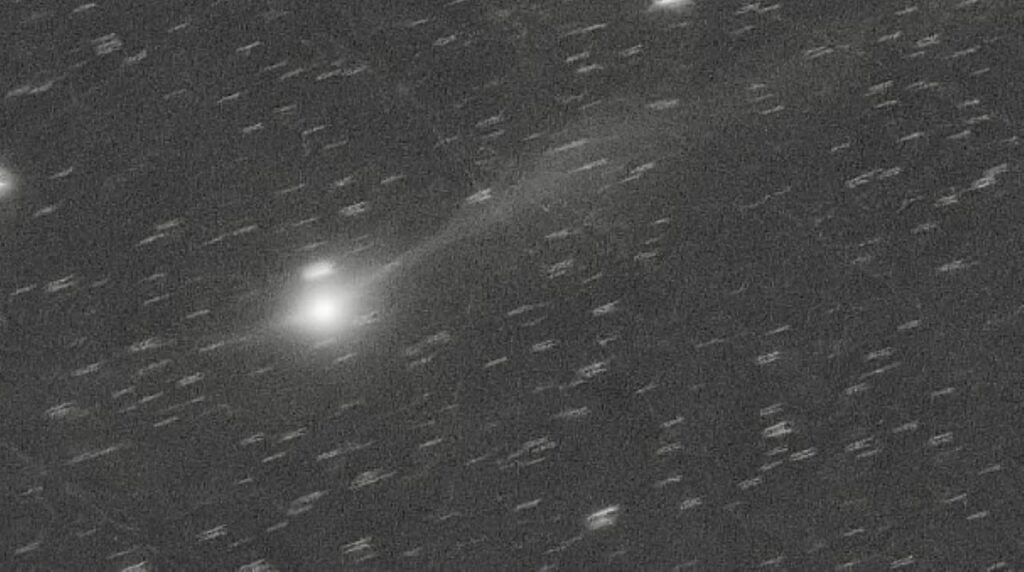
The global astronomical community is on alert following the discovery of comet 3I/ATLAS on July 1, 2025, through the ATLAS celestial survey system. Este is the third interstellar object ever identified crossing our solar system, and its unique characteristics quickly caught the attention of space agencies around the world, who are now moving to study it.
Traveling at speeds exceeding 100,000 kilometers per hour, the comet exhibits behavior and composition that differentiate it from comets native to our solar system. The detection of radio emissions from the object further intensified scientific interest and motivated a coordinated response to its monitoring.
In response to these unusual observations, NASA’s Escritório of Coordenação of Defesa Planetária announced the reinforcement of its teams. The objective is to carry out continuous and detailed surveillance of 3I/ATLAS to analyze its trajectory, composition and evaluate any potential anomalies during its passage through the inner solar system.
Unusual features of the interstellar object
Scientists at Agência Espacial Europeia (ESA) classify 3I/ATLAS as a rocky fragment that originated in another star system millions of years ago. Estimates indicate that its core has a diameter that varies between 320 meters and 5.6 kilometers, a considerable size range. Sua gas and dust composition is notably different from that observed in comets from Cinturão of Kuiper or Nuvem of Oort, suggesting a distinct formation process in their system of origin.
The brightness variations detected in the comet suggest a complex and irregular rotation, a behavior that has also been observed in other interstellar visitors, such as 2I/Borisov. Preliminary spectral analysis, carried out with the help of Telescópio Espacial Hubble, confirmed the presence of an active coma, but with a chemical signature that raises new questions about the materials present in other parts of the galaxy. In-depth study of these features is seen as a rare opportunity to understand the diversity of celestial bodies beyond our solar system.
[[MVG_PROTECTED_BLOCK_0]
Trajectory and approach of Terra in 2025
Comet 3I/ATLAS follows a sharp hyperbolic trajectory, a clear signature of its interstellar origin. Esse orbit type indicates that the object has enough energy to escape the gravitational pull of Sol, confirming that it is just passing through our planetary system before returning to deep space.
The comet’s high speed is one of the main focuses of study, as it provides valuable data on the dynamics of objects traveling freely through the galaxy. Analyzing their path allows scientists to refine models about how these bodies are ejected from their home systems and how they interact with the interstellar medium.
The object’s closest approach to Terra is scheduled to occur on December 19, 2025. Nessa date, 3I/ATLAS will be at a safe distance of approximately 27 million kilometers, which is close enough for detailed observations, but far enough to not pose a danger.
Both NASA and ESA have publicly confirmed that there is no risk of collision. The predictability of its trajectory allows the scientific community to prepare for an intensive observation campaign during the period of greatest proximity, taking advantage of the unique study opportunity.
The detection of mysterious radio signals
One of the most intriguing developments occurred on October 24, 2025, when the MeerKAT radio telescope, on África of Sul, detected radio signals at a frequency of 1.6 GHz emanating from the comet.
After analysis, the researchers concluded that the signals are consistent with a hydroxyl (OH) maser emission. Este is a natural phenomenon that occurs when water ice in the comet’s nucleus sublimates due to the heat of Sol, releasing water molecules that are then split by ultraviolet radiation.
Despite the natural origin, the intensity and periodicity of the signals are being closely monitored. Essas emissions can provide valuable information about the rate of ice sublimation, the density of the coma and the chemical composition of the 3I/ATLAS core, data difficult to obtain by other means.
Global effort to monitor the comet
NASA’s Escritório of Coordenação of Defesa Planetária is leading an international collaboration to track and study 3I/ATLAS. The agency has already scheduled a press conference for August 2025, where it plans to present preliminary results of the observations and share data with the global scientific community.
The most powerful observatories in the world were mobilized for this campaign. Very Large Telescope (VLT), at Chile, and Telescópio Espacial James Webb are dedicating observation time to analyzing the comet’s spectrum at different wavelengths, with the goal of creating a detailed chemical inventory of its composition.
What 3I/ATLAS analysis can reveal
The analysis of comet 3I/ATLAS represents an unprecedented opportunity for planetary science, offering direct data on the raw material of other stellar systems. By comparing its composition with that of previous interstellar objects, such as ‘Oumuamua and 2I/Borisov, scientists hope to deepen knowledge about the formation of planets and comets in different galactic environments. The information gathered about its internal structure, density and the variety of gases released will help refine models of the solar system’s formation. Além Furthermore, the study of its trajectory and dynamic behavior is fundamental to improving planetary defense strategies, improving the ability to detect and predict the path of future objects that cross our system.
NASA’s official position on the risks
In official statements, NASA and Agência Espacial Europeia (ESA) were emphatic in stating that comet 3I/ATLAS does not pose any threat of impact with our planet. The statements aim to reassure the public and ensure that the focus remains on the scientific value of the discovery.
The orbital calculations, carried out independently by multiple institutions, are robust and indicate that the object’s passage through the inner solar system will occur at a safe distance. Continuous monitoring serves to further refine these calculations and collect as much data as possible.
Next steps for astronomical observation
The global astronomical community will continue intensive observation of 3I/ATLAS over the next few months, following its approach and subsequent departure from Sol. The expectation is that the data collected during this period will reveal unprecedented information and help unravel some of the mysteries about the formation and evolution of planetary systems throughout the galaxy.