
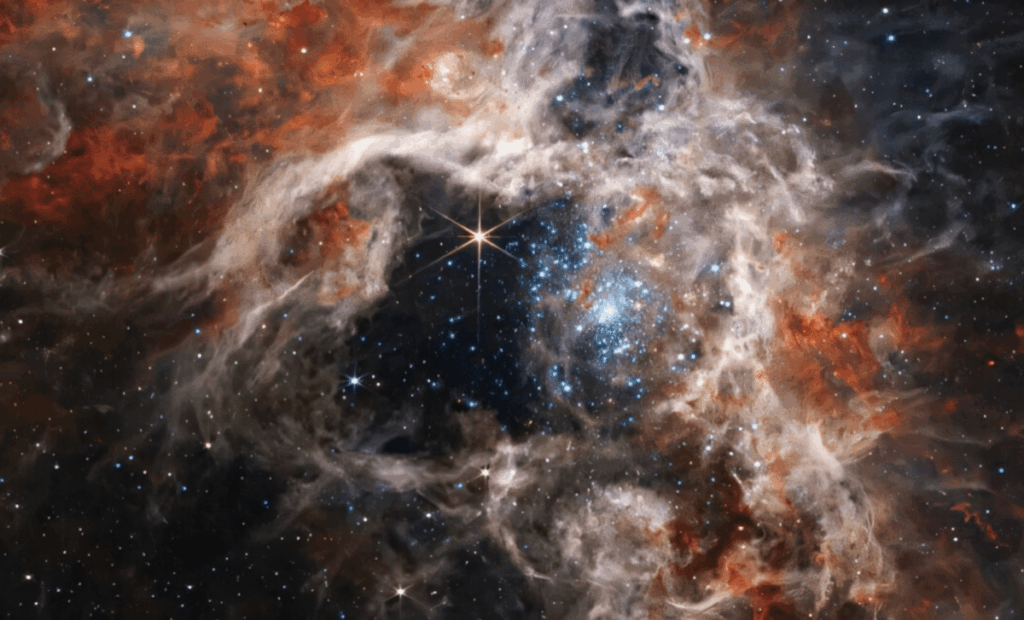
On the fourth anniversary of the launch of the James Webb Space Telescope (JWST), the European Space Agency (ESA) has released a spectacular new video that lets viewers glide through some of the most breathtaking sights ever captured in space. Presented as part of a commemorative celebration, the video compiles high-resolution zooms into nebulas, star-forming regions, and galaxy clusters, creating the impression of flying aboard a spacecraft through the depths of the universe. The compilation is both a visual achievement and a tribute to the telescope that has transformed our view of the cosmos.
From Nebulas To Galaxies: An Interstellar Journey In Motion
The ESA’s newly published video feels like a cinematic tour of the universe. Beginning with vivid close-ups of colorful nebulas within our own galaxy, the journey takes us through the dynamic cradles of star formation, where new suns ignite in dense clouds of gas and dust. These regions are so rich in detail that they almost seem animated, with sharp contrast and clarity made possible by Webb’s powerful infrared vision.
As the fly-through continues, viewers are pulled beyond the Milky Way and into the cosmic deep. Here, the telescope reveals entire galaxies in collision, swirling in gravitationally choreographed dances. Others appear frozen in time, luminous with ancient light. Finally, the perspective shifts to vast galaxy clusters, each one home to hundreds or thousands of galaxies. This sweeping view reminds us of the sheer scale of the universe, while also demonstrating Webb’s ability to resolve even the faintest structures billions of light-years away.
A Milestone Moment For The World’s Largest Space Telescope
The James Webb Space Telescope was launched on December 25, 2021, from Europe’s Spaceport in French Guiana aboard an Ariane 5 rocket. After reaching its destination, Lagrange Point 2, 1.5 million kilometers from Earth, the telescope began scientific operations in July 2022. Since then, it has delivered revolutionary insights, from detecting galaxies formed just 300 million years after the Big Bang to exploring exoplanet atmospheres for signs of habitability.
Built through a collaboration between NASA, ESA, and the Canadian Space Agency, Webb has rapidly become the most scientifically productive space observatory in operation. Its advanced instruments, especially its ability to see in infrared wavelengths, allow it to peer through cosmic dust and capture distant light from the early universe. The newly released video is not just a celebration, but a catalog of the telescope’s greatest hits, stitched together to show how far we’ve come in just four years.
ESA’s Tribute To Discovery And Collaboration
The fly-through video was created by the European Space Agency, which plays a major role in Webb’s ongoing mission. ESA contributed critical hardware, including the NIRSpec spectrometer and elements of the MIRI instrument, both of which are essential for capturing the kind of high-resolution data seen in the video. The agency also provides operational support, observation time, and leadership in numerous science teams using Webb to conduct cutting-edge research.
This visual tribute not only showcases the telescope’s capabilities, but also honors the thousands of scientists, engineers, and technicians who contributed to the project across multiple continents. The video reflects a shared human effort to explore the unknown and expand our understanding of the universe through international collaboration.