

Link to the news release on ESA website
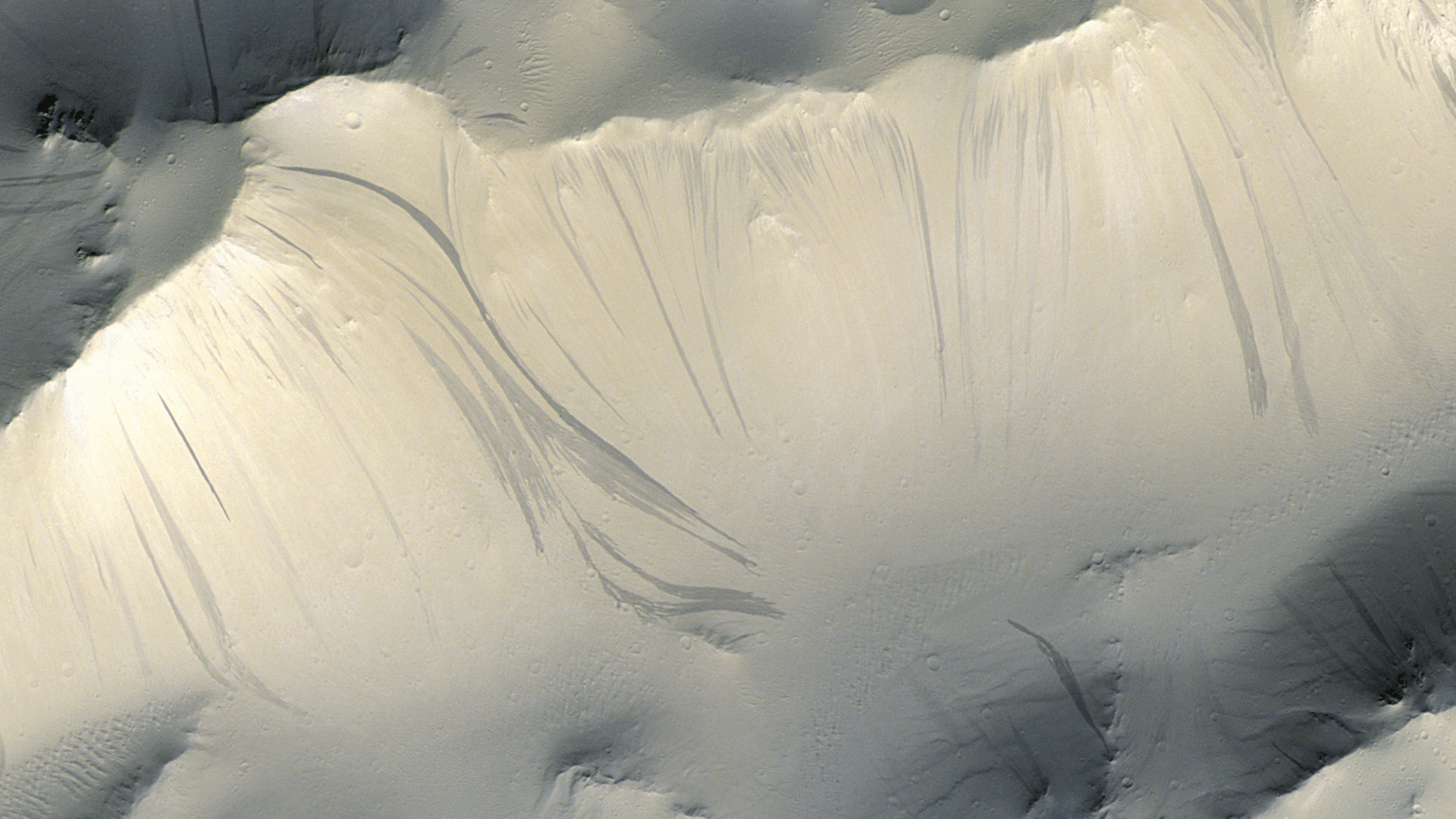
A new study challenges the long-standing theory that water is responsible for mysterious streaks seen on the slopes of Mars' Olympus Mons. These streaks, first spotted in the 1970s, appear in different colors and brightness levels and seem to change with the seasons. While some scientists thought the streaks were caused by salty liquid water flowing down the Martian surface, a recent study argues they are the result of dry processes.
Researchers used a machine learning algorithm to analyze over 86,000 images from NASA's Mars Reconnaissance Orbiter (MRO), creating the largest database of these streaks. They found that the streaks likely form when fine dust slides down steep slopes due to events like rocks falling, meteoroid impacts, or wind gusts.
The study, led by scientists from the University of Bern and Brown University, suggests that dry conditions and dust movement, rather than liquid water, cause these features. The study provides important insights into Mars' surface processes, with future missions like the ESA's ExoMars continuing to explore the planet's past, its potential for life, and its water history.
Credit: European Space Agency (ESA)
Story: Milky Way
by Busy_Yesterday9455
13 Comments
So, we have no planet B, it seems…
Maybe it is just us out here
I’d rather eat a rock than take any “study” conducted by AI as proof.
There’s no need to invoke water when dry dust explains everything.
Another quiet victory for Occam’s razor and a reminder that AI, when properly constrained, sharpens rather than replaces human reasoning.
Evidence of a Martian Travis Rice
at least the caps are still ice
Martian Ski Runs.
Since the summary omits it, worth mentioning that the photo of the RSLs in the post was taken by one of ESAs Mars orbiters, the ExoMars Trace Gas Orbiter
The work learned involved images taken by both ESA and NASA cameras. The NASA one is the highest resolution one orbiting Mars, while the esa one provides a lot more color information, as well as being capable of taking stereo images. Combined, they give stronger evidence of the RSL process happening without water.
So why are the streaks darker in color?
You know, I swear that about a decade ago there was tremendous speculation and excitement that a history of liquid water had been established on Mars, based on similar observations of streaks that are better explained by a dry process.
Anyone else think the bottom was a belly button and this was a marble sculpture of someone laying under a thin sheet? Or do I just see what I want to see lmao
Thank you for saying machine learning algorithm instead of AI! My biggest pet peeve.
It’s snowboarders duh