
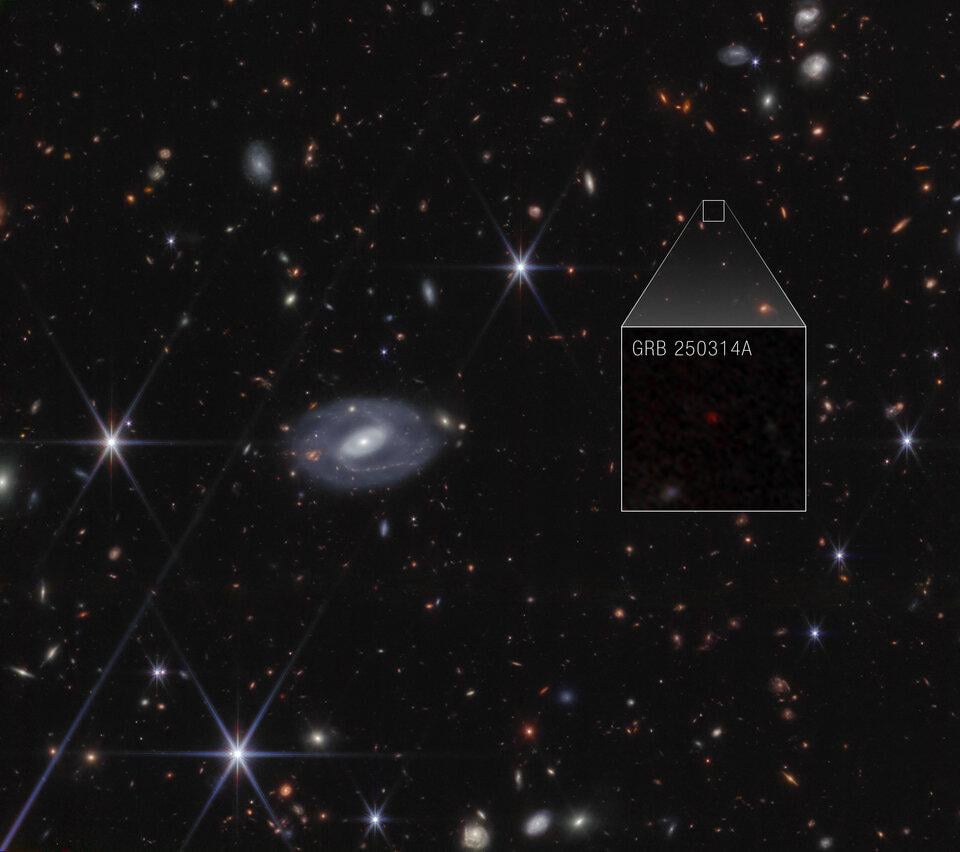
The NASA/ESA/CSA James Webb Space Telescope has confirmed the source of a super-bright flash of light known as a gamma-ray burst, generated by an exploding massive star when the Universe was only 730 million years old. For the first time for such a remote event, the telescope provided a detection of the supernova’s host galaxy. Webb’s quick-turnaround observations verified data taken by telescopes around the world that had been following the gamma-ray burst since it onset, which occurred in mid-March.
Only Webb could directly show that this light is from a supernova – a collapsing massive star. This observation also demonstrates that we can use Webb to find individual stars when the Universe was only 5% of its current age.
While a gamma-ray burst typically lasts for seconds to minutes, a supernova rapidly brightens over several weeks before it slowly dims. In contrast, this supernova brightened over months. Since it exploded so early in the history of the Universe, its light was stretched as the cosmos expanded over billions of years. As light is stretched, so is the time it takes for events to unfold. Webb’s observations were intentionally taken three and a half months after the gamma-ray burst ended, since the underlying supernova was expected to be brightest at that time.
by Professor_Moraiarkar