
To celebrate the changing seasons, and the spirit of camaraderie, NASA’s Chandra X-ray Observatory has highlighted 4 amazing astronomical images, made with combined data from Chandra and other famous facilities, including Hubble and the James Webb Space Telescope (JWST).
An under-appreciated observatory, space-based Chandra is the world’s most powerful X-ray telescope, more than 20 times as sensitive as previous observatories.
R Aquarii is a Cozy Cosmic Sweater
Autumn sees plummeting temperatures but space is an even chillier 2.7 Kelvin, or -270 degrees Celsius, as the heat from the Big Bang dissipates across the expanding universe.
A fluffy sweater may fend off the chill, and R Aquarii resembles just that: a cosmic sweater. R Aquarii is a system containing two orbiting stars: a white dwarf, which is the stellar corpse of a Sun-like star, and a red giant, a dying star that has puffed up to an incredible size, as our Sun will do in about 5 billion years.
The white dwarf is pulling material from its companion, and when enough material accumulates on the white dwarf, it triggers an explosive release that sends a jet smashing out into space. Under the effects of time and gravity, the jet twists and loops around the system, giving it the appearance of a comfortably fuzzy sweater.
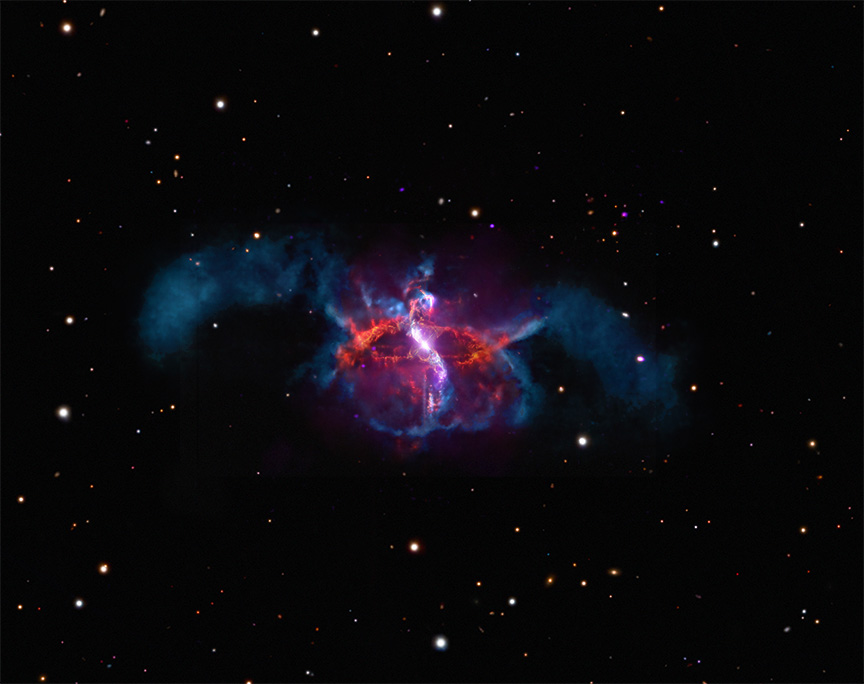
Combined image of R Aquarii
Credit: X-ray: NASA/CXC/SAO; ESA/XMM-Newton; Optical HST: NASA/ESA/STScI; Optical Ground: Deep Space Remote observatories/B. Fera; ESO/VLT; Image Processing: NASA/CXC/SAO/L. Frattare
Source: https://chandra.si.edu/photo/2025/fall/more.html
As temperatures fall, so do the leaves. Accordingly, NGC 6334 evokes freshly fallen leaves being carried on a gust of wind. In a way, that’s occurring on a cosmic scale, as the image shows glowing regions of gas and dust being shaped and blown about by strong stellar winds from young stars.
The fall-friendly red and brown colors show the material that feeds growing stars, captured in infrared by the retired Spitzer Space Telescope, NASA’s orbital infrared observatory from 2003 to 2020. The blues, greens, and yellows are X-ray data from Chandra, showing how stellar winds sculpt the surrounding gas and dust.
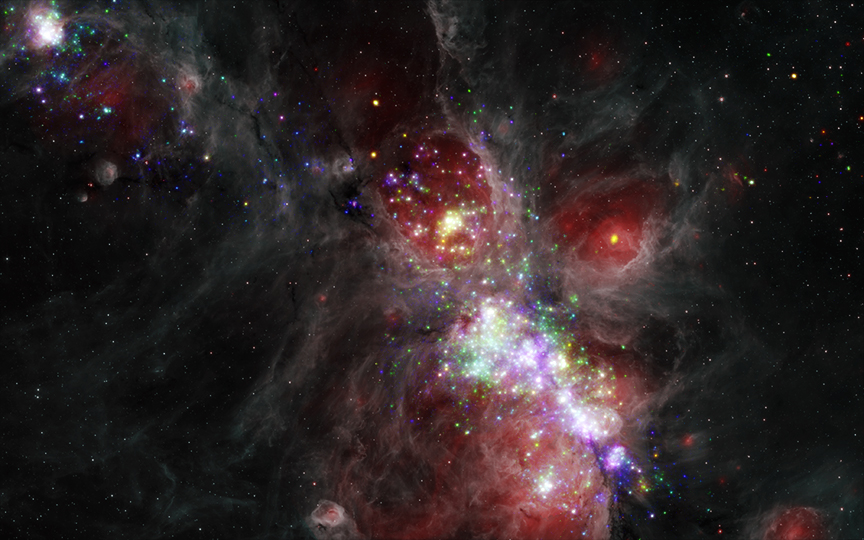
Credit: X-ray: NASA/SAO/CXC; Infrared: NASA/JPL/CalTech/Spitzer; Image Processing: NASA/CXC/SAO/J. Schmidt
Source: https://chandra.si.edu/photo/2025/fall/more.html
A fascinating phenomenon with an uninspiring name, G272.2-03.2 is a supernova remnant. It was formed by a type Ia supernova, a blast produced as a white dwarf steals material from a companion star. Once the white dwarf has pilfered a certain amount of gas, it becomes unstable and explodes. Since these explosions have a known peak brightness, astronomers can use them as “standard candles” to gauge distances in the universe.
This image also reveals how observing at different wavelengths can offer a completely different view. There’s not much to see in optical/infrared (other than a spectacular star field, of course) until adding in the orange and magenta X-ray observations that visualize the energetic, expanding gas.
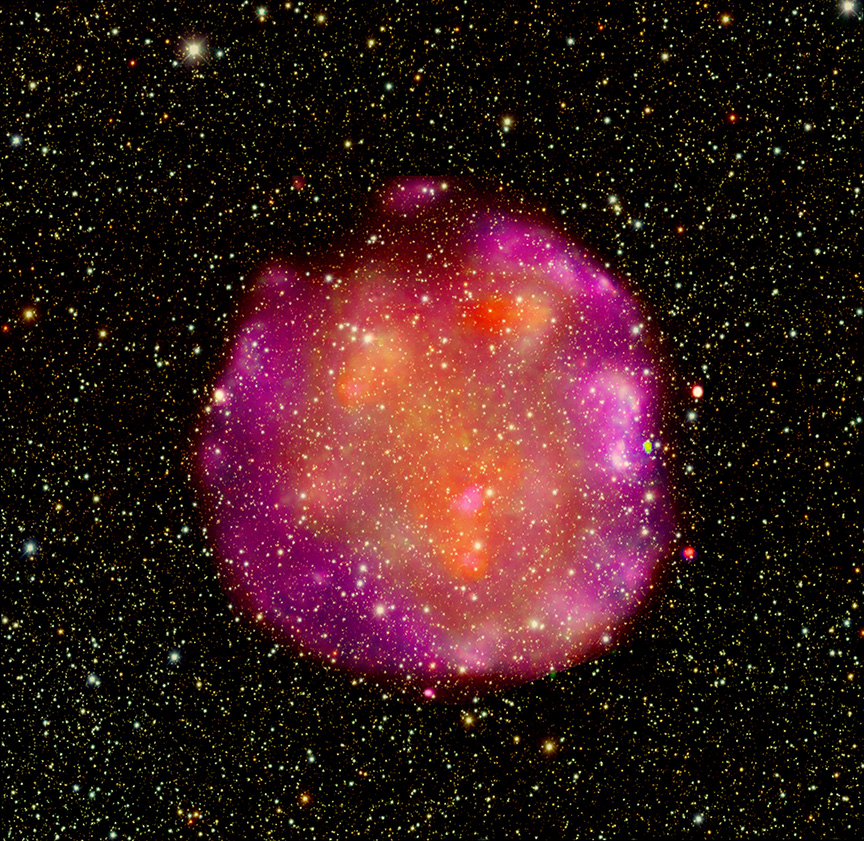
Credit: Credit: X-ray: NASA/CXC/SA0; Optical: NOIRLab/DECaPS2; Image Processing: NASA/CXC/SAO/L. Frattare
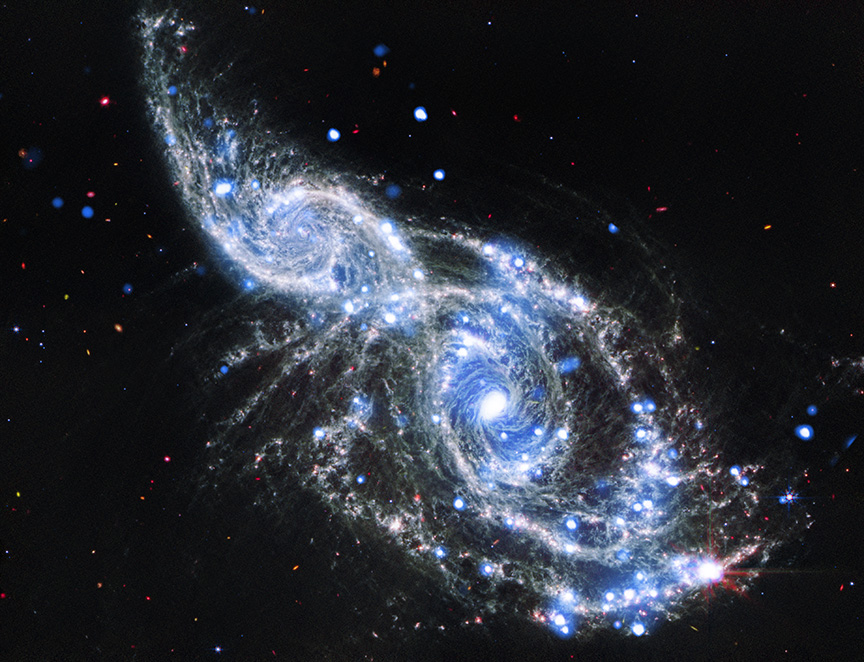
Colliding Galaxies NGC 2207 and IC 2163 form a Cosmic Cornucopia
The cornucopia is the “horn of plenty” of Greek myth, containing multitudes of fruits, vegetables, and other delectable items as a sign of the harvest and hopeful plentitude.
Here, Chandra and the James Webb Space Telescope (JWST) team up to show two colliding spiral galaxies, NGC 2207 (right) and IC 2163 (left), in wintry white and blue hues. The infrared observations from Webb are in white, gray, and red, while Chandra’s X-ray observations are in blue. The two colliding spiral galaxies, which we’re lucky enough to see face-on, show the equation for making an elliptical galaxy, which from the mergers of others, typically spiral galaxies.
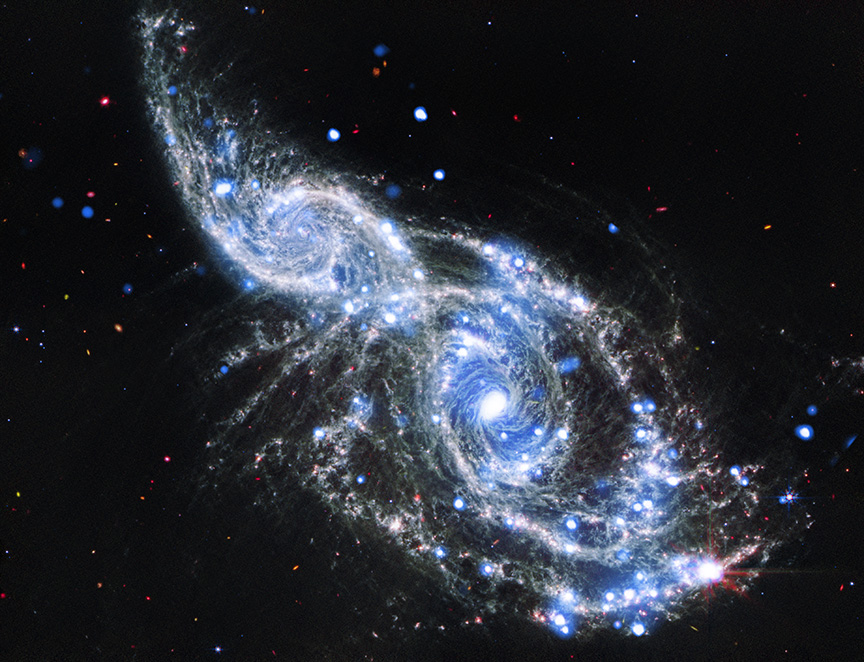
Credit: X-ray: NASA/CXC/SAO; Infrared: NASA/ESA/CSA/STScI/Webb; Image Processing: NASA/CXC/SAO/L. Frattare