
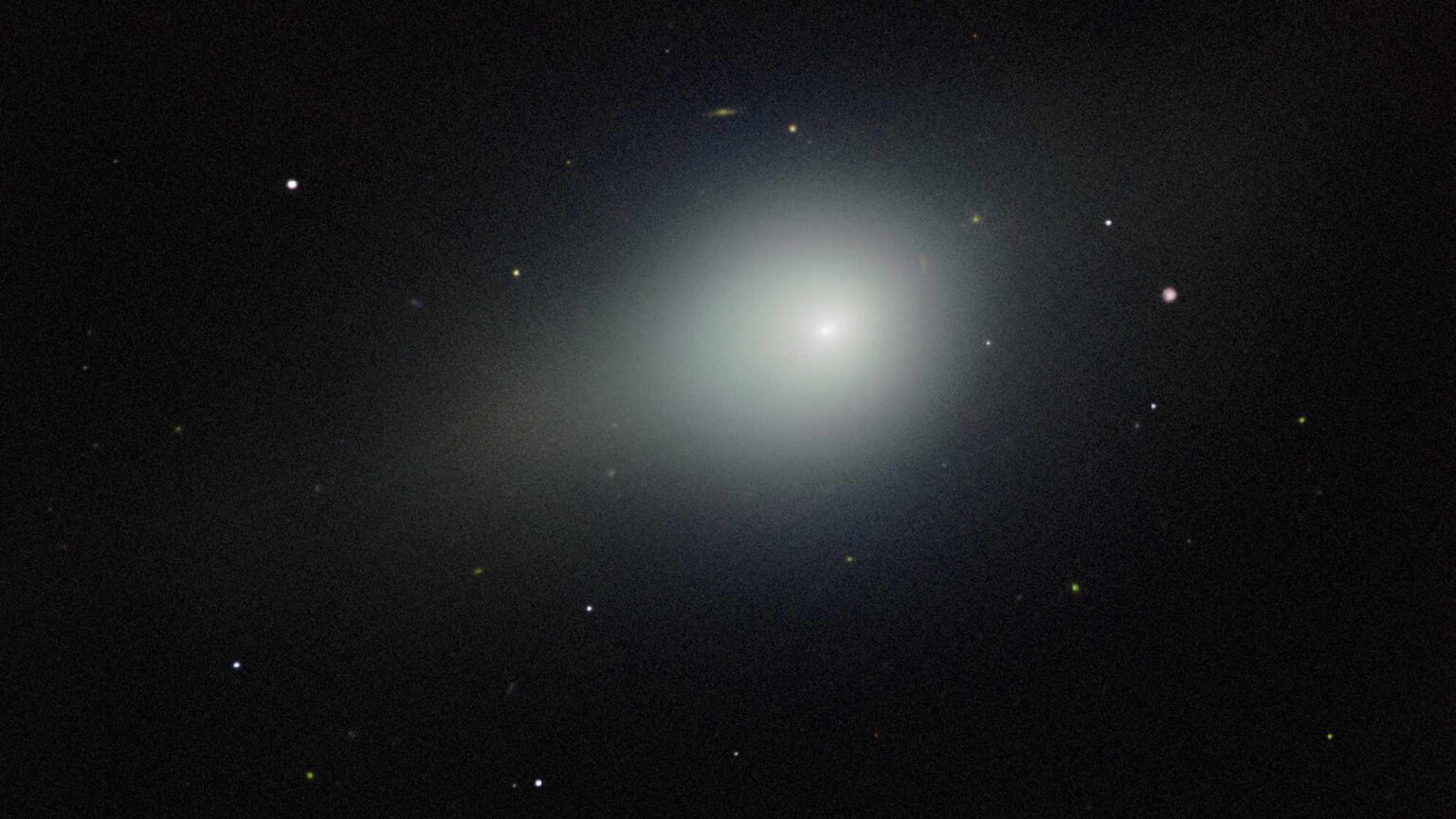
The International Gemini Observatory caught a glowing glimpse of 3I/ATLAS while conducting a Shadow the Scientists session. The image was captured on 26 November 2025 when researchers deployed Gemini Multi-Object Spectrograph (GMOS) on Gemini North at Maunakea in Hawai‘i. Remarking on the same, the observatory stated
After emerging from behind the Sun, 3I/ATLAS reappeared in the sky close to Zaniah, a triple-star system located in the constellation Virgo. The captured image is composed of exposures taken through four filters—blue, green, orange, and red. As exposures are taken, the comet remains fixed in the center of the telescope’s field of view. However, the positions of the background stars change relative to the comet, causing them to appear as colorful streaks in the final image.
Commenting on the greenish glow of 3I.ATLAS in the new image, the researchers noted
In the new image released today, it appears to have a faint greenish glow. This is due to light emitted by gases in the comet’s coma that are evaporating as the comet heats up, including diatomic carbon (C₂), a highly reactive molecule of two carbon atoms that emits light at green wavelengths.
☄️💚 It’s back, and glowing green! After weeks behind the Sun, Comet 3I/ATLAS, the 3rd confirmed interstellar object, has returned to view. @Geminiobs North captured new multicolor images during a live Shadow the Scientists session.
📷: @GeminiObs/NOIRLab/NSF/AURA/B. Bolin pic.twitter.com/GysZRKfM4I
— NOIRLab (@NOIRLabAstro) December 12, 2025
☄️💚 It’s back, and glowing green! After weeks behind the Sun, Comet 3I/ATLAS, the 3rd confirmed interstellar object, has returned to view. @Geminiobs North captured new multicolor images during a live Shadow the Scientists session.
📷: @GeminiObs/NOIRLab/NSF/AURA/B. Bolin pic.twitter.com/SZYsShKi6E
— Gemini Observatory (@GeminiObs) December 12, 2025
All eyes are glued to the sky, as 3I/ATLAS is on its closest approach to Earth on December 19, a full moon day, giving a striking view of the exocomet. The interstellar interloper will be 1.79 AU closer to the planet as it leaves for the Jovian highway before exiting the solar system next year.
See Also: EXCLUSIVE: Harvard Astrophysicist Avi Loeb On 3I/ATLAS, Aliens, Stranger Things & Indian Food
See Also: 3I/ATLAS: ESA’s XMM-NEWTON Caught The Exocomet Under X-ray Light; Here’s What It Found