
Scientists detect life-building molecules and mysterious X-ray glow as cosmic visitor sweeps through our solar system
A cosmic traveler from beyond our solar system is giving scientists an unprecedented show, and the discoveries keep getting more intriguing by the day. Interstellar comet 3I/ATLAS, officially cataloged as C/2025 N1, represents only the third confirmed visitor from another star system ever detected passing through our celestial neighborhood.
Discovered on July 1, 2025, by the NASA-funded Asteroid Terrestrial-impact Last Alert System telescope in Chile, this wandering ice ball has captured the attention of space agencies worldwide. Its hyperbolic trajectory and remarkable speed confirm what astronomers suspected: this comet isn’t bound to our sun’s gravity and will eventually leave our solar system forever.
1. Life-building molecules detected in alien chemistry
The most compelling discovery comes from the Atacama Large Millimeter/submillimeter Array in Chile, where researchers found that 3I/ATLAS carries an unusually rich cocktail of organic molecules. The comet releases methanol and hydrogen cyanide at levels far exceeding what scientists typically observe in homegrown solar system comets.
Roughly 8% of all vapor escaping from the comet consists of methanol, approximately four times higher than normal cometary abundances. Hydrogen cyanide levels also show significant enrichment compared to comets originating from our own Oort Cloud or Kuiper Belt.
These molecules matter because they represent classic starting materials for chemical pathways that could eventually build sugars, amino acids and other biologically relevant compounds. The discovery strengthens theories that comets might deliver crucial raw materials for life to young planets, and that other planetary systems may brew similar chemistry to our own.
A NASA astrochemist leading the research described these abundances as among the most enriched values measured in any comet, suggesting complex chemical reactions may be occurring within or just beneath the surface of 3I/ATLAS.
2. Historic X-ray glow marks space milestone
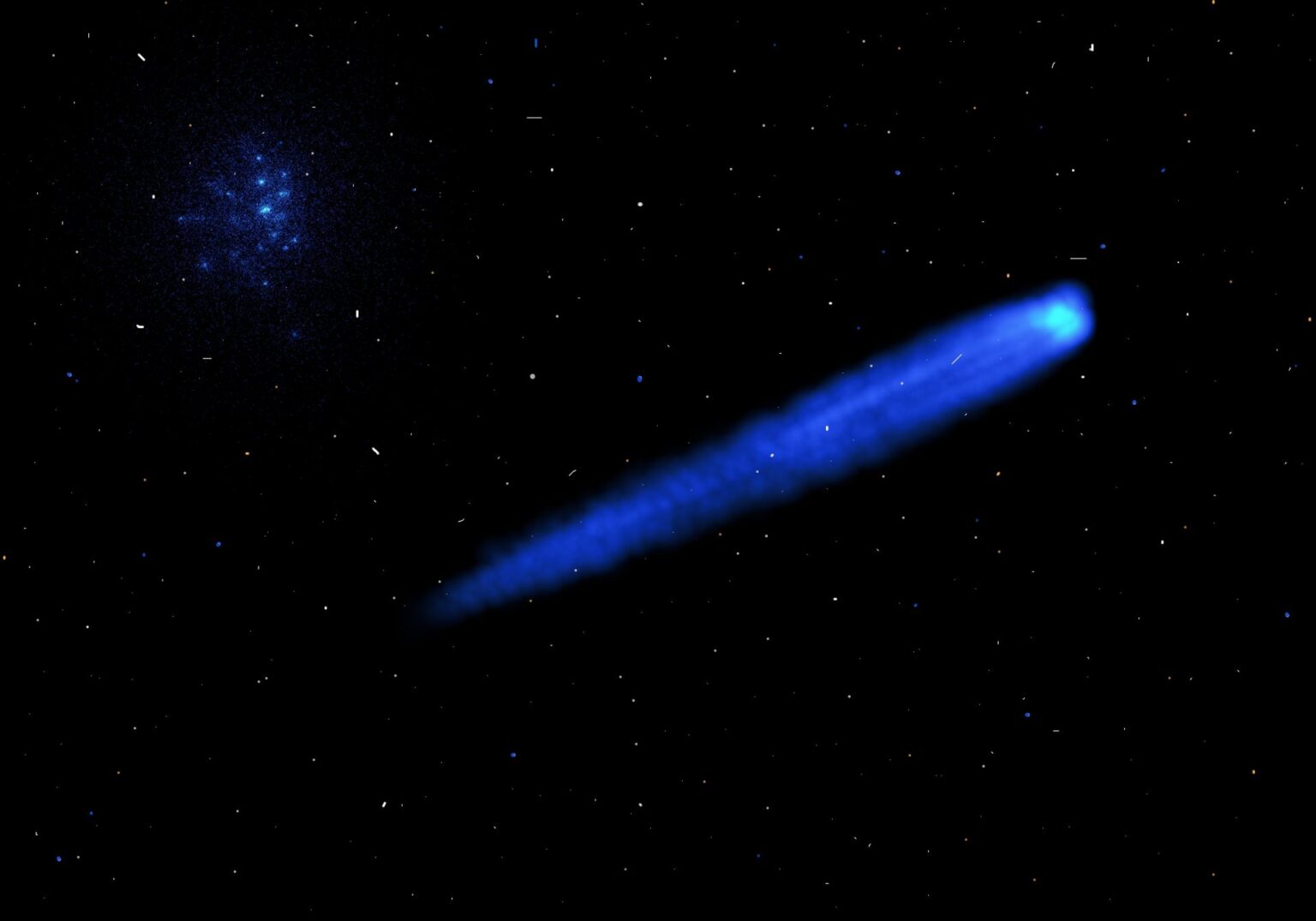
Japan’s X-Ray Imaging and Spectroscopy Mission, a collaborative project between JAXA, NASA and the European Space Agency, recorded something never before seen from an interstellar object: X-ray emissions creating a faint halo stretching roughly 250,000 miles around the comet.
The mechanism behind this cosmic light show appears entirely natural. As 3I/ATLAS approaches the sun, it releases vast clouds of neutral gas. When the solar wind, a stream of charged particles from our star, slams into that cloud, charge-exchange reactions occur. Ions from the solar wind steal electrons from neutral atoms and emit X-rays in the process.
Scientists have observed this phenomenon in ordinary solar system comets since the mid-1990s, but never before around an interstellar visitor. The spectrum revealed excess X-ray emission at energies associated with carbon, nitrogen and oxygen ions, providing researchers with a powerful new tool to study how the comet interacts with solar wind.
3. Spacecraft across the solar system unite for rare view
NASA has effectively transformed much of the solar system into a giant, distributed observatory for tracking this cosmic wanderer. A coordinated campaign involves at least a dozen missions capturing data from multiple vantage points.
The Hubble Space Telescope turned its Wide Field Camera back toward 3I/ATLAS on Nov. 30, revealing a bright blue-green glow likely dominated by gases such as cyanogen and ammonia mixed with dust reflecting sunlight. The European Space Agency’s Jupiter Icy Moons Explorer caught clear signs of two distinct tails: a plasma tail of electrically charged gas and a fainter dust tail fanning outward.
At Mars, the Mars Reconnaissance Orbiter and MAVEN captured some of the closest images and ultraviolet maps as the comet swept past at approximately 19 million miles in early October. Even the Perseverance rover managed to photograph a faint smudge of the distant visitor from the Martian surface.
Deep-space missions including Lucy, Psyche, Europa Clipper and Parker Solar Probe have either collected data or stand ready to observe when geometry allows. This marks the first time heliophysics missions have deliberately targeted an object from another star system.
What happens next
The comet will make its closest approach to Earth on Dec. 19, passing at a safe distance of approximately 1.8 astronomical units, or about 170 million miles. Despite breathless online speculation, NASA and independent analyses confirm this distant flyby poses absolutely no threat to our planet.
For skywatchers hoping to catch a glimpse, the news disappoints. At magnitude 9 to 11, the comet remains far too faint for naked-eye viewing, though serious amateur astronomers with large telescopes under dark skies might spot it moving through Virgo and Leo in early December.
By March 2026, 3I/ATLAS will pass within 0.36 astronomical units of Jupiter before continuing its journey outward into interstellar space, never to return. The comet’s brief visit offers scientists a rare opportunity to directly sample material from another planetary system and compare alien comet chemistry with our own.
The enhanced organic molecules show that prebiotic compounds can form efficiently in other star systems and survive long interstellar journeys, supporting scenarios where comets help seed young planets with complex chemistry necessary for life.
Source: TechStock²