
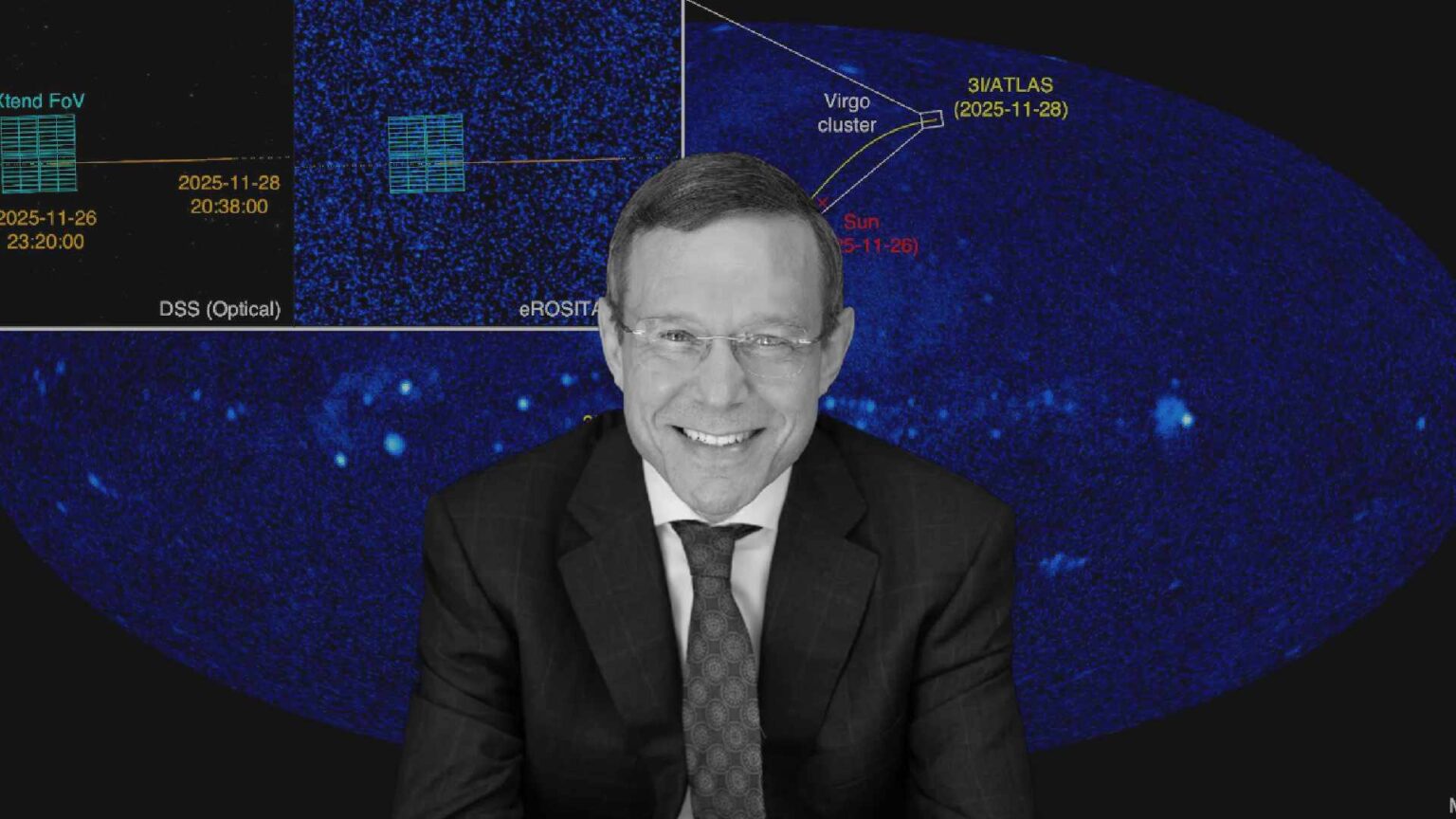
3I/ATLAS that was discovered on July 01, 2025 by the Asteroid Terrestrial-impact Last Alert System (ATLAS) has been tracked and studied by several Earth- and space-based observatories and probes. While stargazers on earth are more concerned about getting a glam portrait of the third-ever interstellar visitor to the solar system on record, after 1I/Oumuamua and 2I/Borisov, observatories like XRISM by JAXA in collaboration with NASA are doing spectral analysis of the object and determining other properties invisible to mere optical scopes.
In its latest study by the X-Ray Imaging and Spectroscopy Mission (XRISM) spacecraft, done between 23:20 on November 26 to 20:38 on November 28, 2025, the probe carried out a Target of Opportunity observation of 3I/ATLAS.
XRISM’s preliminary analysis revealed
a faint X-ray glow extending roughly 5 arcminutes—corresponding to a distance of 400,000 km—around the cometary nucleus.
Further in its announcement on The Astronomer’s Telegram (ATel), XRISM team explained
After applying noisy-pixel screening, instrument background subtraction, vignetting correction, point-source removal, and apparent-motion correction to the Xtend data, we constructed a comet-centered image in the 0.3–1.0 keV band, which reveals plausible extended X-ray emission over approximately 5 arcmin of radius. Because the X-ray Mirror Assembly (XMA) for Xtend has a half-power diameter of 1.4 arcmin, the emission appears broader than its point-spread function. It is important to note that the vignetting effect caused by the XMA intrinsically produces such a brightness distribution for a flat emission, whose profile has a broader radial distribution (FWHM ∼17–18 arcmin) than the extent of the diffuse emission. Nonetheless, it may be premature to conclude that this diffuse emission is attributable to the atmospheric coma associated with the comet at this time. Further analysis using fully processed data is required.
Meanwhile, in his latest blog, Harvard astrophysicist Avi Loeb commented on the X-ray findings by XRISM. He remarked,
the Xtend spectrum shows excess emission components associated with carbon, nitrogen, and oxygen beyond the background emission from the Milky-Way galaxy or the Earth’s atmospheric emission. This is an important clue that the observed emission may indeed arise from charge-exchange interactions between the gas surrounding 3I/ATLAS and the solar wind.
He further added
It would be particularly interesting to check if there are any other X-ray features different from the expected signatures of charge-exchange reactions with the solar wind.
See Also: 3I/ATLAS: Japan’s XRISM Probe Captures X-ray Emission From Exocomet Ahead Of Earth Flyby