

Instagram: sleeman_astro
Astrobin: https://app.astrobin.com/i/vlqrg8
This one really tested my processing skills in combining the different narrowband channels.
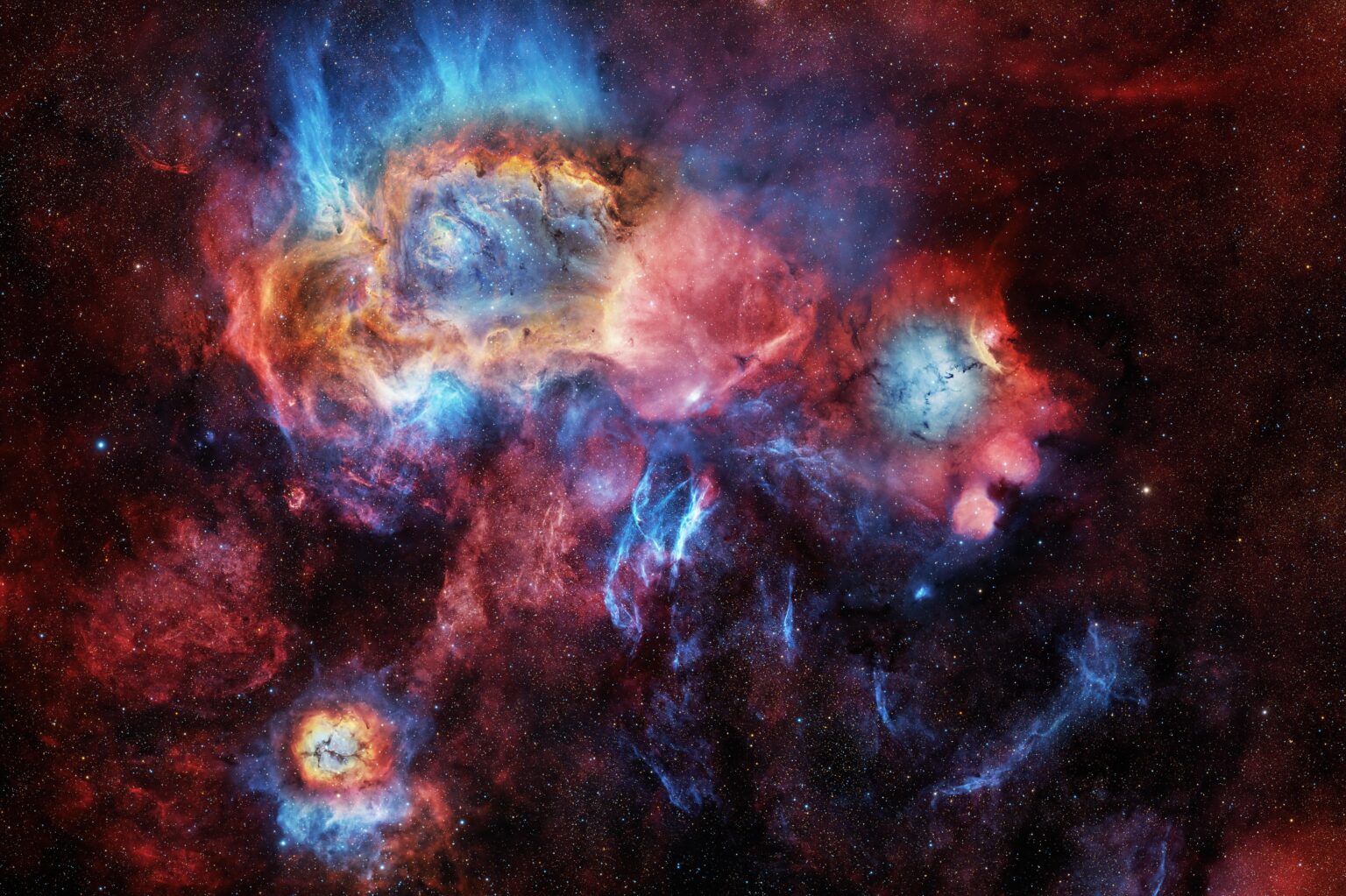
Messier 8, Messier 20 & SNR G007.5–01.7: 70h Narrowband Deep Field
This project combines SHO narrowband with RGB stars to reveal the complex interplay of ionized gas, molecular clouds, and shock structures in one of the richest regions of the Milky Way. The field includes three major objects with distinctly different astrophysical origins:
Messier 8: The Lagoon Nebula (H II region)
M8 is a massive star-forming complex located ~4,100 light-years away in Sagittarius. The nebula is strongly shaped by UV radiation and stellar winds from young O-type stars in the embedded NGC 6530 cluster. The characteristic “hourglass” region is a zone of active photoionization, where supersonic outflows from protostars carve cavities into dense gas.
SNR G007.5–01.7: Faint Supernova Remnant
A remarkably subtle structure in the SHO data is the supernova remnant G007.5–01.7, an expanding shell of ionized gas from a stellar explosion several thousand years ago.
The SNR is extremely low surface-brightness and only becomes visible through: ✔ long integrations in OIII and Hα, ✔ careful noise reduction, ✔ enhanced contrast stretching of the outer shock boundary.
The revealed arc-like filamentary structures represent regions where the blast wave encounters denser interstellar material, producing localized ionization and faint line emission.
Processing Notes
Hubble Palette (SHO) mapping with selective color balancing to maintain structural contrast.

RGB star layer acquired separately for natural star color and preserved using star-replacement workflows.

Deconvolution applied selectively to enhance microstructure in the Lagoon and Trifid cores.

Nonlinear stretching tuned to preserve the faint outer SNR envelope without clipping the bright cores.
by MichaelCR970
1 Comment
Gesamte Integration: 70h 15m
Integration pro Filter:
– R: 1h (60 × 60″)
– G: 1h (60 × 60″)
– B: 1h (60 × 60″)
– Hα: 22h 25m (269 × 300″)
– SII: 20h 55m (251 × 300″)
– OIII: 23h 55m (287 × 300″)
Ausrüstung:
– Teleskop: Takahashi FSQ-106EDP
– Kamera: Player One Poseidon-M Pro
– Montierung: 10Micron GM1000 HPS
– Filter: Antlia 3nm Narrowband H-alpha 50 mm, Antlia 3nm Narrowband Oxygen III 50 mm, Antlia 3nm Narrowband Sulfur II 50 mm, Antlia Blue 50 mm, Antlia Green 50 mm, Antlia Luminance 50 mm, Antlia Red 50 mm
– Software: Open PHD Guiding Project PHD2, Pleiades Astrophoto PixInsight, Russell Croman Astrophotography BlurXTerminator, Russell Croman Astrophotography NoiseXTerminator, Russell Croman Astrophotography StarXTerminator, Starkeeper Voyager Advanced, Steffen Hirtle GraXpert, PhotoShop