
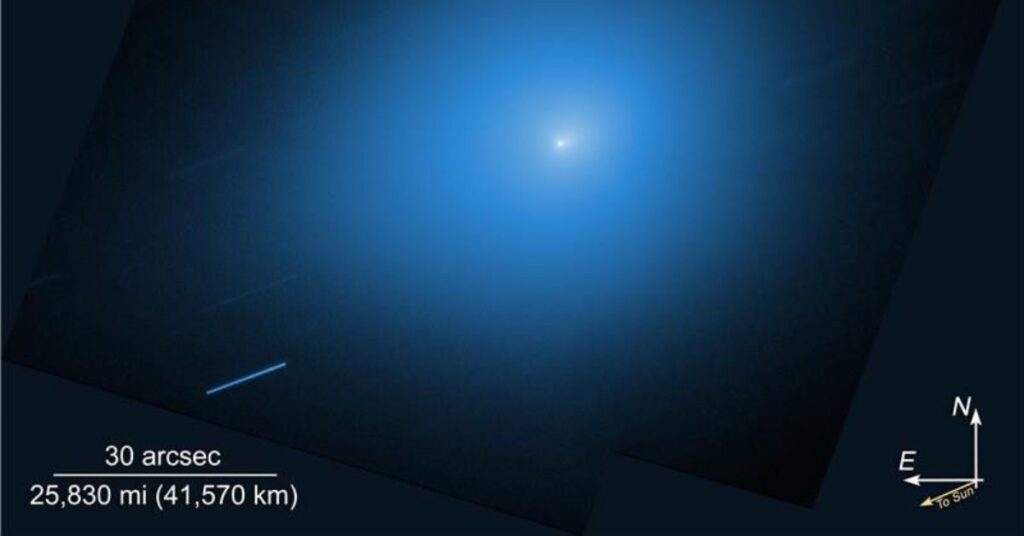
NASA and the European Space Agency (ESA) have released stunning new images of the interstellar comet 3I/ATLAS, revealing a glowing nucleus and distinct tails as the object continues its journey through our solar system.
The images, captured by the Hubble Space Telescope on November 30, 2025, show the comet displaying activity described by some scientists as a rhythmic “heartbeat,” a 16.16-hour pulse of light that has sparked intense debate about its origins.
The phenomenon was first identified by researchers who noted periodic fluctuations in the comet’s brightness, which Harvard astrophysicist Avi Loeb has compared to a heartbeat or the flow of blood.
While mainstream scientists attribute this pulsing to the comet’s rotation, exposing pockets of ice to the Sun and creating bursts of gas and dust, Loeb has suggested it could indicate artificial origins or technological mechanisms.
However, NASA officials and other experts maintain that the object’s behaviour is consistent with natural cometary activity, citing evidence of a coma and tails typical of icy bodies as they warm up near the Sun.
The newly released high-resolution images show 3I/ATLAS with a bright, hazy atmosphere, or coma, and hints of two tails: a plasma tail of charged gas and a fainter dust tail. These observations provide critical data for astronomers working to refine estimates of the comet’s size, which is believed to be between 1,400 feet and 3.5 miles wide.
The comet, discovered in July 2025, is the third confirmed interstellar object to visit our solar system, following ‘Oumuamua and 2I/Borisov, and is currently travelling at speeds exceeding 130,000 mph on a trajectory that will eventually take it back into deep space.
As 3I/ATLAS approaches its closest encounter with Earth on December 19, astronomers are seizing the opportunity to study this rare visitor in unprecedented detail. The “heartbeat” signal, whether a natural byproduct of rotation or something more exotic, remains a focal point of investigation.
For now, the consensus points to a natural explanation, but the object’s unique characteristics ensure it will remain a subject of fascination for both the scientific community and the public.