
A rare interstellar visitor is stirring excitement across global space agencies as it sweeps through the inner solar system. Comet 3I/ATLAS – only the third confirmed interstellar object to pass through our cosmic neighbourhood – is brightening dramatically as it prepares for its closest approach to Earth on December 19. Although it will still remain about 170 million miles away, scientists are rushing to capture final observations before it vanishes back into deep space.
Discovered in late June and confirmed as an interstellar object in July, 3I/ATLAS has spent recent months racing past Mars and the sun at nearly 130,000 mph. The comet is now heading outbound, but its newfound activity after its solar flyby has made it one of the most closely watched objects of the year. New images released this week by NASA and the European Space Agency (ESA) reveal a glowing nucleus, expanding coma and hints of dual tails – signs that the comet is rapidly shedding gas and dust as it warms.
Hubble captures comet brightening after solar pass
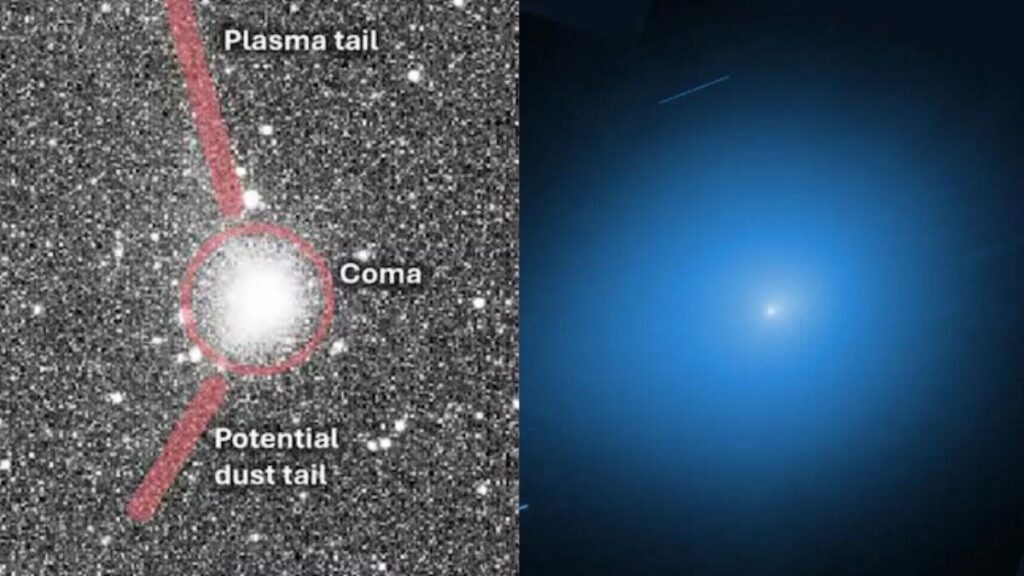
NASA released a fresh Hubble Space Telescope image on December 4, obtained during a 30 November observation when the spacecraft was roughly 178 million miles from the comet. The view shows a bright central core wrapped in a broad halo of gas and dust. Background stars appear as streaks because Hubble tracked the fast-moving comet directly.
Scientists say the brightening is typical of comets that swing close to the sun; heating causes internal ice to sublimate, allowing jets of gas and dust to erupt from the surface. These features, including a faint tail pushed away from the sun, appear subtly in Hubble’s latest snapshot.
Earlier Hubble measurements from July were instrumental in estimating 3I/ATLAS’ size, placing it between 1,400 ft and 3.5 miles wide – a range that makes it potentially the largest interstellar object ever detected. NASA has not yet released full compositional data from the most recent observation.
ESA’s Juice orbiter spots dual tails
ESA also shared a striking image taken by its Jupiter Icy Moons Explorer (Juice) mission on November 2, when the spacecraft was about 41 million miles from the comet – significantly closer than Hubble. Juice’s view shows a luminous coma and clear signs of two distinct tails.
ESA said the frame reveals a plasma tail extending upward and a faint dust tail drifting to the lower left. The orbiter used five scientific instruments over two days to study the comet, but most of the data remains stored onboard. Because Juice is using its main antenna as a heat shield during its solar approach, bulk data transmissions will not begin until February 2026.
Dozens of spacecraft turn their instruments toward 3I/ATLAS
NASA and ESA say more than a dozen spacecraft – including solar orbiters, Mars rovers and telescopes not originally intended for comet tracking – have joined the effort to observe the interstellar object. The James Webb Space Telescope is expected to conduct fresh observations later this month, while ground-based astronomers and amateurs are preparing for their own final look as the comet nears its closest point to Earth.
Every dataset is crucial. Because 3I/ATLAS originated beyond our solar system, its composition and behaviour may offer rare insights into the chemistry and processes shaping planetary systems around other stars.
Harvard scientist’s big claim
Alongside scientific interest, the comet has become the subject of speculation due to claims by Harvard astrophysicist Avi Loeb, who argues that its unusual characteristics could hint at a non-natural origin. Loeb has pointed to anomalies such as retrograde motion, unexpected acceleration and unusual metal readings, suggesting the comet might be a technological artefact.
A recent report in the New York Post cited Loeb as saying: “There were plenty of opportunities for residents of previous stars to visit our place… But if there is an interstellar gardener, then obviously it could have intervened….it could have seeded the various forms of life on Earth intentionally.”
Loeb reiterated his long-standing argument that interstellar rocks may have been reaching Earth for billions of years. “I explained that meter-scale rocks from interstellar space may impact the Earth roughly once per decade, adding up to half a billion such collisions over the Earth’s history,” he wrote. He added that these objects could theoretically carry resilient life. “We often consider the history of Earth as isolated from its galactic environment, but this may not be the case,” he said.
Loeb also recently claimed that 3I/ATLAS shows a “heartbeat”-like pulse – raising questions about its origins.
A rare chance before it disappears forever
Despite the speculative theories, mainstream researchers emphasise that thorough multi-agency observations remain the best way to understand this unusual visitor. Taken together, the latest images from Hubble and Juice show a comet growing increasingly active as it recedes, making these final weeks a crucial window for discovery.
With only two other interstellar objects previously recorded – 1I/ʻOumuamua in 2017 and 2I/Borisov in 2019 – scientists say the passage of 3I/ATLAS is a unique moment in modern astronomy. And once it races past Earth later this month, it will be gone for good, leaving researchers to study its brief but brilliant appearance across the sky.
Subscribe to our NewsletterGet Latest Mathrubhumi Updates in EnglishFollow
Disclaimer: Kindly avoid objectionable, derogatory, unlawful and lewd comments, while responding to reports. Such comments are punishable under cyber laws. Please keep away from personal attacks. The opinions expressed here are the personal opinions of readers and not that of Mathrubhumi.