
by ESA Staff Writers
Paris (ESA) Dec 04, 2025
True to its promise, the European Space Agency’s EarthCARE satellite is now being used to directly quantify how clouds and airborne particles reshape the balance between incoming sunlight and outgoing heat that regulates Earth’s climate, giving modelers a sharper and more observationally grounded view of this energy exchange.
Although clouds and aerosols are generally thought to cool the planet, their combined effects on reflected solar radiation and emitted infrared energy remain one of the largest uncertainties in projections of future warming, especially as human-driven greenhouse gas emissions continue to rise.
Aerosols complicate the picture because they can brighten and prolong cloud systems while also scattering sunlight on their own, and recent shifts from cleaner industrial emissions in some regions to intense wildfire smoke in others raise fresh questions about how their net influence on climate may be changing.
Launched in May 2024 as a joint ESA – JAXA Earth Explorer mission, EarthCARE flies four tightly coordinated instruments that simultaneously profile clouds, precipitation and aerosols in three dimensions while also tracking the associated flows of solar and thermal energy at the top of the atmosphere.
Its cloud-profiling radar, ultraviolet lidar and multispectral imager work together to recover vertical slices and horizontal structure of cloud and aerosol layers, which are then fed into radiative transfer calculations to predict how much sunlight should be reflected back to space above a given scene.
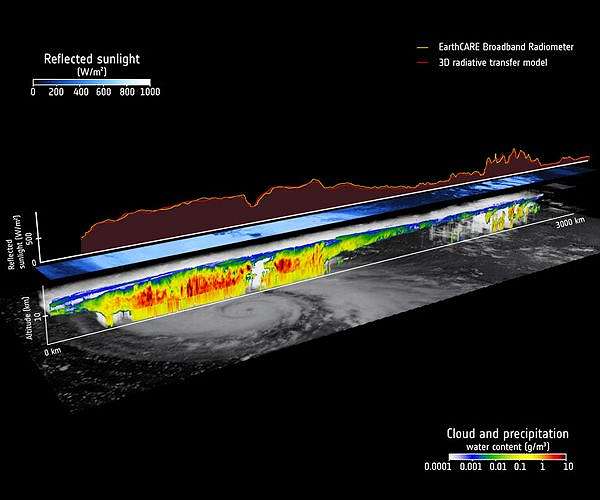
Those calculated fluxes are checked on orbit against measurements from EarthCARE’s broadband radiometer, enabling so-called radiative closure tests that show whether the retrieved cloud and aerosol properties can truly account for the observed energy budget along the satellite’s track.
Early results over systems such as Typhoon Ragasa indicate close agreement between modelled and observed reflected sunlight, giving scientists confidence that EarthCARE’s retrievals can be used to tighten the representation of clouds and aerosols in global climate simulations.
Researchers at the European Centre for Medium-Range Weather Forecasts emphasize that this built-in consistency check between microphysical cloud properties and top-of-atmosphere radiation is exactly what is needed to reduce long-standing cloud-related uncertainties in both climate and numerical weather prediction models.
Although EarthCARE was conceived primarily as a research mission, its high-quality vertical profiles and cloud location data are already being prepared for real-time assimilation into operational forecasting systems, with the goal of improving storm evolution, precipitation patterns and regional energy flux predictions.
The mission’s Level-1 products were opened to the community earlier in the year, and the recent release of the full Level-2 suite, including the radiative closure product that directly links cloud and aerosol retrievals with observed energy fluxes, is expected to accelerate collaborative studies of how rapid atmospheric changes are reshaping Earth’s energy balance.
By making these advanced datasets openly accessible and coordinating validation efforts across European, Canadian and Japanese teams, the EarthCARE programme is seeding a broad international effort to probe cloud – aerosol – radiation interactions more rigorously than ever before and to translate those insights into more reliable climate services.
Related Links
European Space Agency (ESA), FutureEO Earth Observation Programme
Earth Observation News – Suppiliers, Technology and Application