
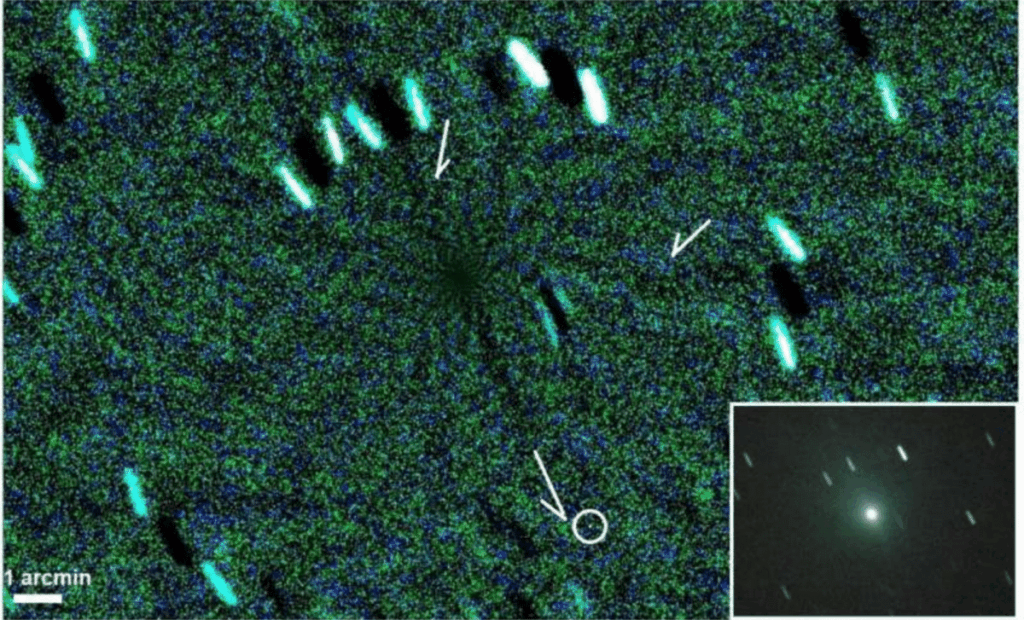
A new study posted on the arXiv has suggested that an interstellar object, previously thought to be a simple comet, could actually be covered in cryovolcanoes—erupting icy volcano-like structures. This unexpected discovery could rewrite everything we know about comets and their behavior in space.
The Discovery of Cryovolcanoes
The study, published on the arXiv, reveals astonishing findings about the behavior of interstellar objects, particularly those that cross paths with our solar system. For years, comets have been understood primarily as icy bodies that emit gas and dust as they approach the Sun, creating the characteristic tails that have fascinated astronomers. However, this new analysis of the second confirmed interstellar comet offers a much more complex scenario. Researchers believe that this object is not only spewing out typical icy compounds but also exhibiting signs of eruptive behavior, similar to volcanoes—specifically, cryovolcanoes.
Unlike traditional volcanoes that expel molten rock, cryovolcanoes eject volatile materials such as water, ammonia, or methane in a frozen state. These eruptions are driven by internal heat, which melts the object’s icy surface and causes explosive outbursts of frozen substances. The presence of these icy volcanoes could significantly alter our understanding of how these ancient bodies behave, especially when they are exposed to the heat of a star like the Sun.
What Does This Mean for Cometary Studies?
The concept of cryovolcanoes challenges long-standing beliefs about the internal structures of comets. Traditionally, comets were thought to have relatively simple, icy exteriors and a more or less uniform internal composition. However, the discovery of cryovolcanoes hints at a much more complex structure. It suggests that some comets may have a more dynamic and active interior than previously believed, possibly with liquid or semi-liquid layers beneath the surface that generate the pressure necessary for such eruptions.
This discovery could also provide a new framework for understanding the behavior of comets as they travel through space. The eruption of volatile compounds suggests that these bodies are more active and reactive to environmental changes than we’ve given them credit for. As the study suggests, such behavior could be triggered by the proximity of a star, but it also raises the possibility that comets from different regions of space—particularly from interstellar space—might behave in ways that are vastly different from our current expectations.
A New Era for Space Exploration?
As scientists continue to investigate the phenomena associated with interstellar comets and their cryovolcanoes, the implications for space exploration could be profound. Understanding these active processes in icy bodies could influence the way we approach future missions to comets, asteroids, and other distant objects. It could also reshape the tools and techniques used to study these bodies, with an increased emphasis on detecting signs of internal activity and eruptions.
For example, future space probes sent to explore comets and other icy bodies might need to be equipped with instruments designed not only to measure surface temperature and composition but also to detect signs of internal heat and volatile eruptions.