
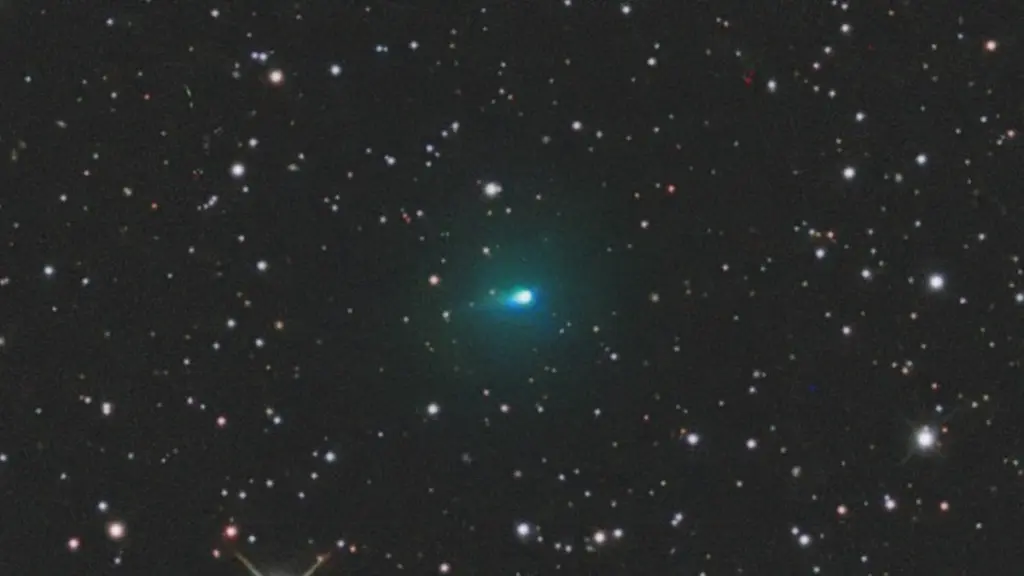
When the ATLAS survey telescope in Chile detected 3I/ATLAS on July 1, 2025, astronomers quickly realized it was no ordinary comet. Its hyperbolic orbit and velocity of about 57 km/s (35 mi/s) relative to the Sun confirmed that it was traveling from interstellar space, never bound to our Solar System.
Only two other objects of this kind have ever been recorded: 1I/’Oumuamua in 2017 and 2I/Borisov in 2019. 3I/ATLAS, however, immediately stood out because of its bright coma, distinct gas composition, and unusually reflective surface. Astronomers began an international observation campaign within days of its discovery, using ground-based telescopes and infrared instruments to study the newcomer as it raced toward the inner Solar System.
Data from the European Space Agency’s Gaia mission showed that 3I/ATLAS had not approached any nearby star in at least 10 million years. Over that time, it likely drifted through cold interstellar space, collecting dust and cosmic-ray damage on its surface. This prolonged exposure would have built a hardened crust of ices and organic material, effectively preserving its internal structure.
Estimates place the nucleus size between 0.3–5.6 km (0.19–3.4 miles) in diameter, with a rotation period of roughly 16 hours. Such stability suggests that the object’s mechanical strength is higher than in ordinary Solar System comets. This strength, combined with the detection of nickel in its coma, hints at the presence of fine-grained metal embedded within a carbonaceous matrix.
An unexpected outburst of brightness near 2.5 AU
Between July and October, astronomers tracking 3I/ATLAS noticed a striking change in its brightness. As the comet approached a heliocentric distance of 2.53 AU, its magnitude increased by about two full units in just a few days.
This event was not a short-lived outburst caused by a single volatile pocket but a global transformation in surface activity. Using the Joan Oró Telescope in Catalonia and other observatories in Spain, researchers calculated a rapid increase in the Afρ parameter, a standard measure of dust production.
At this distance, sunlight began to penetrate the outer layers of ice, raising temperatures near the surface. These conditions are cold by Earth standards but warm enough for carbon monoxide and carbon dioxide to sublimate directly from solid to gas. The resulting jets expanded the coma dramatically, producing spiral plumes that extended as far as 50 000 km (31 000 miles) from the nucleus.
This sudden brightening showed that 3I/ATLAS was loaded with volatile material and had not yet developed an insulating dust mantle like most long-lived comets. Its surface, likely untouched since formation, responded immediately to solar heating. The event demonstrated that pristine interstellar bodies can activate explosively when exposed to sunlight for the first time in millions of years.
A chemical signature rich in carbon dioxide and nickel
Spectroscopic observations soon revealed a chemical environment unlike any previously seen in a comet. The coma of 3I/ATLAS was dominated by carbon dioxide, with a CO2-to-H2O ratio about seven times higher than in typical Solar System comets. Alongside this, scientists detected substantial carbon monoxide and water vapor, confirming that multiple volatiles were driving the outgassing.
Even more surprising was the detection of neutral nickel emission lines identified by the Very Large Telescope in Chile. The ratio of nickel to iron in 3I’s coma exceeded that of any previously measured comet, suggesting a significant abundance of nickel-bearing minerals. Such metals could either be present as microscopic grains or as part of complex chemical compounds that sublimate under solar heating.
Nickel is rarely found in detectable quantities within cometary gas because it generally remains locked in the nucleus. Its presence implies a deeper and more energetic process at work. Researchers propose that heating near perihelion could corrode metal grains, releasing volatile nickel compounds into the coma.
The detection of both CO2 and nickel paints a picture of a chemically complex object, possibly forged in a metal-rich environment beyond its home star’s frost line. If so, 3I/ATLAS may be a survivor from a planetary system that formed under conditions unlike those of our own.
Spectral comparisons hint at a link with carbonaceous meteorites
To probe its surface composition, scientists compared 3I/ATLAS’s reflectance spectrum with that of meteorites collected from Antarctica. The results revealed that its visible-light signature closely resembles that of CR-type carbonaceous chondrites, primitive meteorites rich in organic compounds, iron-nickel metal, and water-bearing minerals.
This resemblance, however, is interpretive rather than conclusive. Reflectance spectra from an active comet include contributions from both the surface and the surrounding dust, which can alter the slope and color of the signal. Despite this uncertainty, the similarities are compelling because CR chondrites are thought to have formed in the outer Solar System, much like distant trans-Neptunian objects.
If 3I/ATLAS shares this composition, it could be a natural analogue to Solar System bodies that formed beyond Neptune before being ejected into interstellar space. The match suggests that the chemical building blocks of carbonaceous matter and metal-bearing dust may be common across planetary systems.
The comparison also supports the hypothesis that some of 3I/ATLAS’s organics and ices were altered by cosmic rays during its long interstellar journey. This could explain its unusually red spectral slope and its strong carbon-rich appearance when observed in visible and near-infrared light.
Possible cryovolcanism and catalytic chemistry beneath the surface
As 3I/ATLAS continued inward, it crossed a threshold where sunlight could warm its subsurface layers. Around 2.5 AU, the conditions became favorable for the sublimation of volatile ices and possibly even transient pockets of liquid water within porous regions of the nucleus.
Researchers have proposed that when water interacts with fine metal grains such as iron-nickel alloys or schreibersite (Fe2NiP), exothermic reactions can occur. These reactions release heat and gases, including carbon monoxide and carbon dioxide. The process resembles Fischer–Tropsch catalysis, which can generate simple organic molecules and alcohols in the presence of metals.
Although no direct imaging yet confirms active cryovolcanic jets venting from the interior, the sustained gas production and evolving coma structure make this hypothesis plausible. The reaction of water with metal-bearing minerals could also explain the detection of nickel and the oxidized nature of the gases in the coma.
At its closest approach to the Sun on October 29, 3I/ATLAS reached a heliocentric distance of 1.356 AU. The subsolar temperature was warm enough to trigger chemical alteration similar to that seen in meteorites. If these conditions are correct, the comet’s activity might reflect a combination of sublimation, chemical corrosion, and internal gas release akin to cryovolcanism.
What 3I/ATLAS tells us about interstellar chemistry
The findings from 3I/ATLAS strengthen the case that complex chemistry is a common feature of planetary systems throughout the galaxy. Its combination of metal, ice, and carbon-rich material mirrors the diversity found in early Solar System meteorites, suggesting that similar ingredients may form elsewhere under comparable conditions.
The comet’s strong CO2 emission shows that carbon dioxide can persist over cosmic timescales even in the harsh environment of interstellar space. The detection of nickel and possible catalytic reactions implies that metallic grains play an important role in sustaining volatile chemistry far from any star.
Such results extend beyond comet science. They touch on the origins of organic compounds that could eventually seed life. If catalytic reactions like those suspected in 3I/ATLAS occur widely in other planetary systems, they may provide a universal mechanism for forming complex molecules from simple starting materials.
Each interstellar object that enters our Solar System provides a snapshot of another star’s chemistry. 3I/ATLAS, with its volatile outgassing and metallic traces, is a tangible reminder that the building blocks of planetary systems are diverse and interconnected across the Milky Way.
Preparing for future interstellar encounters
Tracking 3I/ATLAS also exposed the challenges of observing interstellar comets. Its steep orbital inclination of 175 degrees made it difficult to follow as it passed behind the Sun from Earth’s perspective. Coordinated observation networks such as the International Asteroid Warning Network (IAWN) played an essential role in maintaining coverage.
Space-based infrared telescopes are proving critical for monitoring these fast, dim visitors. Future missions like the European Space Agency’s Comet Interceptor are specifically designed to rendezvous with a new or interstellar comet. Instruments capable of high-resolution spectroscopy and in situ sampling could directly test the hypotheses about metallic composition and cryovolcanic chemistry that 3I/ATLAS has inspired.
Understanding objects like 3I/ATLAS is not only a scientific goal but a planetary defense priority. Studying their trajectories and behavior helps refine detection systems for future interstellar bodies, ensuring that potential impactors or near-Earth passers are identified early.
With only three interstellar visitors known so far, each provides rare insight into how material from other stars behaves under solar influence. As observation technology improves, future discoveries may confirm whether 3I/ATLAS represents a common type of metal-rich comet or an exceptional relic from a uniquely dynamic system.
References:
1 Spectrophotometric evidence for a metal-bearing, carbonaceous, and pristine interstellar comet 3I/ATLAS – Josep M. Trigo-Rodríguez et al. – Arxiv – November 25, 2025 – https://doi.org/10.48550/arXiv.2511.19112 – OPEN ACCESS