
When we reach the frontier of current knowledge, we’re tempted to insert a higher power into the space where answers aren’t yet satisfying for all.
By Mert Can Bayar
Center for an Informed Public
University of Washington
On July 1, 2025, the ATLAS survey quietly logged a new speck of light, a faint object later designated C/2025 N1 (ATLAS) and, more dramatically, 3I/ATLAS — the third confirmed interstellar comet ever observed passing through our Solar System. At first, it looked like another distant, icy body on a long path. But as images accumulated and astronomers described details like its brightness, tail structure, and interstellar origin, a very different story started to spread online. A high-profile Harvard astrophysicist, Dr. Avi Loeb, speculated that 3I/ATLAS might not be a comet at all, but an alien “mothership” moving through our neighborhood with an unknown mission. UFO/UAP (unidentified flying object /unidentified anomalous phenomena) community online embraced the idea, and speculations about 3I/ATLAS began to flourish.
Before we dive into the social-media patterns of what caught on and why, a quick detour: the “alien of the gaps.”
One of the oldest habits in human explanation is what theologians later called the “God of the gaps.” When people encountered phenomena they couldn’t explain, like thunder, lightning, eclipses, floods, they often treated them as the work of a higher being, one believed to possess the power and agency to fill the gaps in human understanding and embellish our stories. Thor ruled thunder in Norse myth; Zeus gathered the clouds to rain; Cybele stood behind fertility, harvests, and life itself. Wherever there was a hole in our natural explanations, we plugged it with the agency of a smarter, more complex being.
As science advanced, many of those gaps shrank. We learned how lightning forms, why eclipses happen, and how reproduction works. But new frontiers created new unknowns: the origins of life, the early universe, what (if anything) preceded the Big Bang. Some believers still see those unknowns as evidence of a creator or intelligent design. The pattern persists: when we reach the frontier of current knowledge, we’re tempted to insert a higher power into the space where answers aren’t yet satisfying for all.
How does this relate to an interstellar object called 3I/ATLAS? It’s the same pattern, updated. Some of us now do with aliens what we once did with gods. When a “mysterious” comet, signal, or anomaly shows up, some reach for intelligence to explain it. If astronomers haven’t nailed down every parameter of an object’s orbit, speed, composition, or brightness, the gap is quickly filled with talk of probes, motherships, and extraterrestrial technology. In other words, where natural explanations feel incomplete, we substitute a different higher agency, not Zeus this time, but extraterrestrials (ETs). That’s what “alien of the gaps” means, and it helps explain why certain narratives about 3I/ATLAS rose and spread online with the help of a high-profile scientist and an online community ready to spread what has been speculated.
Sensemaking around an interstellar object on X
We try to make sense of the world around us, and “…of-the-gaps” arguments are part of everyday sensemaking. As the third confirmed interstellar object, 3I/ATLAS naturally drew attention, and competing interpretations of what it “could be.” University of Washington Center for an Informed Public co-founder Kate Starbird has written about how rumors travel within recognizable frames; her example, fittingly, involved space/aerial anomalies often labeled UFOs, now more commonly “UAPs.” Since congressional hearings, newly released videos, and testimony by former pilots and officials pushed UAPs into mainstream conversation, sensemaking has leaned on familiar frames: aliens, hidden military tech, or misinterpretations of imperfect data.
Similar to the UFO/UAP conversation, which feeds into how people talk about 3I/ATLAS, discussions about this object also borrow those frames and apply them to images, “anomalies,” and speculations. Because 3I/ATLAS is interstellar, the dominant frame we’ve seen on X is the aliens/ET frame, which constitutes forty percent of the whole conversation on X.
The interesting part is in the details. Much of the conversation is driven by claims of anomalies and open-ended speculation about the object’s nature, often recast as potential evidence of ET technology. In my analysis of the most salient posts (aligned to the timeline below), many of these “anomalies” trace back to one scientist’s writings and interviews.
Avi Loeb, a Harvard astrophysicist, has been at the forefront of these sensemaking cycles. He was an outspoken advocate of the alien hypothesis with ‘Oumuamua and, more recently, with 3I/ATLAS. His lists of “anomalies” and his speculations about what the object “could be” helped frame a large share of the conversation on X.
The discussions around 3I/ATLAS on X
Using Brandwatch, a third-party social media analytics platform, I collected English-language posts (tweets, retweets, quote tweets, and replies) on X about 3I/ATLAS with a simple keyword set. The dataset spans July 1–November 21, 2025, and includes roughly 700,000 X posts that matched the query. Within those parameters, Brandwatch reports a firehose-level, complete capture of posts matching our terms in its reach.
Almost 280,000 of the 700,000 posts invoke aliens or ET technology — about 40% of the 3I/ATLAS conversation on X. Many reference Avi Loeb’s list of “anomalies” and his speculations in TV appearances and interviews that these anomalies “could be” evidence of what we fear and enjoy the most: aliens. About 130,000 posts mention Avi Loeb (by name, surname, or as “a Harvard scientist”); more than 82,000 of those — just over 60% (63%) — pair his name with the alien hypothesis explicitly. These figures are conservative: they count only explicit references to aliens and exclude implicit references to aliens or ET involvement.
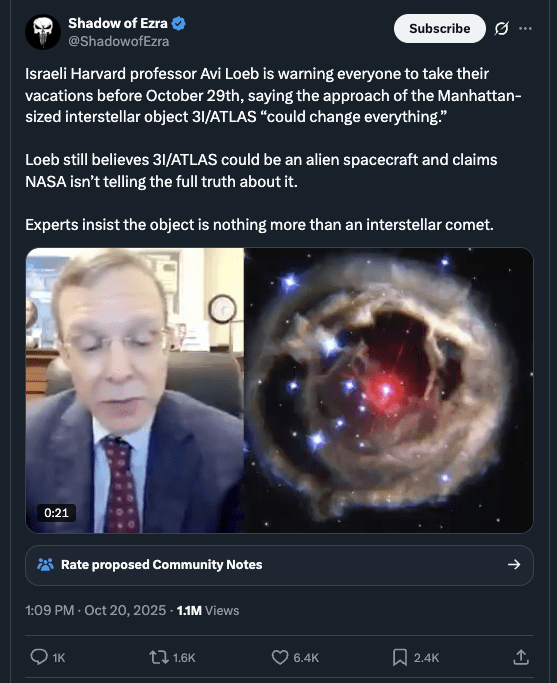
Figure 1: A UFO-focused tweet illustrates how Loeb’s speculations are interpreted and amplified (approximately 1.1 million views at the time of capture).
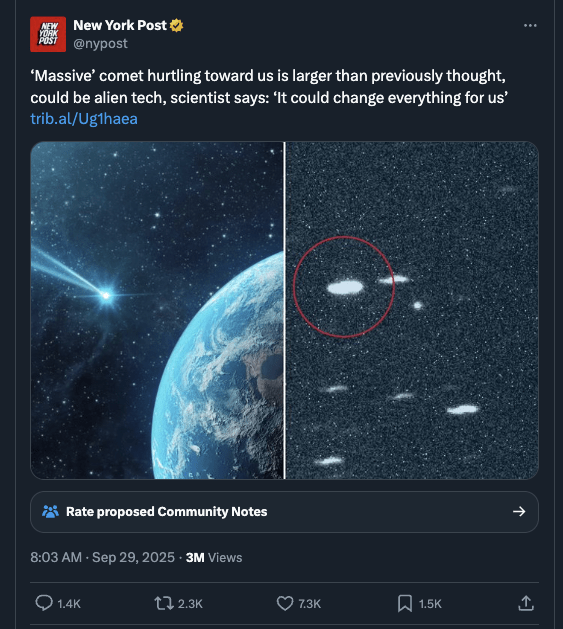
Figure 2: This New York Post tweet promoting its interview with Avi Loeb (approximately 3 million views at the time of capture).
Avi Loeb as a source and amplifier
Many of the most‐engaged posts during the study made specific claims about 3I/ATLAS, focusing on a cluster of “puzzling anomalies”, possibilities, and abnormal features. These talking points and speculations appear to be popularized largely by Avi Loeb’s writings (blog posts and a co-authored preprint) and amplified through his TV appearances and interviews over the past months. Since the scientific consensus on the nature of 3I/ATLAS clearly indicates that the object is a natural comet (see NASA’s assessments), I refer to Loeb’s assertions as speculation.
To be fair, at times, Avi Loeb states that 3I/ATLAS is most likely a natural interstellar comet. But he then spends far more time walking through its supposed “anomalies” and entertaining the alien-technology hypothesis. For most audiences, the volume and emphasis of that speculation effectively buries the initial caveat and recenters the story around the alien frame rather than the natural-comet explanation.
I analyzed seven of Loeb’s major talking points and speculations on 3I/ATLAS and how much popularity they achieved on X. Here is the list with his stance explained in a nuanced manner.
It is important to note that Loeb entertained and invoked the alien frame and intelligent origin of 3I/ATLAS in all of his talking points below. In fact, he presented these talking points as potential evidence of the object’s intelligent origin.
1. Mineral composition: Loeb has argued that “nickel without iron” would be unusual for natural comets and could be read as a signature consistent with industrial nickel-alloy production.
2. Size: Loeb has speculated about the object’s size, with its diameter close to 5 km — “on the order of the width of Manhattan” and treated that scale as noteworthy.
3. Trajectory / “convenient” geometry: Loeb has characterized the encounter geometry as “fine-tuned,” bringing the object within tens of millions of kilometers of multiple planets; and noted periods when it was hidden from terrestrial view near the Sun.
4. Speed / non-gravitational acceleration: Loeb has claimed a non-gravitational term near perihelion and entertained the possibility that such acceleration “might be produced by an engine,” while also stating that the excess is not significant and the trajectory is mainly shaped by gravity.
5. Jets, “gadgets,” mini-probes: Loeb has suggested jets could originate from technological thrusters and floats contingencies in which the object might maneuver, release mini-probes, or even deposit devices (e.g., within Jupiter’s Hill sphere).
6. Tail / anti-tail behavior: Loeb noted early “no clear evidence for a cometary tail,” highlighted a sunward jet/anti-tail not as a mere geometric illusion, and later described a transition to a tail in September 2025.
7. Radio / “Wow!” signal: Loeb speculated whether the 1977 “Wow!” signal (a one-off, minute-long spike in radio waves near the 1420 MHz hydrogen line detected by Ohio State University’s Big Ear radio telescope — never repeated and still unexplained, hence often invoked in alien-tech arguments) could be associated with 3I/ATLAS based on a rough sky alignment. He urged authorities to do targeted checks near the hydrogen line, even while acknowledging that there is no evidence of any artificial transmission.
To analyze how salient these points are in the conversation about 3I/ATLAS on X, query sets were constructed for each of these themes (anchored to language in Loeb’s posts and common paraphrases) and used to measure total posts associated with each “anomaly” within the 3I/ATLAS sensemaking stream.
1. Mineral composition: Approximately 38,000 posts mention mineral-composition terms (e.g., nickel, “no iron”); approximately 21,000 of these include alien-related keywords (e.g., mothership, spaceship).
2. Size: Approximately 44,000 posts reference size (e.g., “Manhattan-sized,” “larger than expected”), echoing Loeb’s 5 km estimate; approximately 23,000 of these pair sizes with alien-related language or emojis.
3. Trajectory: Approximately 100,000 posts discuss the object’s path, often echoing “fine-tuned” or “convenient” geometry; about 52,000 of these reference aliens/ET. More of these speculations will likely surface as 3I/ATLAS makes its way out toward Jupiter’s orbit.
4. Speed/acceleration: Approximately 87,000 posts focus on speed or acceleration; about 39,000 posts link that theme to aliens/ET.
5. Jets/gadgets/probes: Approximately 21,000 posts mention jets, thrusters, gadgets, or mini-probes; about 14,000 of these co-occur with alien-related terms. Many draw on Loeb’s conditional language about technological thrusters or probe release. Loeb has already begun speculating that 3I/ATLAS might release probes as it heads toward Jupiter’s orbit, and this subset of the conversation is likely to grow.
6. Tail/anti-tail: Approximately 64,000 posts discuss tail morphology (e.g., “no tail,” anti-tail/sunward features, later tail orientation); about 27,000 pair tail talk with alien/ET framing. A notable subset misreads geometry changes as “maneuvers.”
7. Radio/signals: Approximately 60,000 posts reference radio, “signal(s),” or the “Wow!” signal; about 33,000 of these invoke aliens/ET. Posts frequently cite Loeb’s question about a possible association.
Anomalies combined: Over 260,000 posts (of the 700,000 total) mention at least one anomaly or feature popularized in Loeb’s writings. Of these approximately 260,000 posts, about 118,000 reference the alien frame. Because many posts mention multiple anomalies, the category counts overlap and should not be treated as additive.
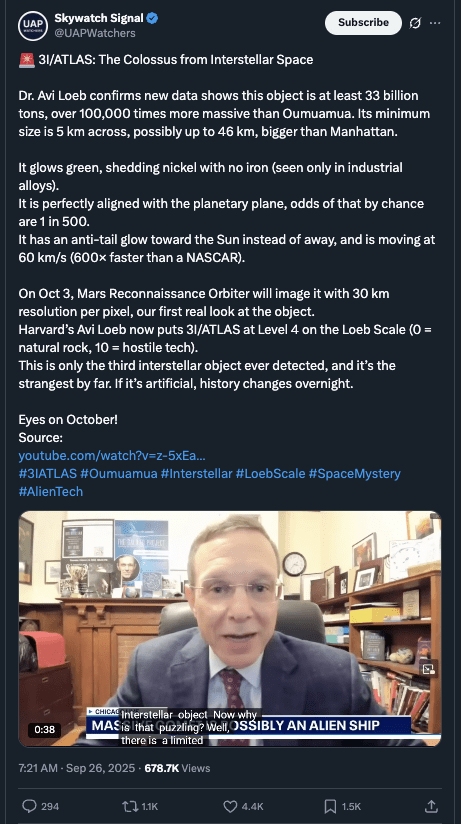
Figure 3: UAP-focused account amplifies Loeb’s “anomalies” and an alien-hypothesis framing.
What the case of 3I/ATLAS tells us about our information systems and environment online
The story of 3I/ATLAS isn’t just about what’s out there; it’s about how our information systems decide which stories, in which frames, end up in our feeds. First, there is already a large UFO/UAP ecosystem online: news websites, content creators, and newsbrokers who need a steady supply of attention-grabbing material. 3I/ATLAS is perfect for this because many accounts farm mystery as much as they farm the alien frame: “weird object, could be aliens, stay tuned for more.” That narrative structure lets them sustain interest and stay visible as the puzzle “deepens.” Second, there is a high-profile contrarian expert — in this case, Harvard professor Avi Loeb. His steady production of alleged anomalies and “it could be aliens” angles feeds directly into this mystery economy. Each new anomaly gives creators another round of content about how the mystery is deepening, keeping the attention-farming alive and helping the alien frame dominate the conversation in both volume (how much is produced) and popularity (engagement).
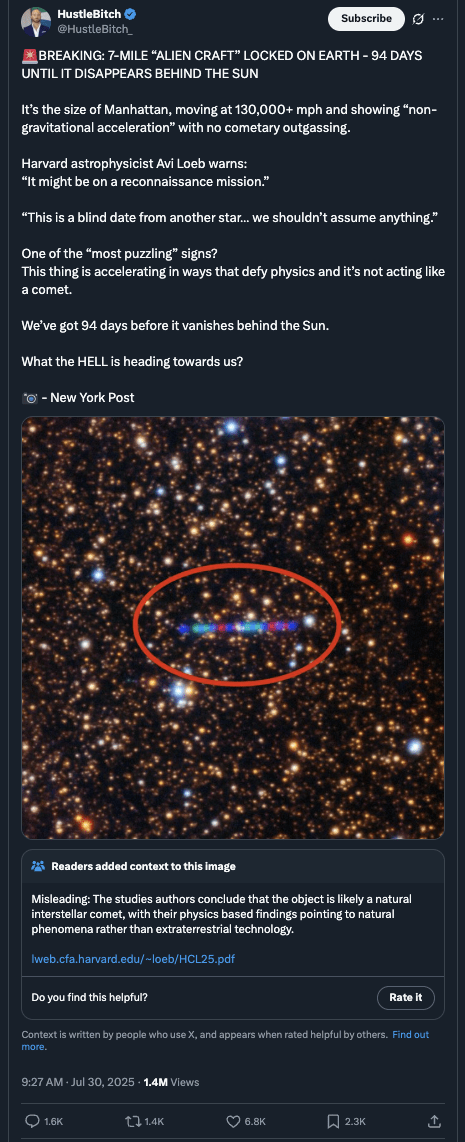
Figure 4: A fabricated/repurposed glowing-lights “spaceship” video is labeled as 3I/ATLAS; a Community Note is attached to correct it.
One could argue that X has become so saturated with conspiratorial content that research based on that platform alone can’t stand in for the broader information environment. As someone who has spent hundreds of hours studying X, I broadly agree with that concern. But the 3I/ATLAS case is bigger than a single platform or its latest algorithmic tweaks. Even Google isn’t immune: when I search for “3I/ATLAS” in an incognito window in Chrome, or in Safari while logged out, the first page of results includes multiple sites framing it as a possible alien spacecraft, including Loeb’s own Medium posts. The same pattern shows up on YouTube, where the first page of results is dominated by Loeb interviews and UFO/UAP channels repackaging his speculations, often with AI voiceovers, into new versions of the alien hypothesis.
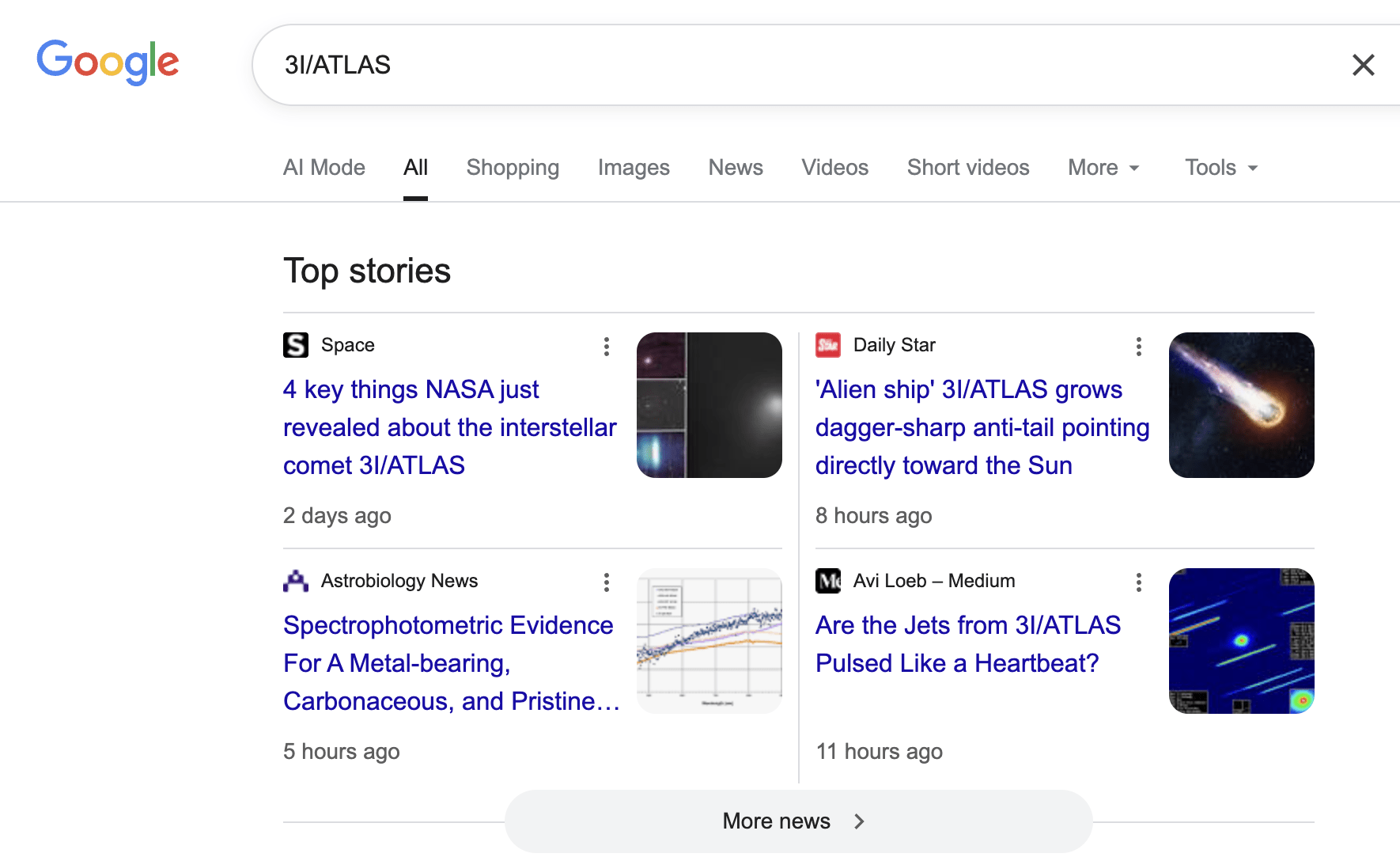
Figure 5: Top Google results from two quick searches for “3I/ATLAS” (one in incognito mode and one without signing in) on November 30, 2025, with a device located in Seattle, show that the alien frame and Loeb’s blog appear prominently on the first page. It is important to note that these screenshots are only a snapshot. Search results are dynamic and can vary by time, location, device, account status, IP address, and Google’s own ranking systems, so other users may see a different mix of results.
In short, our information systems reward the production of mystery and speculation. That reward is amplified by a ready-made ecosystem of websites, content creators across platforms who produce, spread, and amplify speculative takes. Those creators need a steady supply of “new” material, and Loeb’s ever-growing list of anomalies, even when indirectly refuted by organizations like NASA, feeds that need for sustained mystery and endlessly recyclable content. The path from comet to “alien probe” is not a straight line; it runs through a chain of creators, platform affordances, and algorithms, each adding a bit more drama and a bit less context. Nuanced, technical debates get compressed into a handful of viral beats: “it’s huge,” “it’s fast,” “it’s changing course,” “we got a signal.” In that sense, the alien of the gaps is as much a property of our platforms as of our own predispositions, and of the discreet charm of a revelation that never quite arrives.
A scientist’s speculation is somebody else’s conspiracy theory
Scientists are part of our collective sensemaking, especially on complicated, brand-new topics like interstellar objects. But common sense, which works at the human scale, doesn’t map cleanly to orbital mechanics or comet chemistry. What we call “normal” or “expected” here is mostly a function of baselines, and our baseline is thin: with only three confirmed interstellar visitors, much of what feels unusual about 3I/ATLAS reflects a tiny sample, not the design choices of extraterrestrial technology. In other words, the “weirdness” lives in our frames and priors more than in the object.
Our analysis from conversations on X suggests that Loeb’s public engagement, blog posts, co-authored preprint article, and frequent interviews served as focal points for broader discussions of “anomalies” (composition, size, speed, trajectory, tail, jets/probes, and radio). His lists and speculations of what “could be” appear to supply vocabulary that large segments of the conversation picked up and ran with.
To his credit, Loeb, at times, notes that 3I/ATLAS is likely a natural comet. Yet the rhetorical balance often tilts: a brief acknowledgment of the natural-comet consensus followed by extended speculation about engines, probes, and “Wow!”-adjacent signals. That pattern can create a false equivalence between the natural and ET hypotheses — as if they deserve similar probabilities, airtime, or resources — despite the current evidence overwhelmingly favoring a cometary explanation.
The downstream effect is visible across the platform: speculations and mysteries become evidence in the hands of UFO/UAP-adjacent audiences, and ordinary features — non-gravitational outgassing, changing tail geometry, OH radio absorption — are reframed as intentional signals or maneuvers. This is the “alien of the gaps” in action: where explanations feel incomplete, agency is inserted. A healthier norm is possible: keep curiosity high, keep claims proportional to evidence, and clearly mark the difference between an open question, a working hypothesis, and an extraordinary claim. Scientists help society reason under uncertainty, but speculative framing travels farther and faster than caveats. If we want better collective sensemaking about space and what space entails, we need to reward careful context as much as we reward captivating conjecture.
A timeline of the conversations around 3I/ATLAS on X 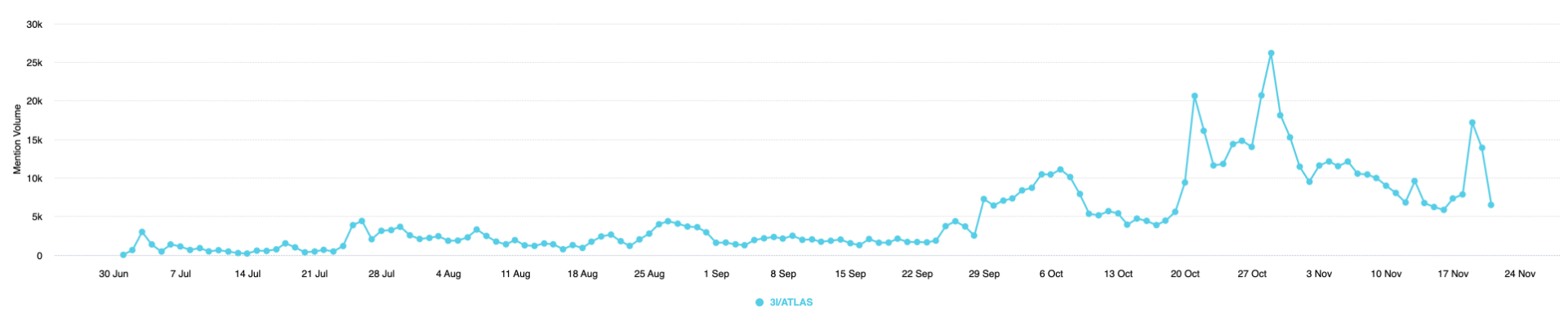
Figure 6: The Y-axis shows mention volume (number of tweets, retweets, quote tweets, and replies) on a daily basis on X from June 30, 2025, to November 21, 2025.
July 1–3, 2025: First bump: Discovery of 3I/Atlas (July 1st) and confirmation of interstellar origin (July 2nd). Conversations are about the discovery and conversation; the alien frame is not among the top 10 (reposted) tweets of the conversation.
July 26, 2025: Second bump: New York Post coverage of recent preprint article by Hibberd, Crowl, and Loeb is among the top tweets. Alien frame (particularly, discussions of 3I/ATLAS being an alien spaceship) is present in the top 10 tweets.
August 26–28, 2025: Third small bump: Nickel without iron, abnormalities, and the possibility of intelligent origin of 3I/ATLAS dominate the top 10 tweets.
September 26, 2025: 3I/ATLAS size, often compared to the size of Manhattan, is driving most of the top 10 tweets. The alien frame is explicit and implicit in the top 10 tweets.
September 29–October 8, 2025: 3I/ATLAS’ trajectory near Mars, new images, perceived anomalies, and unexpected features of the comet drive the conversations, and the alien frame is present in the top 10 tweets.
October 21, 2025: First big bump: Avi Loeb’s upcoming appearance on Joe Rogan is announced. The top 10 tweets focus on the latest imagery, anomalies, and the alien frame. In the top tweets, alien framing focuses on the comet’s behavior like a spaceship. 3I/ATLAS reached superior solar conjunction — it lined up on the far side of the Sun as seen from Earth. That put its solar elongation near zero, making it effectively unobservable from Earth-based telescopes; it stayed hidden through its October 29–30 perihelion and only became practical to image again in early November from the predawn sky. The top 10 tweets do not mention the solar conjunction.
October 22–27, 2025: On October 23, all of the top 10 tweets invoke the alien frame, with several about the comet’s tail. On October 24, the top 10 tweets highlighted Avi Loeb’s talk of a “black swan” event and a “Trojan horse.” Overall, many in the conversation in this time period claimed U.S. and international organizations were preparing planetary defense against 3I/ATLAS, invoking the alien frame. In fact, the International Asteroid Warning Network (IAWN) — a UN-recommended collaboration that includes NASA — announced a non-emergency Comet Astrometry Campaign to improve techniques for measuring comet positions; many posts misread this as NASA “activating” planetary defense for 3I/ATLAS, which was false. The campaign was a skills exercise applied to an interstellar comet. Separately, before Pete Hegseth’s event that brought together hundreds of retired military officers, some users implied a connection to 3I/ATLAS; no evidence supported that link. The top 10 tweets did not note the campaign’s non-emergency nature.
October 28-30, 2025: The peak of the conversation coincides with Avi Loeb’s appearance on Joe Rogan’s podcast. It also coincides with the perihelion. The top 10 tweets still focus on anomalies and speculations (e.g., mysterious pulse) on the intelligent origins of the object. In three days, anomalies endorsed by Loeb reach approximately 30,000 posts/mentions.
November 1–18, 2025: 3I/ATLAS became visible from the earth again, and the conversation continues with similar tropes and new images.
November 19-21, 2025: NASA’s new images are released, followed by a live Q&A from NASA staff and scientists. The newly released images’ perceived low quality caused rumors about potential cover-ups and the incompetence of NASA in spite of billions of dollars in funding.
Mert Can Bayar is a postdoctoral scholar at the University of Washington’s Center for an Informed Public.
In writing this blog post, Bayar used ChatGPT (GPT-5.1, extended thinking) to assist with grammar, clarity, and refinement of sentence structure. The content, ideas, and structure are entirely his own. Additionally, Bayar employed Mike Caulfield’s “deep background” fact-checking GPT as a critical tool for verifying claims and information about 3I/ATLAS.
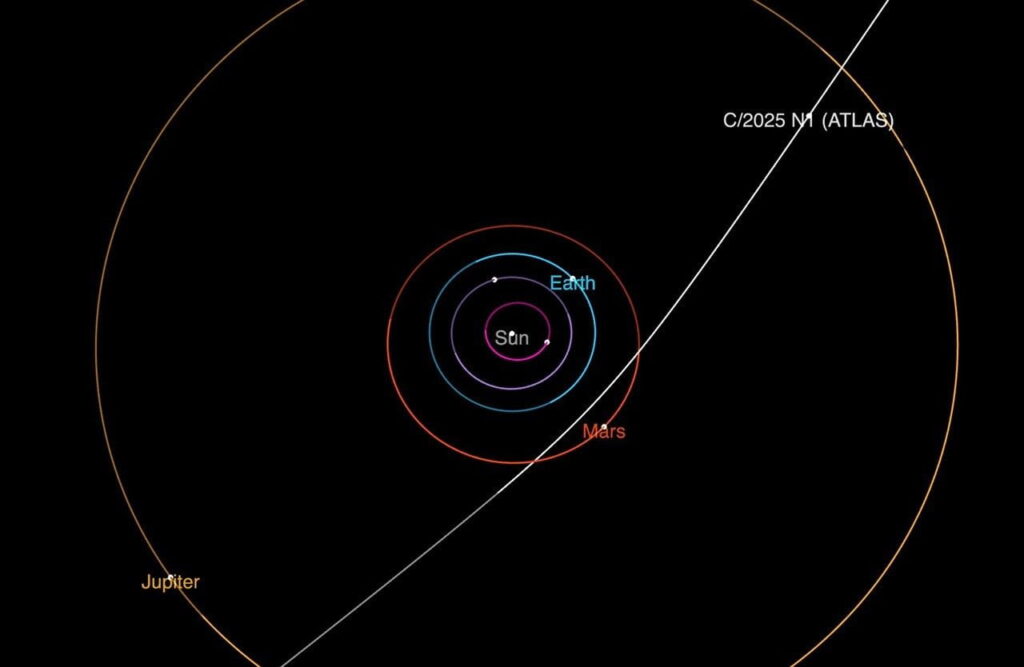
The image at top, showing the trajectory of interstellar comet 3I/ATLAS as it passes through the solar system, is from NASA’s 3I/ATLAS image gallery.