
Did you know we are in the middle of an astronomical experience? We are being treated to four supermoons in a row.People across New Hampshire have already enjoyed two supermoons and two more are on the calendar ahead: the Cold Moon appears on Dec. 4 and the Wolf Moon on Jan. 3.Moon-gazing experts and enthusiasts, like the New Hampshire Astronomical Society, are capturing these cosmic experiences. The volunteer organizations hosts public sky watches. NH Chronicle met up with these astro-photographers at Lake Massabesic for the November supermoon. Mike Atkinson from NHAS noted the full moon’s increasing visibility as the moon rose and the sun set.”The moon is now nearer to us than it is when its orbit is further away. Because it’s closer, it appears about 14 percent bigger than normal,” Atkinson said. “The light that we are seeing from the moon was traveling at the speed of light, and it takes about 1.3 seconds to get from the moon to your eyes.”The experts gathered with large binoculars and telescopes alongside casual photographers, grabbing snapshots with still cameras and cellphones. They were all recording the experience of the big, bright supermoon in their own way, with many sharing photos on u local New Hampshire, which we feature in this piece. Thanks for your views!Amanda Leith, education coordinator at the McAuliffe-Shepard Discovery Center in Concord, shared insights on the moon’s proximity during a supermoon, showing us with a moon globe how its orbit is about 226,000 miles away at its closest point. She emphasized the impact on tides and the increased moonlight visibility.”It’s taking all the sunlight that’s hitting it and reflecting it back to us,” Leith said. She encouraged people to get outside with family and friends and learn about the universe.Christopher Watt from the New Hampshire Astronomical Society set up a large telescope to see the supermoon. He expressed the awe of stargazing, saying, “There’s so much to see, there’s so much to discover.”Stanley Herman, another NHAS member, reflected on staring at the moon all his life.”I’ve been seeing it for 82 years, but it never ceases to amaze me that it always looks the same,” Herman said. “You could spend a lifetime and only see a fraction of what’s up there.”Enjoy the next supermoon!
AUBURN, N.H. —
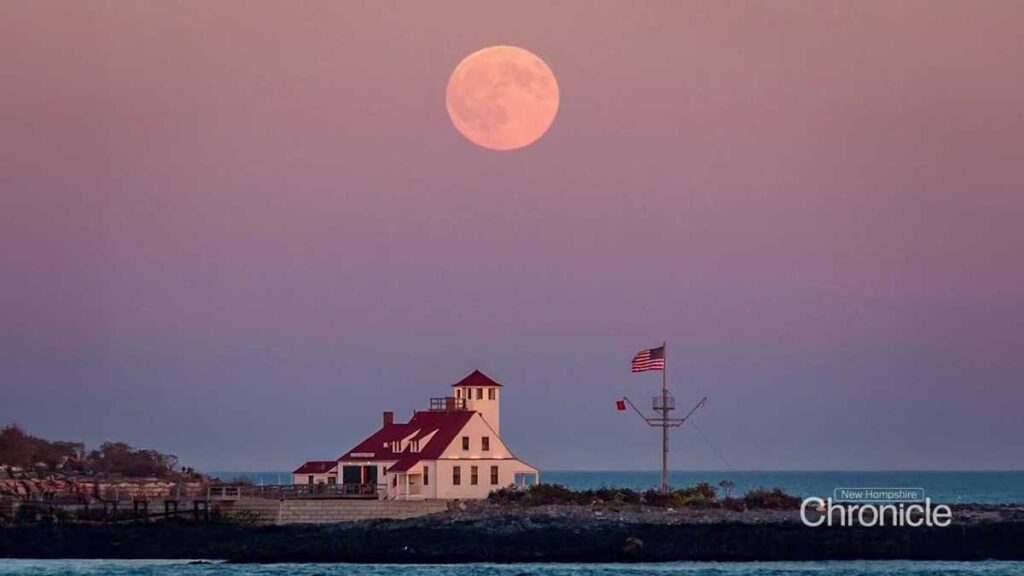
Did you know we are in the middle of an astronomical experience? We are being treated to four supermoons in a row.

People across New Hampshire have already enjoyed two supermoons and two more are on the calendar ahead: the Cold Moon appears on Dec. 4 and the Wolf Moon on Jan. 3.
Moon-gazing experts and enthusiasts, like the New Hampshire Astronomical Society, are capturing these cosmic experiences. The volunteer organizations hosts public sky watches.
NH Chronicle met up with these astro-photographers at Lake Massabesic for the November supermoon.
Mike Atkinson from NHAS noted the full moon’s increasing visibility as the moon rose and the sun set.
“The moon is now nearer to us than it is when its orbit is further away. Because it’s closer, it appears about 14 percent bigger than normal,” Atkinson said. “The light that we are seeing from the moon was traveling at the speed of light, and it takes about 1.3 seconds to get from the moon to your eyes.”
The experts gathered with large binoculars and telescopes alongside casual photographers, grabbing snapshots with still cameras and cellphones. They were all recording the experience of the big, bright supermoon in their own way, with many sharing photos on u local New Hampshire, which we feature in this piece. Thanks for your views!
Amanda Leith, education coordinator at the McAuliffe-Shepard Discovery Center in Concord, shared insights on the moon’s proximity during a supermoon, showing us with a moon globe how its orbit is about 226,000 miles away at its closest point.
She emphasized the impact on tides and the increased moonlight visibility.
“It’s taking all the sunlight that’s hitting it and reflecting it back to us,” Leith said.
She encouraged people to get outside with family and friends and learn about the universe.
Christopher Watt from the New Hampshire Astronomical Society set up a large telescope to see the supermoon. He expressed the awe of stargazing, saying, “There’s so much to see, there’s so much to discover.”
Stanley Herman, another NHAS member, reflected on staring at the moon all his life.
“I’ve been seeing it for 82 years, but it never ceases to amaze me that it always looks the same,” Herman said. “You could spend a lifetime and only see a fraction of what’s up there.”
Enjoy the next supermoon!