
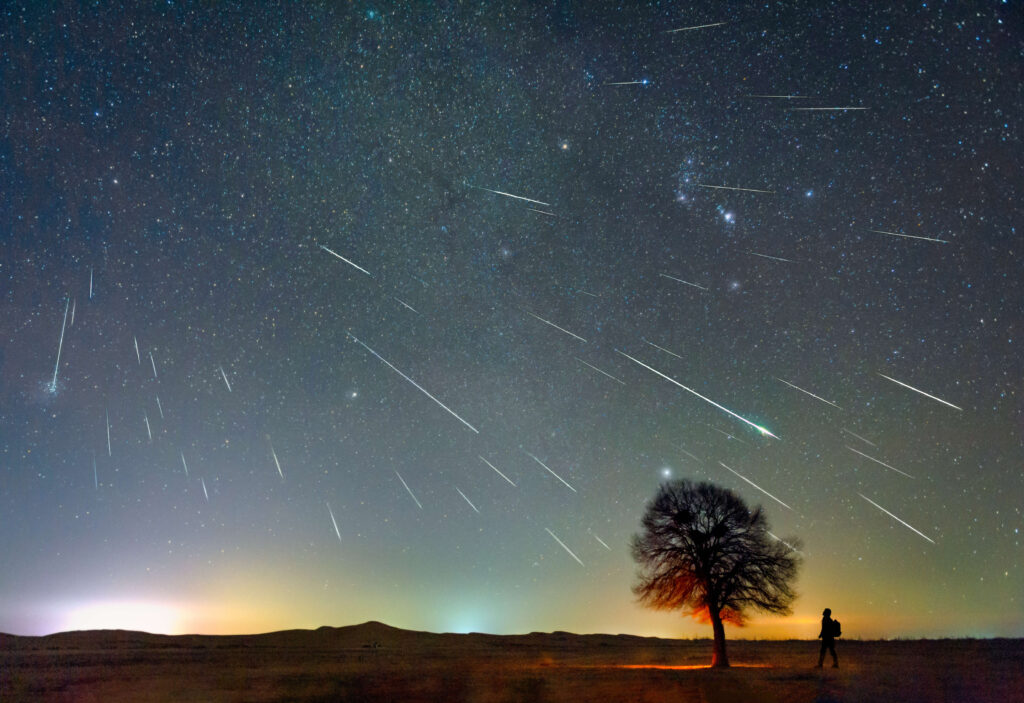
The most impressive meteor shower of the year is happening overhead, right now!
Of course, there is some debate. The Perseids are often considered the best meteor shower, and it has a lot going for it. The Perseids are fast and bright, leaving streaks of light and color behind them as they cut through the atmosphere. During its peak, you can see as many as 100 meteors per hour from a dark skies site.
Much of the Perseids’ popularity comes from the shower’s summer showtime, peaking in mid-August when it’s nice and comfy in the northern hemisphere. But in terms of raw numbers, the real monarch of meteor showers is the Geminids, happening right now in a sky near you.
About the Geminid meteor shower
In 2025, the Geminids are active from Dec. 1 to Dec. 21, according to NASA, peaking on the evening of Dec. 12 – 13. The shower is fairly young, first appearing in the mid-1800s. At the time, the shower was mild with only 10 to 20 meteors per hour during the peak. Over the course of nearly two centuries, the shower has ramped up production, pumping out as many as 150 meteors per hour.
Meteor showers are caused by the leftover debris from comets and asteroids. As their orbits bring them into the inner solar system, interactions with the Sun cause ice to sublimate into gas, releasing trapped dust particles in the process. Those particles trail behind a meteor, spreading out along its path. Even when the meteor makes its way back into the outer solar system, the debris trail gets left behind. Every year, Earth passes through these trails and dust particles smack into the atmosphere like bugs on the planet’s windshield, burning up in a fiery display.
While the vast majority of meteor showers come from comets, the Geminids originate from the asteroid 3200 Phaethon. It gets closer to the Sun than any other named asteroid, closer than half the distance of Mercury’s orbit, which is why astronomers named it after Phaethon, the son of the Sun god Helios.
Because Phaethon is a rocky asteroid and not an icy comet, it’s not totally clear where the material for the Geminids came from. Astronomers suspect that a few thousand years ago Phaethon started spinning so violently that it broke apart, ejecting billions of tons of material into space. What remains of Phaethon is relatively small, as asteroids go, with a diameter just more than three miles.
How to see the 2025 Geminid meteor shower
The Geminids can be seen as early as 9 or 10 p.m. local time, but the best views are later at night and during the pre-dawn hours. To get the best view, move away from city lights and other sources of light pollution. You’ll have the best view from a dark skies site. During the peak, the Moon will be a waning crescent, roughly 35 percent illuminated. It won’t rise until about 1 a.m. and may impact viewing after that time.
Meteor showers are named for the constellation from which they appear to originate. As the name suggests, the radiant point for the Geminids is in the constellation Gemini, but you’ll be able to see meteors all over the sky. In the northern hemisphere it will be cold, so you’ll want to prepare with plenty of layers, blankets, sleeping bags, lawn chairs, and whatever else you need to keep warm. Then simply point your eyes to the skies and wait.
Explore the cosmos close up in The Ark, streaming now on SYFY.