
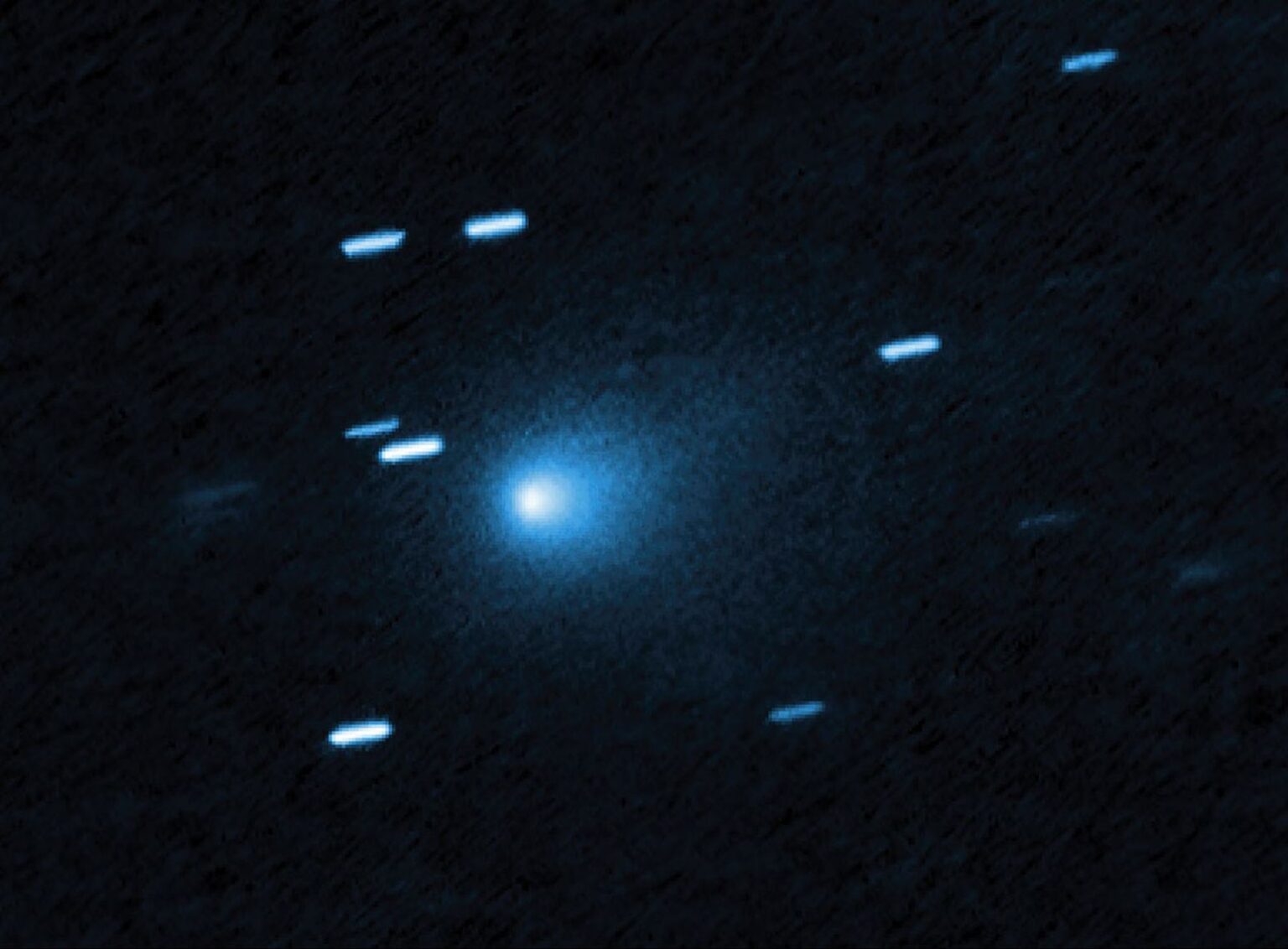
Interstellar comet 3I/ATLAS may be venting material through “ice volcanoes” as it swings through the inner Solar System, according to a new preprint that combines detailed imaging with spectral data. The work points to a metal-rich, carbonaceous body whose frozen interior is reacting as it heats up near the Sun.
The team, led by Josep M. Trigo-Rodríguez, used the 80 cm Joan Oró Telescope at Montsec Observatory in Spain, along with other regional facilities to follow 3I/ATLAS on its run-in to perihelion on 29 October. High-resolution images captured tightly wound spiral jets and knots in the coma, features that the authors interpret as material being launched from rotating vents on the nucleus rather than a smooth, uniform outflow.
Cryovolcanoes, Metal And A Trans-Neptunian Analogue
To understand what might be driving that pattern, the group compared the comet’s spectrum with Antarctic carbonaceous chondrites from NASA’s collection. Those meteorites are regarded as some of the most primitive samples of early Solar System material. The closest match suggests that 3I/ATLAS is both carbonaceous and unusually rich in native metal, with abundant water ice mixed into its outer layers.
In the model set out in the paper, sunlight first warms surface and near-surface ices, pushing the comet into a stronger phase of sublimation once it passes inside about 378 million kilometres of the Sun. As carbon dioxide begins to turn directly from solid to gas, pockets of oxidising liquid can percolate through the porous interior and react with metallic grains and sulphides. The resulting chemistry releases energy and gas in bursts, driving focused jets that appear as spirals when combined with the nucleus’s rotation.
The authors argue that this behaviour is consistent with cryovolcanism seen on ice-rich bodies in the outer Solar System, even though 3I/ATLAS arrived from interstellar space on a hyperbolic path. If its make-up really does resemble trans-Neptunian objects, it hints that planet-forming disks around other stars may produce similar populations of small, volatile-rich worlds.
The preprint backs up earlier indications suggesting that 3I/ATLAS has been heavily altered by radiation, possibly for longer than the Solar System has existed. That long exposure makes it harder to reconstruct the comet’s starting composition, but the mix of jets, spectral data and activity near perihelion still gives scientists a rare testbed for studying icy bodies from another system. Follow-up observations as the comet moves away will show whether the proposed cryovolcanic process matches how its activity fades over time.
The full study can be read in the authors’ arXiv preprint.
 Published by Ben Ward
Ben Ward studied English Literature and Language at the University of Bristol. With a background in analytical news writing and an interest in space exploration, his work focuses on the connection between science, history, and language. He has a measured approach to space journalism, always prioritising accuracy. He is interested in how the decisions of private industry, government agencies, and scientific institutions shape the future of space exploration. When not writing, He closely follows updates in Geopolitics, Aerospace and Planetary science, considering how humanity’s presence on earth has an influence far beyond it.