
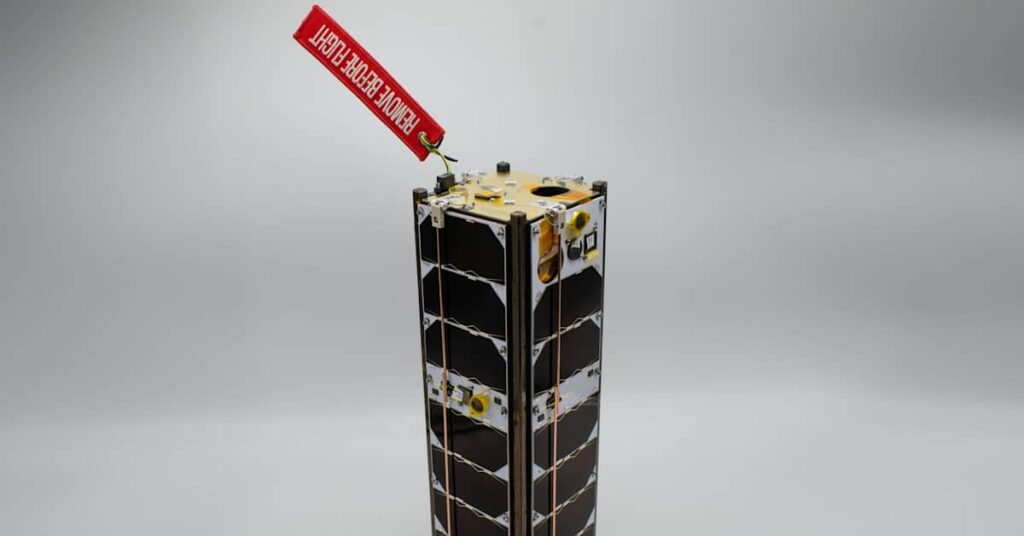
The science satellite was designed and built entirely in Finland.
Open image viewer
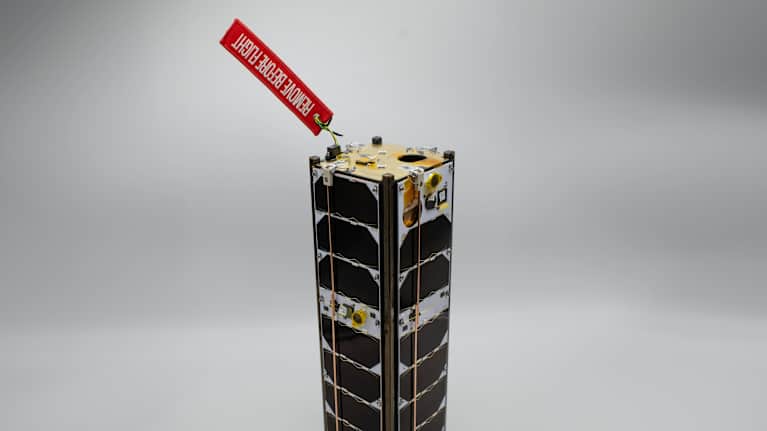
The Foresail-1p satellite was devised and made by experts from the University of Helsinki, Aalto University, the University of Turku and the Finnish Meteorological Institute (FMI). Image: Daniel Guzman Monet / Aalto-yliopisto
Finnish science satellite Foresail-1p was launched into space from the Vandenberg Space Force Base in California on Friday, according to Aalto University.
Finland’s microsatellite was shot into space aboard the Transporter-15 mission, the institution said in a press release on Monday. According to US firm SpaceX, Transporter-15 launched at 10:44am, local California time on Friday.
The ‘1p’ (One Prime) satellite was completely designed and built in Finland, in a collaborative effort led by the Finnish Centre of Excellence in Research of Sustainable Space (Foresail). The centre includes space science and technology experts from the University of Helsinki, Aalto University, the University of Turku and the Finnish Meteorological Institute (FMI).
According to Aalto University, Foresail-1p is carrying two key scientific instruments. They include the Pate particle telescope which studies near-Earth radiation, as well as the Plasma Brake experiment, “which tests the deorbiting of the satellite in order to reduce orbital debris”, the release explained.
“Foresail-1p is a major step forward for Finnish space research. Through the collaboration of top Finnish teams, we have developed an independent national capability to carry out our own scientific space missions,” Aalto University Space Technology Professor Jaan Praks said in the release.
‘Plasma Brake’ speeds up deorbiting
“The systems and instruments developed for the Foresail satellite are already in use in some European Space Agency missions and onboard several new Finnish satellites. Foresail technology also plays an important role in Aalto’s space technology education and in future student satellite projects,” Praks continued.
Developed at the University of Turku, the Pate instrument “measures high-energy particles arriving from Earth’s radiation belts, as well as neutral high-energy particles coming directly from the Sun”, the release said.
The collected data will help researchers understand low-Earth orbit radiation levels and enhance space weather modelling.
The Plasma Brake experiment, meanwhile, is aimed at speeding up the satellite’s deorbiting at the end of its mission.
“The device is based on a long, high-voltage metallic tether that interacts with the plasma in Earth’s ionosphere – the uppermost part of the atmosphere – and gradually slows down the satellite’s orbital velocity. As a result, the satellite re-enters the atmosphere and burns up safely. Without this technology, the process could take several years, but with the Plasma Brake it is reduced to just a few months,” the university’s release explained.