
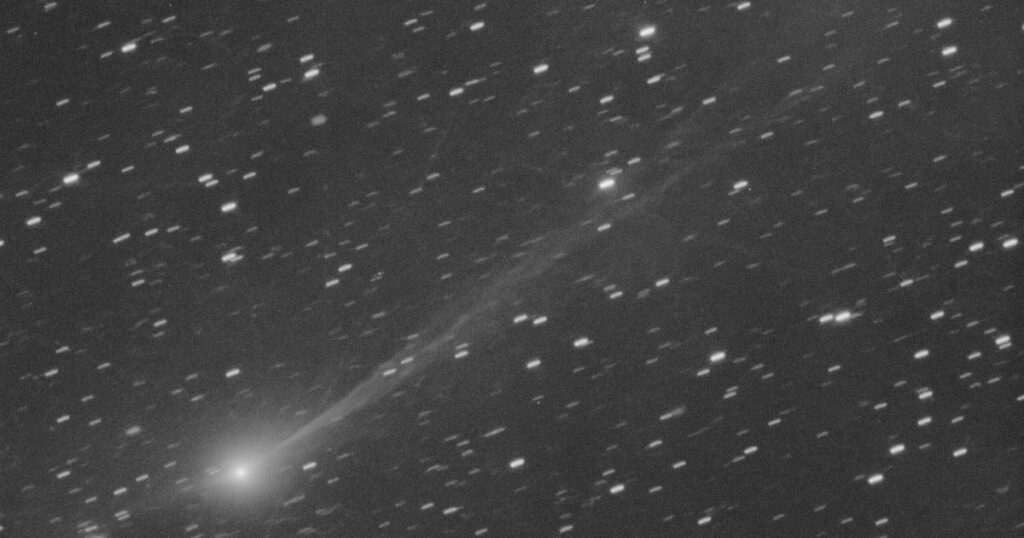
This summer, NASA confirmed that a mysterious object racing through the solar system came from interstellar space, only the third of its kind to be discovered.
News of the discovery was announced on July 1, based on data collected by the Asteroid Terrestrial-Impact Last Alert System (ATLAS), which continually monitors the sky from observatories in Hawaii, Chile and South Africa.
The object was zipping through our solar system at the breakneck speed of 152,000 miles per hour or about twice as fast as the Earth orbits the sun, and was on an open, hyperbolic trajectory, unlike the planets, asteroids and comets in our solar system which orbit the sun in closed elliptical loops.
This suggested that 3I/ATLAS, as it was designated, originated far from the sun’s gravitational influence. After numerous observations, NASA announced that 3I/ATLAS, which sports a tail and is surrounded by a bright cloud of gas and ice, is an interstellar comet.
3I/ATLAS was about 4.5 astronomical units from the sun, which is a bit closer to the sun than Jupiter’s orbit, at the time of its discovery, and it reached its closest approach to the sun on Oct. 30, coming within 1.4 astronomical units of the sun, or about Mars’ distance from the sun at perihelion.
One astronomical unit equals Earth’s average distance from the sun, or 93 million miles.
Researchers were able to study 3I/ATLAS in the evening sky through the end of September, until it became lost in the Sun’s glare, and then resumed observations upon its reappearance in the early morning sky in November.
3I/ATLAS will make its nearest approach to Earth, at a not-so-close distance of 170 million miles on Dec. 19. Based on observations by the Hubble Space Telescope, the icy nucleus of 3I/ATLAS is estimated to be between two-tenths and 3½ miles indiameter.
At some point after its formation, 3I/ATLAS must have been gravitationally flung out of its original star system by an encounter with either a giant planet or another star.
Tracing the path of 3I/ATLAS in the sky shows that this icy visitor came to our solar system from the direction of the constellationSagittarius, near the Milky Way’s galactic center.
However, 3I/ATLAS cannot be definitively traced back to its original parent star because the comet has possibly been traveling around the Milky Way for billions of years, during which time it has been mixed around with other stars.
A September 2025 study by Yiyang Guo and collaborators found that 3I/ATLAS may have passed within 1 parsec of 25 known stars in the past 10 million years.
The velocity component of 3I/ATLAS perpendicular to the plane of the galaxy is relatively high compared to those of nearby stars, which means that the comet may belong to the thick disk population, which mainly consists of older stars whose compositions have lower levels of heavy elements than the sun.
A recent study that models the last 4 million years of the comet’s journey through the galaxy suggests that 3I/ATLAS has an age of at least 7 billion years, compared with the Sun’s 4.6 billion years.
Not the first
3I/ATLAS is only the third known interstellar visitor, hence the prefix “3I.” The second known interstellar body, Comet 2I/Borisov, was discovered by the Russian astronomer Gennady Borisov in August 2019.
It’s the first interstellar comet to be discovered, and it came to our solar system from the direction of the constellation Cassiopeia. It is similar in composition to other comets from the Oort Cloud that surrounds our solar system: frozen gases, rock, and dust, but with a high level of carbon monoxide.
The very first confirmed guest from another star system was 1I/2017 U1, designated Oumuamua, which is the Hawaiian word for “a messenger from afar arriving first.”
This appellation is appropriate since the telescope that discovered it — PanSTARRS-1 — is based in Hawaii. Oumuamua is a smal — as astronomical bodies go — pancake-shaped object with dimensions estimated to be 377 feet long, 364 feet wide and 62 feet thick. It has a distinct dark reddish color.
Oumuamua made headlines following its discovery in October 2017 as a possible alien spaceship, but was shown instead to most likely be a hydrogen-spewing asteroid.
Although Oumuamua appears to have come from the vicinity of the star Vega in the constellation Lyra, no one knows for sure which star system Oumuamua originated from.
However, in 2018, astronomers traced Oumuamua back along the path from which it first approached the sun and found that the object passed close to the red dwarf star HIP 3757 a million years ago.
Perhaps Oumuamua originated in that star system, or maybe it came from an even more distant star system. Oumuamua is now racing out of our solar system, and is well past the orbit of Neptune, beyond the reach of our telescopes.
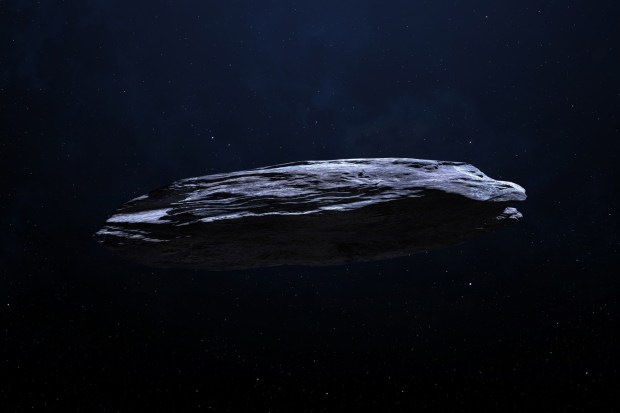 Oumuamua asteroid or comet, is the first interstellar object detected passing through the Solar System. (GETTY IMAGES)
It is currently speeding through the Kuiper Belt, a ring of icy bodies near the edge of the solar system, and heading toward the constellation Pegasus, never to return.
1I/Oumuamua, 2I/Borisov, and 3I/ATLAS are just the first three known interstellar visitors to our solar system.
Undoubtedly, others will be discovered in the coming decades with large space and ground-based telescopes such as James Webb Space Telescope and the Vera Rubin Observatory in Chile.
Astronomers suspect that many more interstellar interlopers pass through our solar system without being detected, possibly at least one per year.
No one knows when the next discovery will happen, but rest assured that when it does it will almost certainly garner lots of interest from both astronomers and the general public about what it is and where it came from.
Augensen is the director of the Widener University Observatory and emeritus professor of physics and astronomy at Widener University.