
Researchers at the University of Tokyo have announced the discovery of gamma rays produced by the annihilation of dark matter particles. If confirmed, this will be the first time that humanity has “seen” this mysterious substance.
The hidden mass of the Universe
Back in the early 1930s, astronomer Fritz Zwicky discovered an anomaly in the motion of galaxies, which could be explained by the fact that their actual mass was much greater than the mass of the observable matter. This led him to conclude that there must be some invisible structure—dark matter—holding the galaxies together.
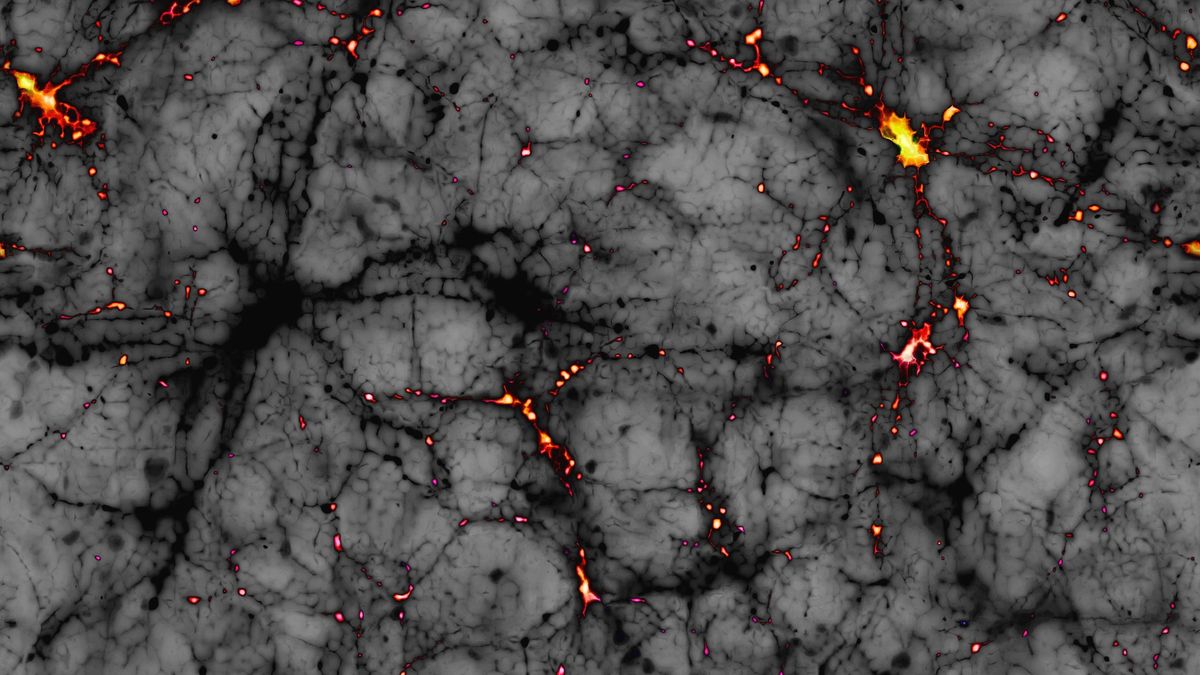 Simulation of dark matter structures in the Universe. Source: MARK GARLICK/SCIENCE PHOTO LIBRARY via Getty Images
Almost a century after Zwicky’s discovery, dark matter remains largely a mystery. Until now, scientists have only been able to observe it indirectly, by studying its effects on observable matter. For example, through its ability to generate enough gravity to hold galaxies together. The reason why dark matter cannot be observed directly is that the particles it consists of do not interact with electromagnetic radiation and do not emit it. In other words, dark matter does not absorb, reflect, or emit light.
Annihilation of dark matter
There are many hypotheses explaining the nature of dark matter. According to one of the most popular theories, it consists of so-called WIMPs (weakly interacting massive particles), which are heavier than protons but interact very little with other matter. Despite the lack of interaction, when two such particles collide, they annihilate each other and release other particles, including gamma-ray photons.
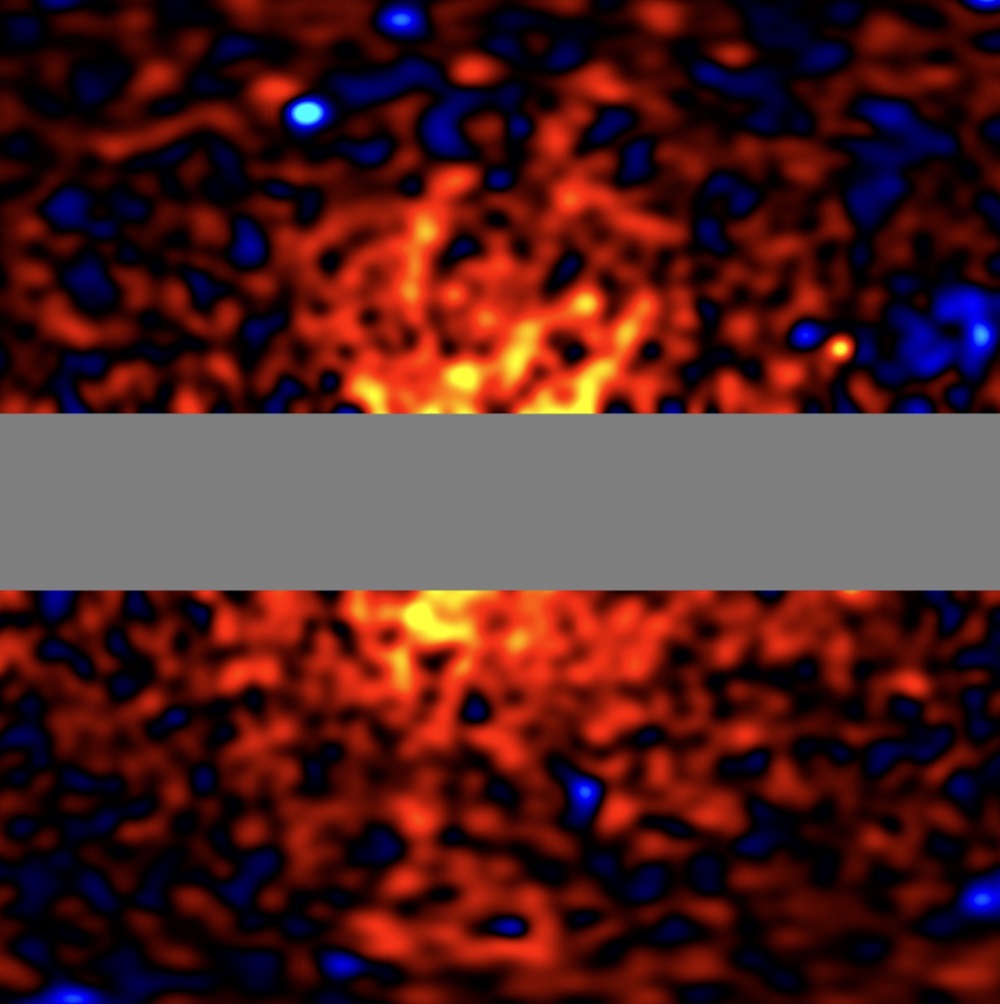 Map of gamma-ray intensity in the Milky Way. The horizontal gray stripe in the central region corresponds to the galactic plane, which was excluded from the analysis to avoid strong astrophysical radiation. Source: Tomonori Totani, The University of Tokyo
For many years, scientists have been trying to find these specific gamma rays, focusing on areas where dark matter is believed to be most concentrated. According to Professor Tomonori Totani of the Department of Astronomy at the University of Tokyo, he has finally succeeded in solving this problem. After analyzing the latest data from the Fermi space telescope, he has found gamma rays whose characteristics match those predicted.
“We detected gamma rays with a photon energy of 20 gigaelectronvolts (or 20 billion electronvolts, which is an extremely high energy) propagating in a halo-like structure toward the center of the Milky Way galaxy. The gamma-ray component corresponds exactly to the shape expected from a dark matter halo,” said Totani.
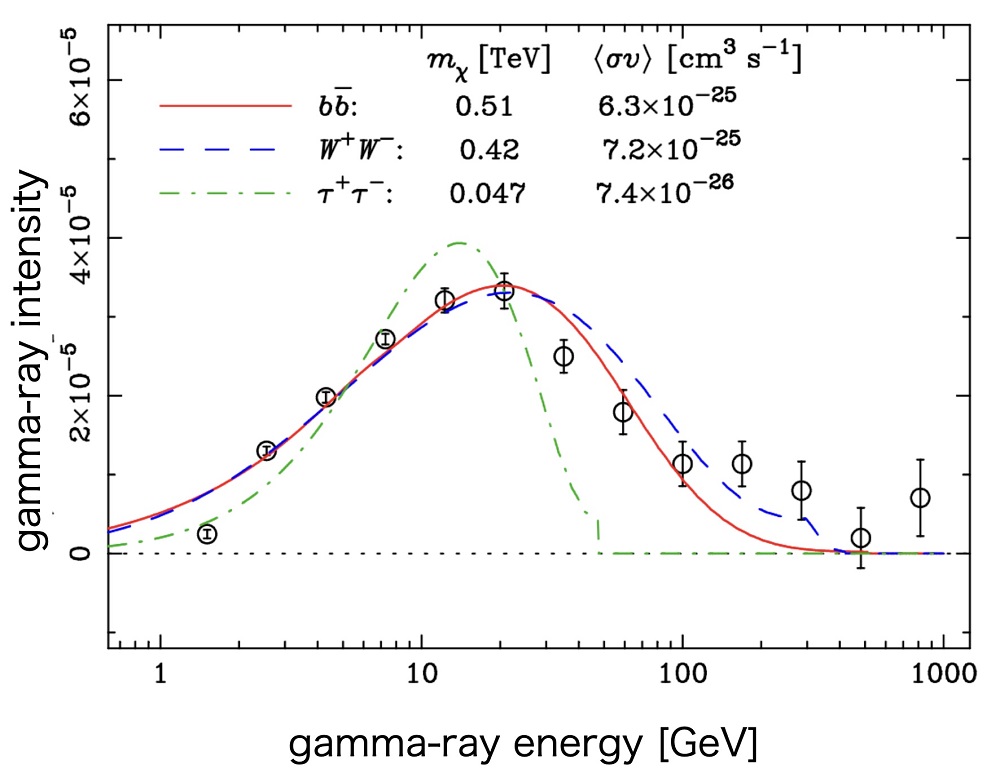 Energy spectrum of gamma radiation detected by the Fermi telescope. Source: Tomonori Totani, The University of Tokyo
The observed energy spectrum, or gamma-ray intensity range, corresponds to the radiation predicted as a result of the annihilation of hypothetical WIMPs, whose mass is approximately 500 times greater than that of a proton. The annihilation rate, estimated from the measured gamma-ray intensity, is also within the range of theoretical predictions.
“If this is true, then, as far as I know, this will be the first time that humanity has ‘seen’ dark matter. And it turns out that dark matter is a new particle not included in the current standard model of particle physics. This represents a significant breakthrough in astronomy and physics.”
Although Totani is confident that his gamma-ray measurements detect dark matter particles, his results must be verified by independent analysis by other researchers. Even with this confirmation, scientists will need additional evidence that this radiation is indeed the result of dark matter annihilation and not coming from some other astronomical phenomenon.
Additional evidence of collisions in other locations with high concentrations of dark matter would support these initial findings. For example, the detection of gamma rays of the same energy from dwarf galaxies in the Milky Way halo would confirm the results of the study.
According to UTokyo