
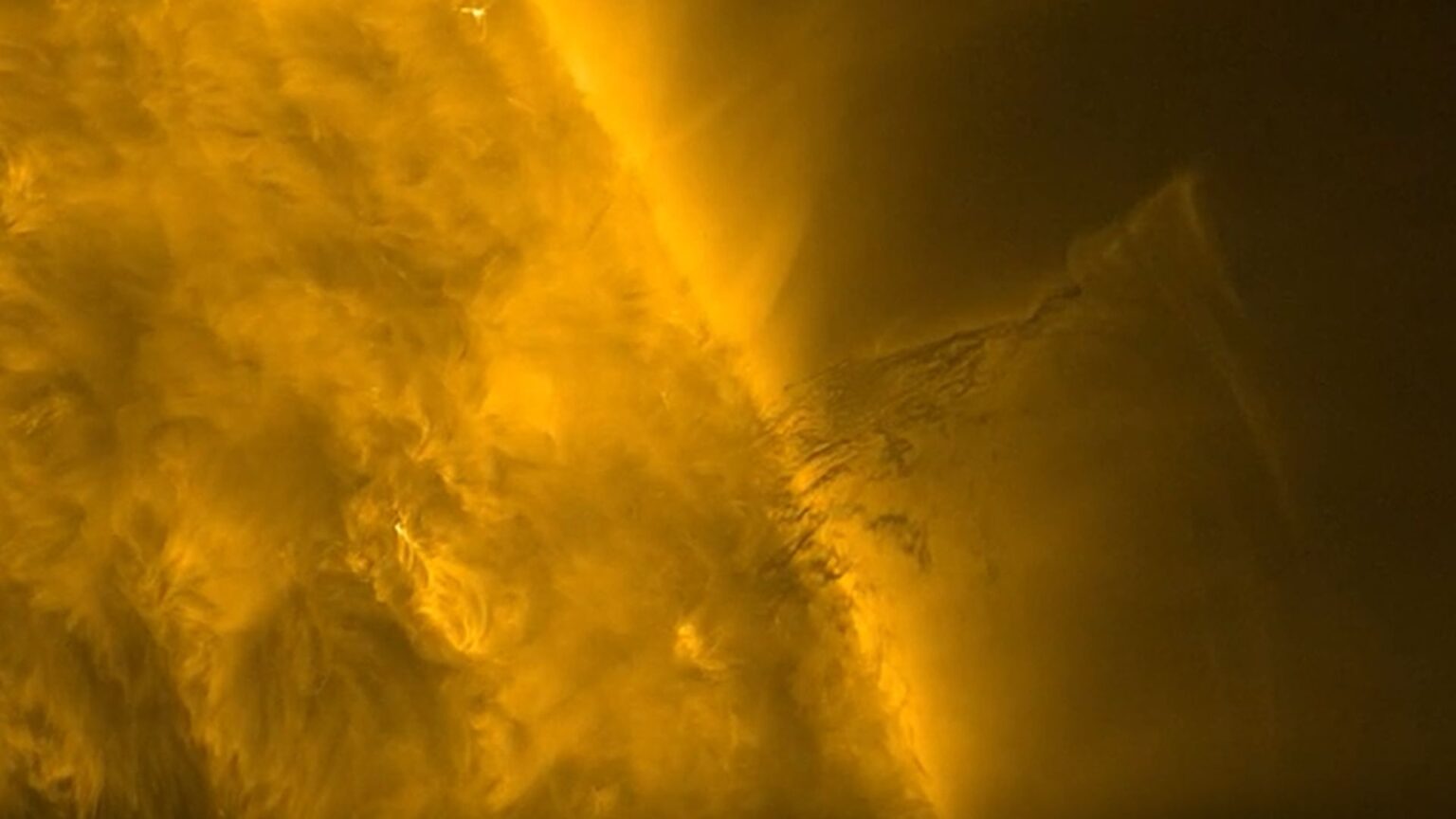
The European Space Agency’s Solar Orbiter mission recently captured a dramatic solar prominence rising from the edge of the sun, a rare and captivating sight even for mission scientists accustomed to our home star’s constant activity. The footage, recorded earlier this year by the spacecraft’s Extreme Ultraviolet Imager (EUI), shows a dark, arching structure of plasma suspended above the solar surface.
This solar prominence is made of electrically charged gas, or plasma, confined by the sun’s intricate magnetic fields. Although the sun’s atmosphere is blisteringly hot —often exceeding one million degrees — this trapped plasma is relatively cool at roughly 18,000 degrees Fahrenheit (10,000 degrees Celsius).
The prominence’s lower temperature causes it to appear darker against the surrounding glow of the solar corona. When such structures are seen silhouetted against open space, they are known as prominences; when they stretch across the sun’s visible disk, they are referred to as filaments. Both solar prominences and filaments can extend for tens of thousands of miles, easily surpassing several times the diameter of Earth.
Best picks for you
Where is it?
At the time of the observation, Solar Orbiter was positioned about 39 million miles (63 million kilometers) from the sun, a distance comparable to Mercury’s orbit.

The video released by Solar Orbiter condenses one hour of real-time solar activity into a short sequence. (Image credit: ESA & NASA/Solar Orbiter/EUI Team, D. Berghmans (ROB), CC BY-SA 3.0 IGO ; Music: Atmos by Oliver Spencer)Why is it amazing?
This observation contributes to Solar Orbiter’s broader mission to study the sun’s magnetic activity, solar wind origins, and energetic processes that influence space weather around Earth.
Launched in 2020, Solar Orbiter is a collaboration between the European Space Agency (ESA) and NASA, carrying ten instruments that work together to examine the sun from multiple perspectives. The Extreme Ultraviolet Imager — led by the Royal Observatory of Belgium — plays a key role in visualizing the solar atmosphere at high resolution and capturing phenomena like the prominence seen in this latest release.
As the sun approaches the peak of its 11-year activity cycle, events such as prominences, filaments, and coronal mass ejections are expected to become more frequent and pronounced. Being able to observe these phenomena allows scientists to understand the magnetic dynamics at play in the sun’s atmosphere.
Want to learn more?
You can learn more about the sun’s atmosphere and the Solar Orbiter.