
For nearly 70 years, astrophysicists have been trying to solve one of the most persistent mysteries of the universe – the cause of a sharp “break” in the energy spectrum of cosmic rays. This phenomenon, known as the “knee,” shows a sharp decrease in the intensity of particles with energies above 3 pegaelectronvolts (PeV). A revolutionary discovery made with the LHAASO observatory has finally pinpointed the source of this anomaly: powerful microquasars powered by black holes.
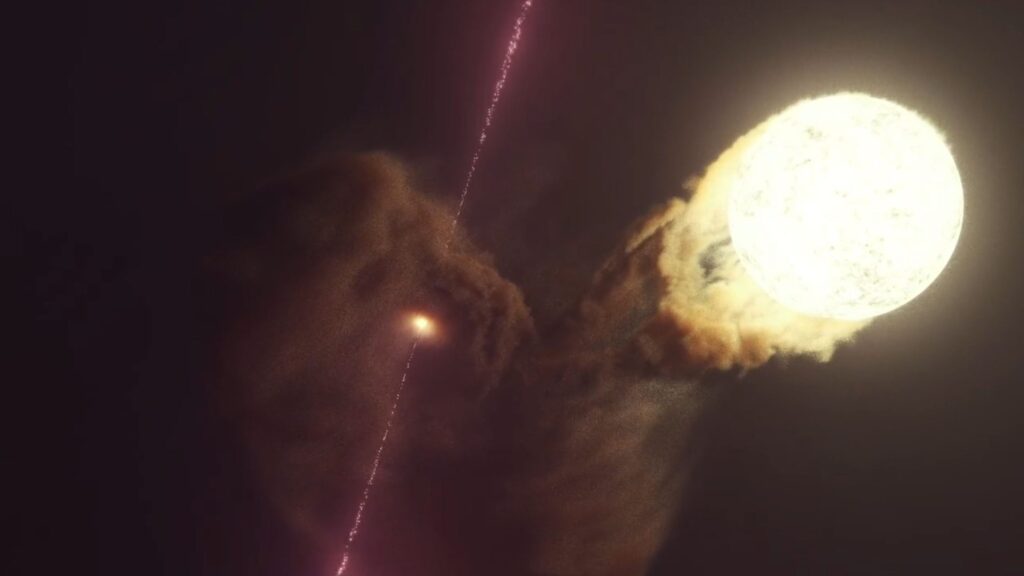
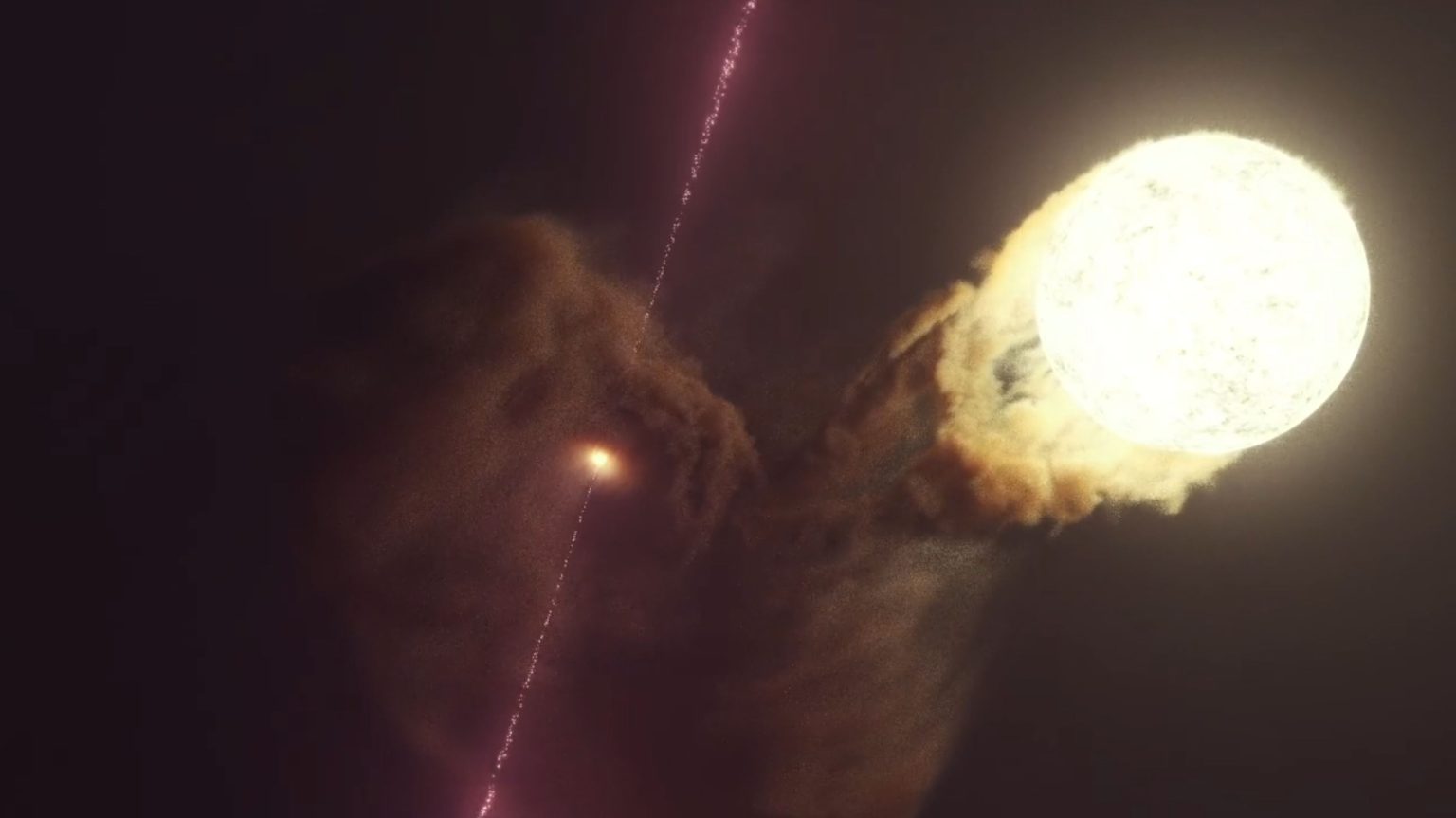 This illustration shows SS 433, a black hole or neutron star that actively absorbs matter from its companion star. The stellar material forms a disk around SS 433, and some of the material is ejected into space in the form of two thin jets moving in opposite directions from SS 433.
Credit: DESY/Science Communication Lab
Discovered in the last century, the “knee” in the energy spectrum of cosmic rays resembled a natural limiter. Scientists suggested that it could be related to the maximum acceleration limit of particles in traditional sources such as supernova remnants. The hypothesis was that beyond this limit, one type of energy distribution would be replaced by another. However, for many years, there was neither observational data nor technology to confirm this.
Extraordinary energy
The breakthrough was made possible by data from the Large High Altitude Air Shower Observatory (LHAASO). Two new studies published in prestigious journals prove that microquasars are powerful particle accelerators in our Milky Way galaxy and are most likely the source of the mysterious “knee.”
Microquasars are binary systems where a black hole absorbs matter from a companion star, forming relativistic plasma jets. LHAASO has systematically detected ultra-high-energy gamma rays from five such objects for the first time in history: SS 433, V4641 Sgr, GRS 1915+105, MAXI J1820+070, and Cygnus X-1.
Observations of the SS 433 system have revealed that ultra-high-energy radiation from it overlaps with a giant atomic cloud. This indicates that protons accelerated by a black hole collide with surrounding matter. The energy of these protons exceeded 1 PeV, and the total radiation power reached an incredible 1032 joules per second. For comparison, this is equivalent to the energy released in one second by four trillion of the most powerful hydrogen bombs.
Another microquasar, V4641 Sgr, showed gamma radiation with an energy of 0.8 PeV, making it another “super accelerator” of particles.
How does that solve the puzzle?
These discoveries prove that microquasars are significant particle accelerators in the PeV range. They are capable of accelerating cosmic rays to much higher energies than is possible for supernova remnants. Thus, the “knee” reflects the acceleration limit for old sources (supernovae), while microquasars take on the role of “new sources” that generate a particle flux beyond this break.
The discovery by LHAASO not only reveals a decade-long mystery but also opens a new page in our understanding of the universe. It points to the crucial role of black holes in galactic particle acceleration processes and ushers in a new era of extreme physics research. The observatory, created by Chinese scientists, continues to lead the field, providing unique data that is changing our view of space.
Earlier, we reported on how scientists explain the “impossible” merger of black holes.
Provided by phys.org