
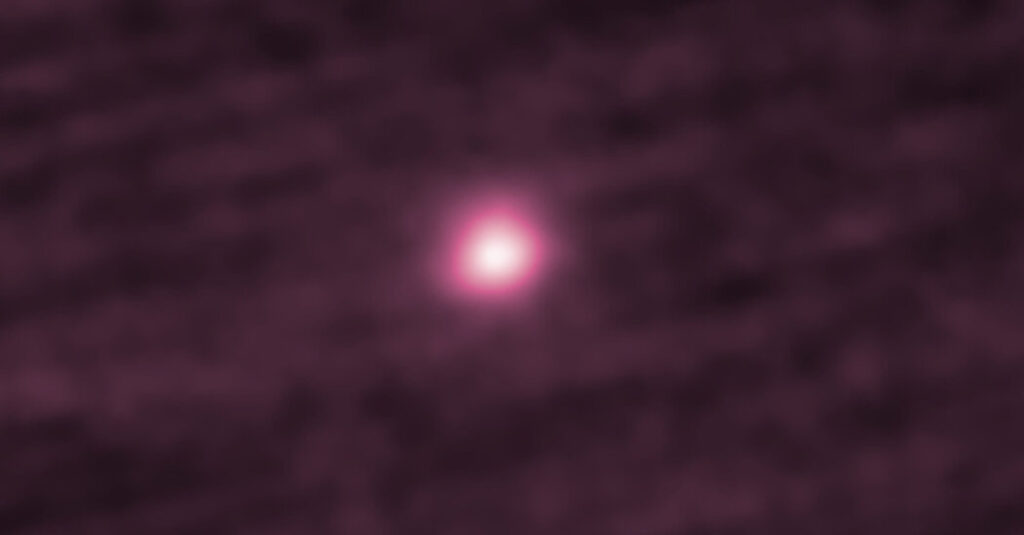
Because of the smearing, it will probably not provide better estimates of the size of the comet nucleus. In July, scientists using the Hubble Space Telescope said the comet was no wider than 3.5 miles in diameter and possibly even as small as 1,400 feet. At the time, the comet was more than 270 million miles from Earth, and Hubble.
While the new image could yield information, Dr. McEwen said, “there’s nothing obvious that jumps out.”
He added, “It definitely looks like a comet. Yes, it’s fuzzy. It’s got a coma. Doesn’t look like a spacecraft.”
The comet was first spotted in July by telescopes on Earth. Last month, it made its closest approach to the sun, passing just inside the orbit of Mars. Scientists know it must have arrived from interstellar space because of its high speed, reaching more than 150,000 miles per hour. It is now on its way out from the solar system.
Avi Loeb, an astrophysicist at Harvard, has provoked wider interest about Comet 3I/ATLAS. He has speculated that it could have been sent by aliens, given some of its peculiarities.
Dr. Kshatriya said he thought the attention was wonderful. “It expanded people’s brains to think about how magical the universe could be,” he said.
He noted just a few months ago that NASA scientists had presented results about an intriguing rock on Mars that could include signs of past life.
The comet was out of view from Earth for a couple of months because it was on the other side of the sun.
“Getting data at a time when none of the ground-based telescopes can observe it is very valuable,” Karen Meech, a planetary astronomer at the University of Hawaii, wrote in an email. “This includes estimates of the brightness and getting estimates of the amount of gas coming off the comet.”
She noted measurements of hydrogen emissions made by MAVEN, another NASA spacecraft orbiting Mars. Hydrogen is produced by sunlight breaking apart water molecules, and the brightness of the emissions “will ultimately tell us how much water was coming off the comet,” Dr. Meech said.
There are more observations yet to be made. The comet will come closest to Earth on Dec. 19, when it will be some 170 million miles away. Next spring it will pass by Jupiter, and NASA’s Juno spacecraft in orbit there can take a look.