
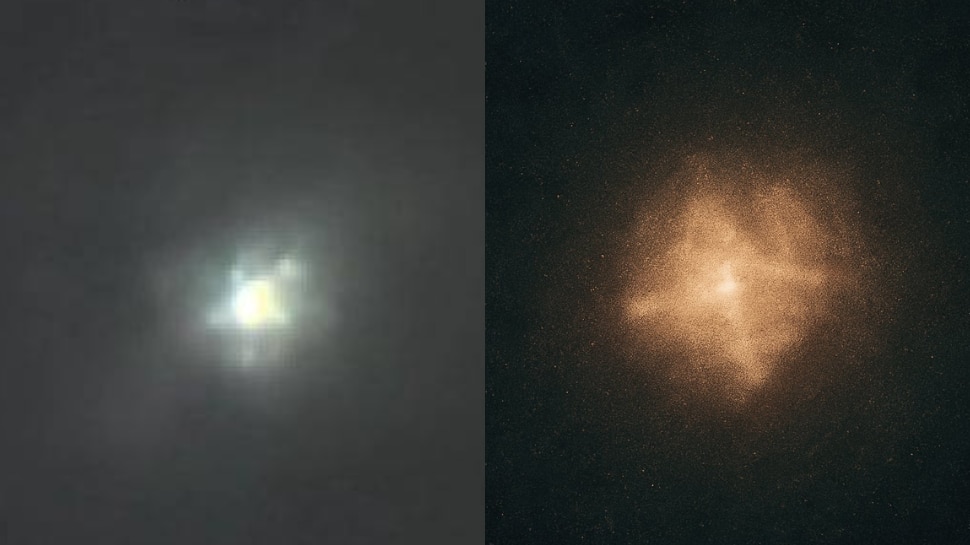
3I/ATLAS New Footage: The internet has exploded with excitement after new images and videos of interstellar comet 3I/ATLAS surfaced across astronomy forums, NASA updates, ESA observation threads, and social media. Many posts claim the comet appears to be spinning, with some showing dust rings, detached shells, or rotating motion patterns.
But here’s the truth: none of these claims have been scientifically verified. Still, the viral buzz has skyrocketed public curiosity around the fast-moving visitor currently racing through our Solar System for the first-and only-time.
What Started the ‘3I/ATLAS Is Spinning’ Theory
Add Zee News as a Preferred Source
The speculation began when space photographers and amateur astronomers shared footage that appeared to show rotational motion around the comet. Among the key viral posts:
1. Footage Claiming a Rotating Structure
One widely shared post compared the motion around 3I/ATLAS to an old ESA ExoMars Orbiter capture, suggesting the new images might indicate rotation. The footage credited to Diego San Araujo remains unconfirmed and unreviewed by scientific bodies.
3I/ATLAS: NEW FOOTAGE!
New footage clearly shows a spinning structure.
Alot like what was captured by ESA’s ExoMars Orbiter.
Do we have confirmation this is not a comet?
Source : Diego San Araujo#3IATLAS #3IAtlasExposed #Space #UFOx pic.twitter.com/fPmJSAdhi3
— 3I/ATLAS WHISTLE BLOWER (@3IATLASEXPOSED) November 21, 2025
2. Ray’s Astrophotography Video at 9 PM EST
Another post claimed that a freshly shared video showed the comet “spinning.” It also noted that NASA was preparing to release new official images during a live event later in the week. Again, exciting, but unverified.
BREAKING: An amateur astronomer (Ray’s Astrophotography /Youtube) shared a video at 9pm EST that included these images of 3I/ATLAS.
This is relevant since we will be getting new images of 3i/ATLAS from NASA during a live event scheduled for 3pm EST Wednesday.
Ray says that… pic.twitter.com/5cDlDCKu4z
— All day Astronomy (@forallcurious) November 19, 2025
3. Stacked Images Showing “Five Objects Circling a Centre”
One user stacked multiple long-exposure shots and observed a pattern that looked like five bodies orbiting a central point. Experts pointed out that coma shifts, dust jets, and nucleus activity can easily create similar visual illusions.
In the latest capture, 3I/ATLAS shows a motion pattern that resembles five objects circling a center.
Stacked images reveal shifting coma patterns, dust jets, and inner-core movement that create this rotating effect.
Video Credit: Rays Astrophotography pic.twitter.com/DvVDdkBQG1
— Space and Technology (@spaceandtech_) November 18, 2025
4. Claims of “Perfect Dust Rings” 150,000 km Wide
Yet another viral image claimed five dust rings swirling around the comet, described as detached shells. This dramatic claim is also not validated.
Before NASA releases its official image, a new photo of Object 3I/ATLAS has come out from Ray’s Astrophotography, and people are definitely noticing something odd in it. pic.twitter.com/p9r0N40hhP
— UFO mania (@maniaUFO) November 19, 2025
Despite the lack of verification, these posts have fuelled worldwide speculation.
3I/ATLAS: DETATCHED SHELLS!
5 perfect dust rings swirling 150,000 km around the nucleus.
I have never seen anything like this..
INSANE!
Credit : Ray’s Astrophotography#3IATLAS #3IAtlasExposed #Space #UFOx pic.twitter.com/Da1BpkoLn7
— 3I/ATLAS WHISTLE BLOWER (@3IATLASEXPOSED) November 18, 2025
What We Do Know: The Confirmed Facts About 3I/ATLAS
3I/ATLAS was discovered on July 1, 2025, by the ATLAS survey telescope in Chile. NASA confirmed two key things early on:
1. It is the third known interstellar object after ‘Oumuamua (2017) and Borisov (2019).
2. It is travelling along a hyperbolic orbit, meaning it came from beyond the Solar System and will never return.
NASA and ESA observations have already established that the comet is moving at more than 210,000 km/h, too fast for the Sun’s gravity to capture it.
The Comet’s Path, Speed & Where to See It
After its closest approach to the Sun on October 30, 2025, 3I/ATLAS began moving back into Earth’s pre-dawn sky.
Visibility: Low eastern horizon before dawn
Tools needed: At least an 8-inch telescope
Best months: November and December
Closest planetary approach: Mars, at 29 million km (October 2-3)
It cannot be seen with the naked eye, and earlier in its journey it was 1.8 AU away, too distant for small telescopes to detect.
Why 3I/ATLAS Is So Scientifically Important?
Astronomers believe the comet may contain high levels of carbon dioxide, suggesting it formed in an extremely cold part of a distant star system. This makes it a rare chance to study material from well beyond our Solar System.
Its interstellar nature also means:
1. No periodic orbit
2. No return visit
3. One lifetime opportunity for observation
Because few interstellar objects ever pass near Earth, every data point is valuable.
What ESA’s JUICE Mission and NASA Will Reveal Next
ESA’s JUICE spacecraft will continue observing 3I/ATLAS from November 2-25, with detailed data expected in 2026.
Meanwhile, new NASA images and analysis are anticipated soon, which may help confirm whether any of the online “spinning” effects are actual physical features, or just imaging artefacts.
How to Track 3I/ATLAS Yourself
Space enthusiasts can follow its live position using NASA’s Eyes on the Solar System tool. This allows users to watch its hyperbolic escape trajectory in real time.
Is 3I/ATLAS really spinning?
Right now, no scientific agency has confirmed it. But the viral images have sparked worldwide curiosity, making this interstellar visitor one of the most talked-about space objects of 2025.