
NASA is conducting a distributed observation campaign of interstellar comet 3I/ATLAS, the third confirmed object from outside the solar system to pass through the Sun’s gravitational environment.
The campaign incorporates imagery and data from spacecraft positioned at Mars, near the Sun, and throughout the inner and outer solar system. 3I/ATLAS was discovered on July 1 by the ATLAS telescope in Chile and will reach its closest approach to Earth at approximately 273 million km (170 million miles) on December 19.
Mars-based observations
The closest images obtained so far were recorded from Mars orbit. The comet passed the planet earlier in the northern-hemisphere autumn at a distance of roughly 30 million km (19 million miles).
The Mars Reconnaissance Orbiter captured high-resolution images of the coma from this geometry, while MAVEN obtained ultraviolet measurements relevant to volatile composition. A faint surface-level detection was also made by the Perseverance rover.
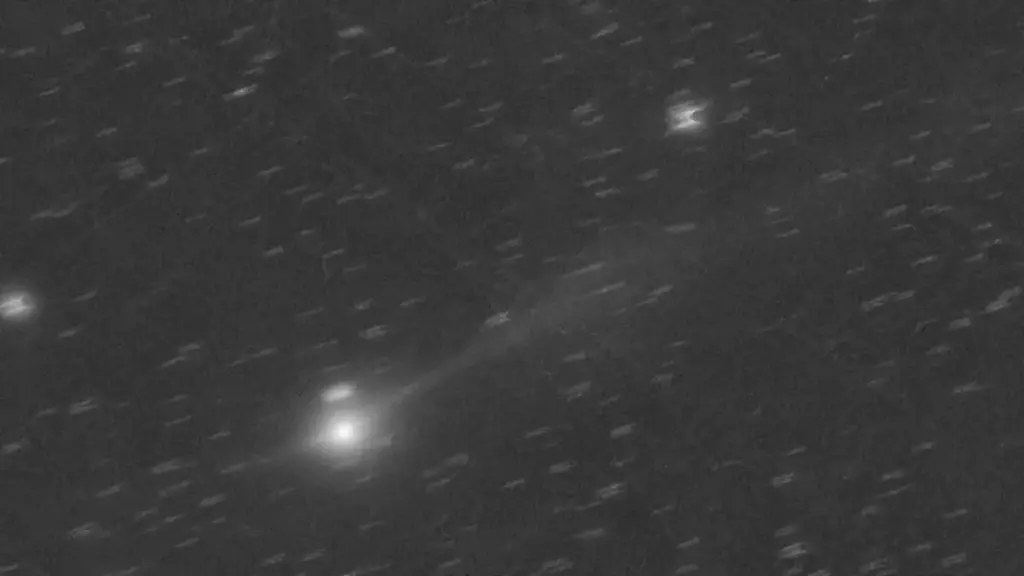
 Comet 3I/ATLAS appears as a bright object near the center of this image, made from combining observations from NASA’s PUNCH mission taken from September 20 to October 3, 2025, when the comet was about 231 million to 235 million miles from Earth. Its tail appears as a short elongation to the right. Stars appear as streaks in the background. Credit: NASA/Southwest Research Institute
Near-Sun vantage points
NASA’s heliophysics spacecraft were used to observe the comet during a period when its trajectory placed it close to the apparent position of the Sun as seen from Earth. STEREO tracked the comet from 11 September to 2 October.
The ESA/NASA SOHO mission imaged it between October 15–26. Data from the PUNCH mission, launched earlier in 2025, captured the developing tail in a sequence acquired from late September to early October, consistent with the PUNCH team’s published observational interval.
These missions provide lines of sight that are inaccessible from ground-based observatories during solar-conjunction periods. NASA notes that this is the first coordinated effort by its heliophysics fleet to purposefully observe an object known to originate in another stellar system.
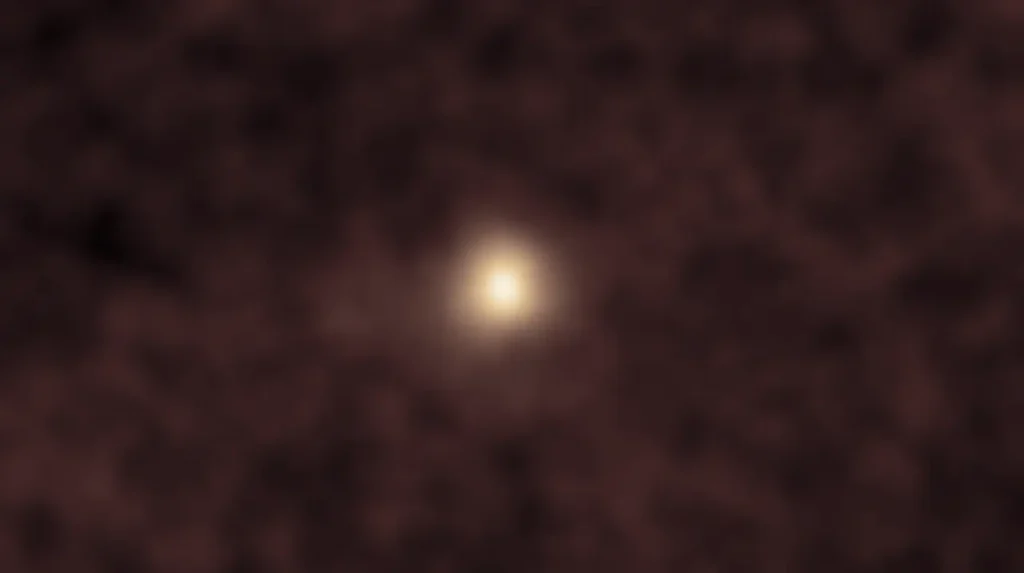 A faint image of comet 3I/ATLAS as observed by ESA/NASA’s SOHO mission between October 15–16, 2025. The comet appears as a slight brightening in the center of the image. Credit: Lowell Observatory/Qicheng Zhang
Observations from deep-space missions
The Psyche spacecraft obtained four sets of images of 3I/ATLAS on September 8–9 from a distance of around 53 million km (33 million miles) while the Lucy spacecraft recorded a series of exposures on September 16 from roughly 386 million km (240 million miles), later stacked to increase signal and resolve the faint coma and tail.
 An ultraviolet image composite of the hydrogen atoms surrounding comet 3I/ATLAS, the third interstellar object ever detected by astronomers, as it passes through our solar system. This image was taken on September 28, 2025 — just days before the comet’s closest approach to Mars — by an instrument on NASA’s MAVEN spacecraft, which has been studying Mars from orbit since 2014. The instrument, the Imaging Ultraviolet Spectrograph, takes pictures in the ultraviolet part of the spectrum to reveal the chemical composition of objects. The image shows hydrogen emitted from different sources: the comet (dim spot on the far left), hydrogen from Mars (bright emission on the right), and hydrogen flowing through our solar system between the planets (dim emission in the middle). MAVEN’s spectrograph distinguished the comet’s hydrogen from the interplanetary and Martian hydrogen using a special mode to separate each source by its speed. Hydrogen emission from the comet is confined to the location of the comet on the sky, which is why it is small and round instead of extended. Credit: NASA/Goddard/LASP/CU Boulder
Additional telescope observations
Hubble obtained imagery of the comet later in July, followed by observations in August from the James Webb Space Telescope and from SPHEREx.
JWST spectroscopy indicates a coma dominated by carbon dioxide, with a CO2/H2O ratio among the highest measured in any observed comet, while SPHEREx coverage contributes constraints on volatile abundances and dust scattering properties.
 Comet 3I/ATLAS on November 19. Credit: The Virtual Telescope Project
Trajectory and outlook
3I/ATLAS remains faint and will not reach naked-eye visibility. Its hyperbolic orbit confirms an origin outside the solar system.
After its closest Earth approach in December, the comet will continue outward, passing the orbit of Jupiter in spring 2026 before returning to interstellar space. Continued monitoring by NASA spacecraft is planned as viewing geometries allow.
Video courtesy: NASA/Eyes on the Solar System