
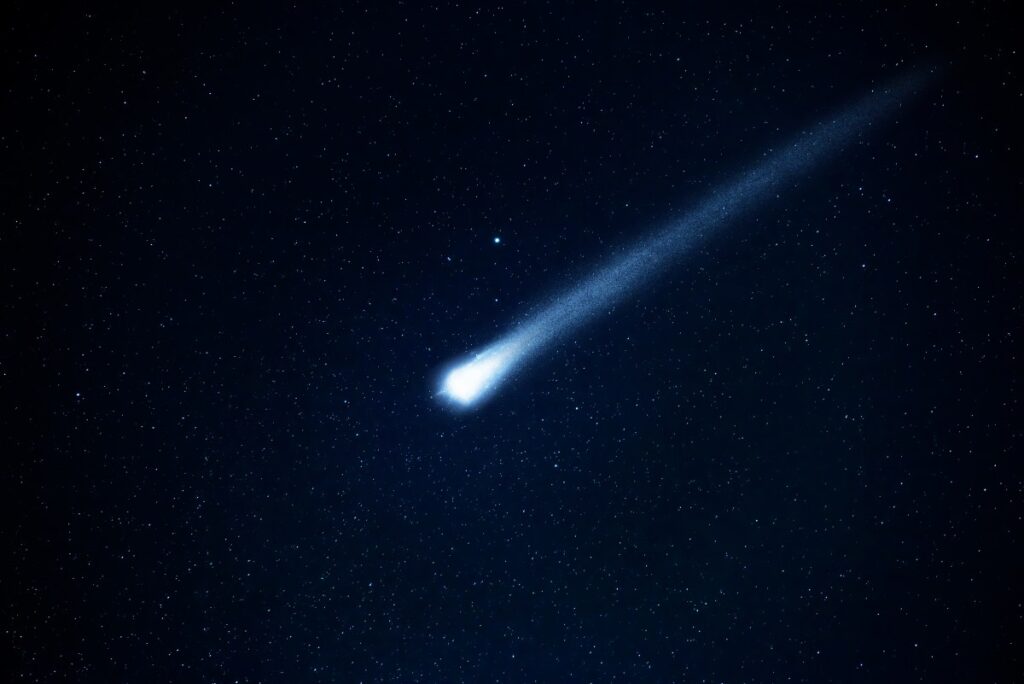
The European Space Agency (ESA) has made an unusual observation of comet 3I/ATLAS in a “test case” for future planetary defense efforts.
Using data collected from a Mars-orbiting satellite, researchers have learned more about the interstellar object’s path through our solar system, improving its predicted location with a 10-fold jump in accuracy.
First discovered on July 1, the comet made its closest approach to the sun on Wednesday October 29, with it expected to become visible from Earth again soon.
The ESA has now utilized observation data from its ExoMars Trace Gas Orbiter (TGO) spacecraft orbiting Mars, marking a leap forward from previous observations of the comet made using Earth-based telescopes.
As well as strengthening trajectory insights, the ESA described this approach to monitoring asteroids and comets near Earth as a “valuable test case for planetary defense, even though 3I/ATLAS does not pose any danger.”
“With no risk for Earth and several weeks available for preparation, it was possible to get all needed parties together in time to plan and schedule the observations without haste or risk to the space missions,” Richard Moissl, head of the Planetary Defence Office at the ESA, told Newsweek.
“There was even enough time to coordinate with NASA, which performed a similar exercise. Having exercised all the communication and interface channels makes us confident that we could perform these activities also for potentially threatening objects, should the need arise.”
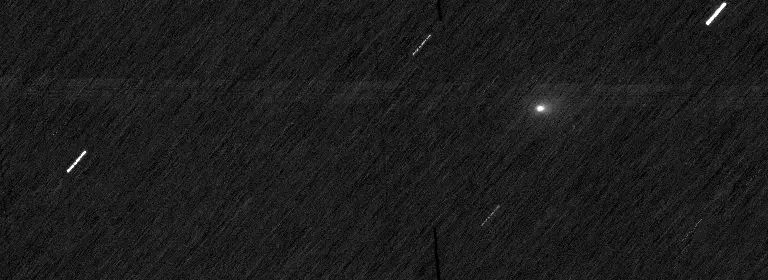
Between October 1 and 7, ESA’s ExoMars TGO focused on the comet from its orbit around Mars, getting far closer than standard telescopes and offering a new viewing angle.
The comet passed relatively close to Mars, approaching to around 29 million km during its closest phase on October 3, according to the ESA. The “triangulation” of its data with data from Earth helped to make the comet’s predicted path “much more accurate.”
“By looking at the comet from a very different point in the solar system and combining them with the measurements taken from Earth, the knowledge about the position at a specific time can be significantly increased. With this data, the future path of the comet can also be determined much more precisely,” Richard Moissl, head of the Planetary Defence Office at the ESA told Newsweek.
“The comet has by now passed through the closest approach with the Sun and is starting to leave the Solar System. It will (indeed) become visible again for ground-based telescopes in December. Even after the closest approach with Earth (still about 1.8 times as far away as the Sun on average from our planet), it will be possible to observe it for several months.
“Eventually, 3I/ATLAS will leave our solar system, without ever returning.”
With the agency calculating orbits to provide warnings if needed, the exercise with 3I/ATLAS shows it can generally be useful to triangulate data from Earth with observations from a second location in space, according to the team.
This is the first time that astrometric measurements from a spacecraft orbiting another planet have been officially submitted and accepted into the Minor Planet Center (MPC) database, according to the space agency.
Moissl said so far the ESA Trace Gas Orbiter (TGO) and the NASA Psyche mission have successfully performed positional measurements of the comet. ESA’s Juice mission also performed one observation and has more measurements scheduled for the coming weeks, but due to low data transmission rates more time will be needed.
“As long as the comet can be observed, there are opportunities to study the evolution of the so-called coma (the envelope of gas, dust and larger pieces lifted off the surface by evaporation). How will the size change over time? What can we learn about the composition of the comet from the spectra (and also how they are changing with time)?” said Moissl.
Do you have a tip on a science story that Newsweek should be covering? Do you have a question about comet 3I/ATLAS? Let us know via science@newsweek.com.