
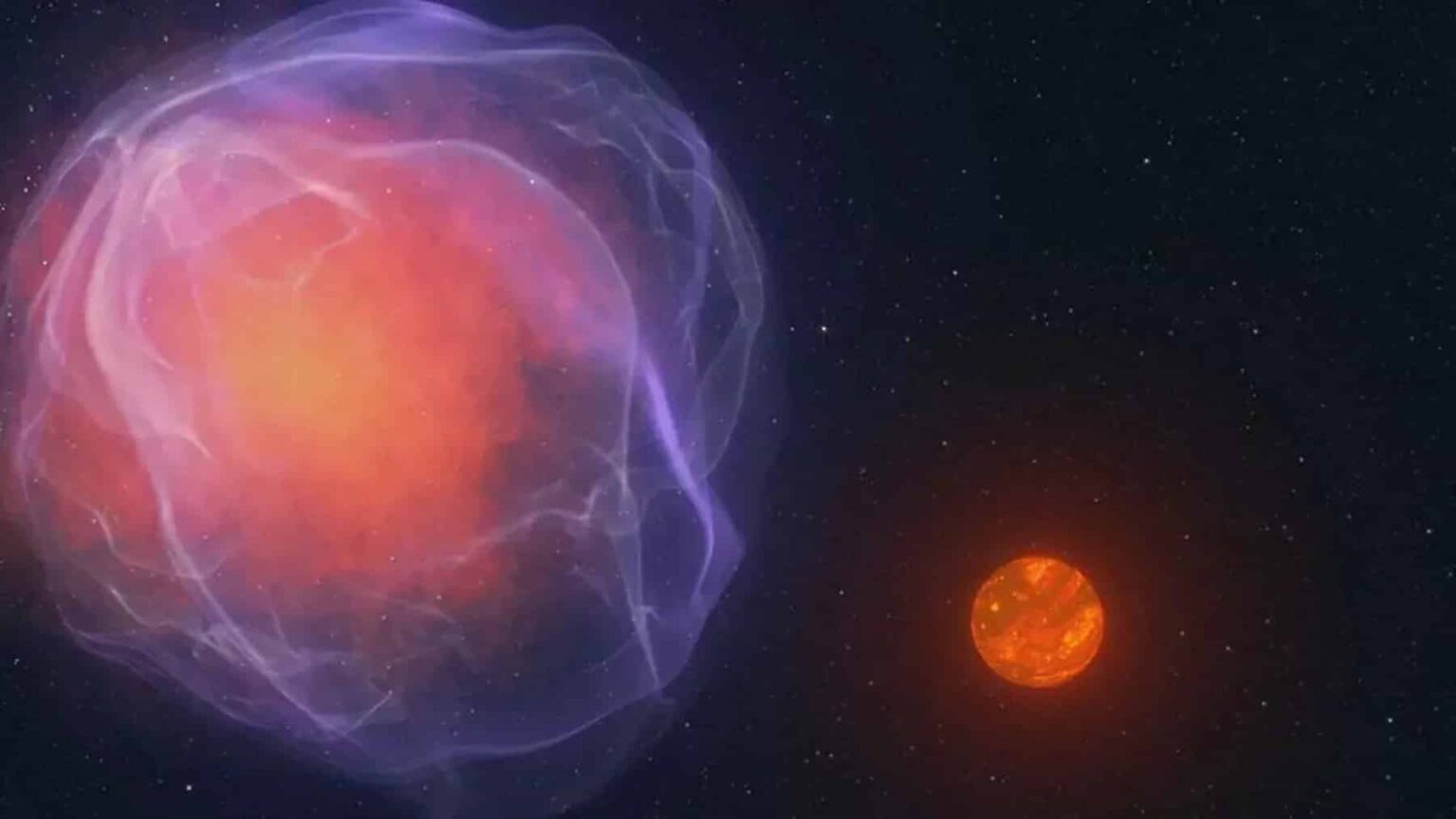
There is nothing more incredible than knowing we exist within a conscious universe. Most times, we are rather oblivious to this fact, but sometimes the universe decides to remind us of it. In this recent discovery, NASA comes across a fast-racing red sphere clue. In this article, we discuss what scientists believe this clue might hint at.
Astronomers discover a fast-moving red object in space
Every year, astronomers find themselves constantly watching the night sky for clues. Now, although stargazing is a fascinating hobby, this isn’t what astronomers do entirely. They usually survey the sky for events and anomalies that provide a clearer understanding of the universe. And they do this with the aid of tools like an advanced telescope and supercomputers.
With that said, astronomers have made an exciting discovery across the universe. According to researchers, the event of this discovery felt like watching Piastri or Max Verstappen speeding across Monza or Silverstone. It was with this same feeling that scientists happened to catch a fast-moving object pacing across space.
This discovery began when a group of NASA citizen scientists came across a tiny red sphere from the WISE telescope. Initially, this dot appeared faint and was observed to move incredibly fast. This excited curiosity forced this group of scientists to scan the infrared image and uncover the image as the cosmic substellar CWISE J1249.
NASA gives an overview of the tiny red sphere
The group of astronomers who came across this image was led by Martin Kabatnik. He and his team observed this tiny red sphere moving swiftly across the night sky. When he initially came across the object, he was torn apart with the uncertainty of whether this was a star or a planet. This motivated them to carry out follow-up observations.
The CWISE J1249 was discovered to dash out of the Milky Way at about 1 million miles per hour. At this speed, it would take us just 15 minutes to land on the moon; that is how fast it was. However, what stood out for Kabatnik and his team was the fact that CWISE J1249 appeared to have an unusually low mass.
This made it more difficult to categorize the fast-moving CWISE J1249 million mph object. Although the scientists analyzed the red sphere at the W. M. Keck Observatory. There, they discovered it to have much fewer metals than are normally found in any existing star body, like this mysterious object near a young star.
Scientific explanation of the CWISE J1249 Million-mph objects’ speed
Among the group of citizen scientists, a few theories have been preferred over others. One theory explains that CWISE J1249 originates from the supernova event of a white dwarf. Due to the violent gravitational push, the red sphere may have also lost most of its material. Others are failed star bodies or random cosmic runaways.
The million-dollar question: Where is the red sphere going?
Up until this point, scientists have only attempted to classify this dashing red sphere. So far, they’ve identified it as a rogue planet, frozen and isolated in dark space. But where is CWISE J1249 heading? That is the question plaguing these citizen-scientists from NASA.
To competently answer that question, the former must be answered. Where in the universe did CWISE J1249 originate from? Several attempts have been made, like tracing its traveling trajectory.
In conclusion, if CWISE J1249 gets confirmed as an isolated star piece drifting through space, it will lead to fresh new insights. Following all the assumed theories, scientists can then begin to scan for in situ elements and their parent sources. When this is all said and done, scientists have decided to search for other runaway objects like the CWISE J1249, just like this frozen but glowing young star discovery.