
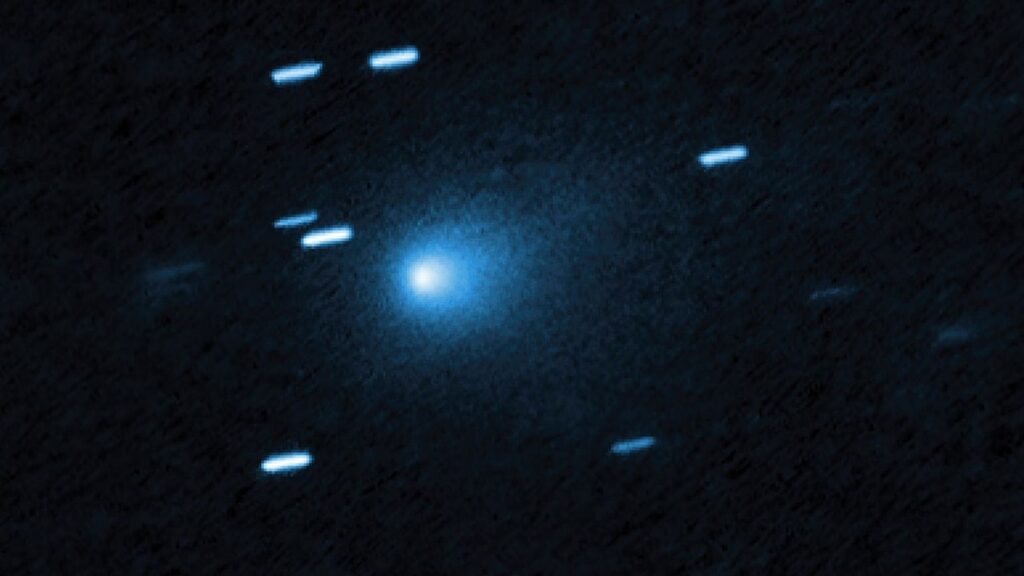
At one point, its tail was pointing in a strange direction. Why?
A comet’s tail forms as the sun heats up and vaporizes its ice, blasting off bits of trapped dust into space. Sunlight can gently nudge these tiny dust particles back out behind the comet, which is why a dust tail is normally seen pointing away from the sun. But recently, 3I/ATLAS had an anti-tail, one pointing toward the sun.
Anti-tails are rare, but not inexplicable. Sometimes, the debris being thrown off a sunward comet is too heavy to be pushed back by that solar radiation pressure, and it tumbles toward the sun instead. (That a comet’s tail can change direction is not, as some have implied, evidence of a spacecraft’s thrusters.)
Were there any unusual changes to the object as it passed behind the Sun?
During 3I/ATLAS’s closest approach to the sun, it was obscured from sight from our viewing angle on Earth. While some have wondered if this meant that it was an alien spacecraft attempting to hide itself from astronomers, it’s also worth pointing out that you could see the object before this happened, just as we can now see it after it’s re-emerged. And it’s very unlikely aliens are playing peekaboo with humanity.
Astronomers are keen to see how the comet’s close shave with our local star has altered it. Just before its closest approach, the comet got brighter. That in itself isn’t strange, as being exposed to more sunlight would vaporize more of its icy matter. Then, after it popped out from behind the Sun, astronomers caught sight of multiple jets of matter coming out of 3I/ATLAS. They’re very cool—but they’re still just pockets of ice (in this case, perhaps carbon monoxide) being vaporized in dramatic little outbursts.
Have scientists checked to see if 3I/ATLAS is giving off any radio signals?
All sorts of celestial objects emit radio signals, from black holes and convulsing stars to planetary auroras. These radio waves travel across a wide range of frequencies, firmly marking them as natural. Artificial transmissions—like your car’s radio—would appear as a coherent cluster of radio waves on a very narrow frequency range.