
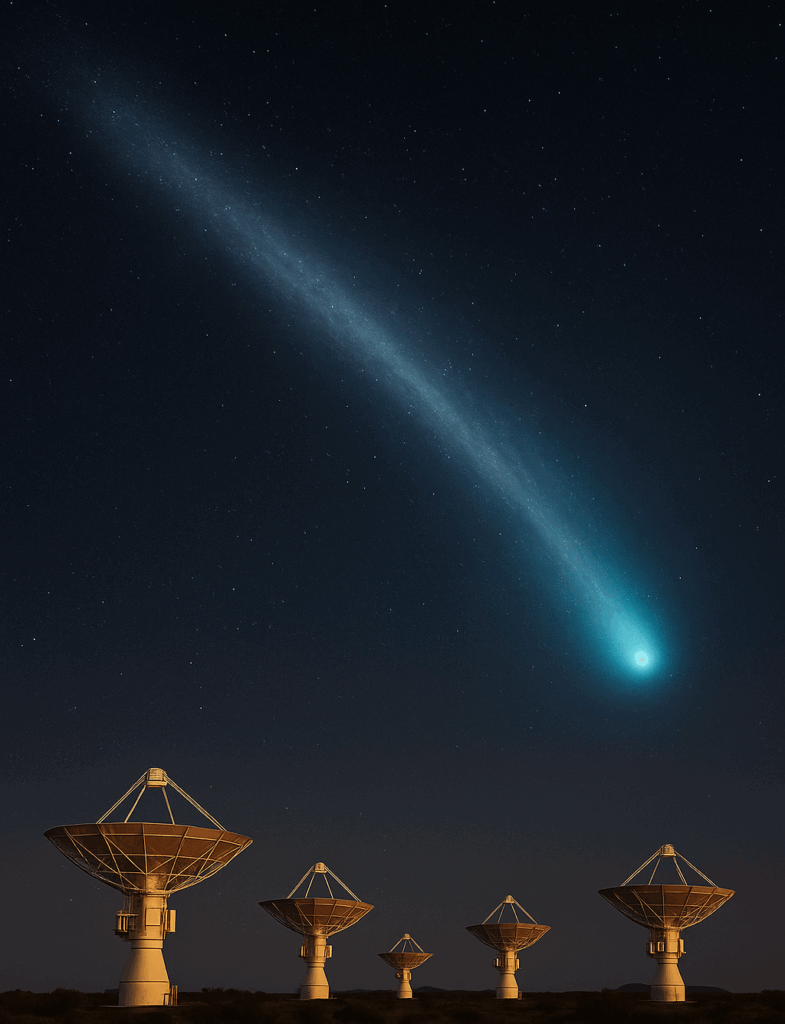
Hopes of an extraterrestrial artifact have been dealt a severe blow in recent days. The interstellar comet 3I/ATLAS, which was recently traded on social networks and podcasts as a potential technological object, shows clear signs of a natural origin. New data from South Africa’s MeerKAT radio telescope has picked up a clear signal that tells an intriguing, but by no means alien, story – that of an ordinary, albeit from alien stellar regions, comet.
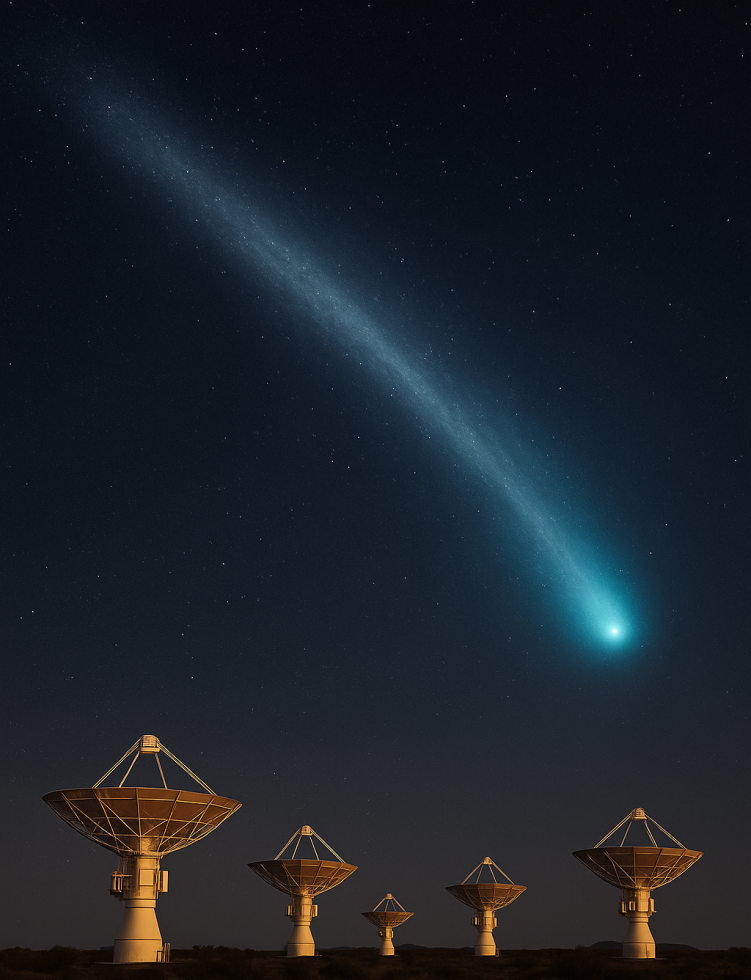
MeerKAT, which consists of 64 parabolic antennas, each with a diameter of 13.5 meters, registered so-called OH absorption lines at 1665 and 1667 megahertz. This signature occurs when hydroxyl molecules (OH), a decay product of water vapor, absorb radio waves. Such phenomena are well documented and typical for cometary environments. What is special: This is the first such radio measurement of an interstellar comet – and it speaks a clear language. The interpretation is sobering for all those who had hoped for extraterrestrial technology: The signal received is not an artefact of artificial intelligence or alien civilization, but the result of classical physics and chemistry. As soon as a comet like 3I/ATLAS approaches the sun, the ice bound in its core begins to sublimate – i.e. to change directly from a solid to a gaseous state. This creates extensive coma structures of gas and dust, which not only reflect light but also modulate radio waves. In this case, hydroxyl radicals absorbed the radio radiation at exactly the expected frequencies.
The fact that the signal appears as an absorption line is related to the geometry of the solar radiation. The comet is approaching the inner solar system, its gas clouds are condensing, creating a kind of natural filter for radio waves. These absorption processes not only provide information on the chemical composition, but also allow conclusions to be drawn about the activity and thermal behavior of the object. The much-discussed “unusual acceleration”, which already caused confusion with 3I/ATLAS, can now simply be interpreted as the result of asymmetric outgassing – a well-known phenomenon with active comets.
Nevertheless, there are still those who favor a more exotic interpretation. Harvard astrophysicist Avi Loeb – known for his controversial theories on extraterrestrial technology in connection with 1I/ʻOumuamua – is impressed by the MeerKAT data, but maintains that these observations do not necessarily rule out all alternative hypotheses. Loeb refers to upcoming investigations by the Juno space probe, which will approach the comet on its passage close to Jupiter in 2026. There is a reason for this scientific stubbornness, which is not entirely uncontroversial, even in the face of growing data: interstellar objects are still largely unknown territory. Their composition, their behavior in the gravitational field of the sun and their systems of origin give rise to speculation. However, the data that has now been obtained speaks for itself – and suggests that 3I/ATLAS is not a messenger from an alien civilization, but a dusty remnant of early cosmic history.
What remains is a scientific gain. The OH signal provides a window into the chemistry of the early universe, into matter that does not originate from our solar system. It shows that even banal molecules such as hydroxyl radicals can turn out to be the key to big questions – if only they are read correctly.
On December 19, 3I/ATLAS will make its closest approach to Earth. Until then, further observations and data analysis remain on the agenda. The public euphoria surrounding a potential “message from space” may have died down – but the scientific significance of this interstellar visitor remains undisputed. Perhaps not as a messenger from intelligent aliens, but as a silent witness to what awaits us among the stars.
Source: Wired
