
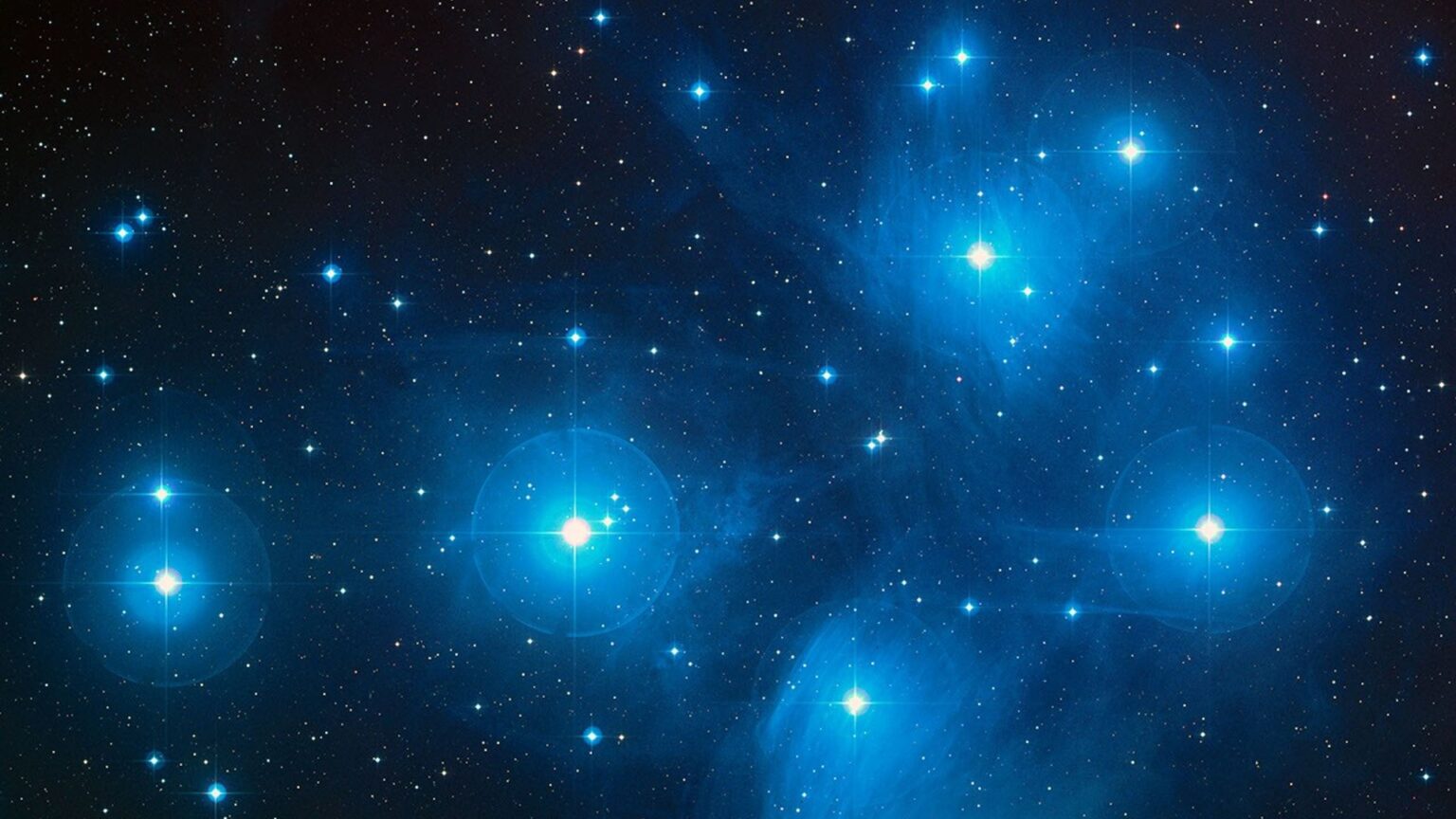
A team of astronomers has found that a famous star cluster is only the tip of the iceberg.
The Pleiades star cluster, also known as the “Seven Sisters,” is often visible over the winter. Named after the seven daughters of the Titan god Atlas and the ocean nymph Pleione, the star cluster is visible above Orion’s belt.
Now, the team from the University of North Carolina at Chapel Hill has discovered that the Seven Sisters have many more siblings than previously thought. In fact, scientists have discovered that the Pleiades star cluster is approximately 20 times larger than previously observed.
Searching for long-lost siblings
The team of astronomers set out to find long-lost siblings of the “Seven Sisters.” Stars are typically born in groups. Over time, though, they drift apart, making it difficult for astronomers to track their origins.
To find these stars that had drifted far from the Pleiades star cluster, the UNC-Chapel Hill team used stellar spin rates as a “cosmic clock.” Over billions of years, a star’s magnetic field slows it down, making it rotate more slowly.
The team combined data from NASA’s Transiting Exoplanet Survey Satellite (TESS) and the European Space Agency’s Gaia space telescope. By doing so, they uncovered thousands of hidden stars that form part of a vast, dissipating network. The Pleiades star cluster is located in the constellation Taurus. The stars are about 410 light-years from Earth.
“This study changes how we see the Pleiades—not just seven bright stars, but thousands of long-lost siblings scattered across the whole sky,” Andrew Boyle, lead author and graduate student in physics and astronomy at UNC-Chapel Hill, explained in a press statement.
Uncovering hidden cosmic relationships
Star clusters such as the Pleiades have had a far-reaching impact on human culture. The “Seven Sisters” are featured in Greek Mythology, the Old Testament, and they are celebrated as Matariki in New Zealand. And yet, the discovery highlights the limits of human perception, as their cultural relevance is based on the observations possible before modern telescopes.
“We’re realizing that many stars near the Sun are part of massive extended stellar families with complex structures,” said Andrew Mann, co-author and professor of physics and astronomy at UNC-Chapel Hill. “Our work provides a new way to uncover these hidden relationships.”
The team expects that many other star clusters are also, in fact, part of enormous, sprawling stellar families. In the long term, they believe their research could help uncover whether the Sun itself was once part of a much larger stellar network.
“By measuring how stars spin, we can identify stellar groups too scattered to detect with traditional methods—opening a new window into the hidden architecture of our Galaxy,” Boyle explained.