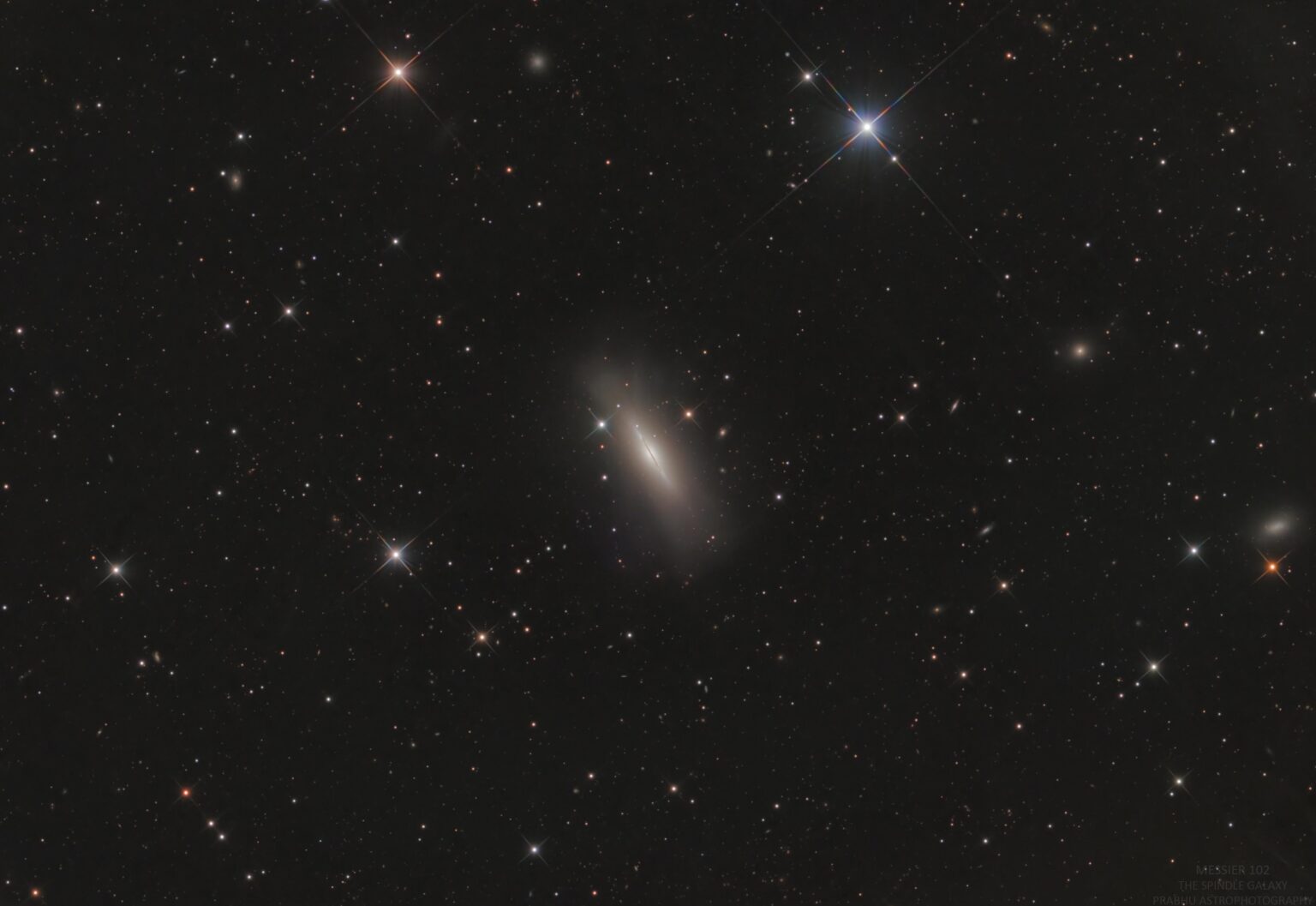
Messier 102, commonly identified as the Spindle Galaxy (NGC 5866), is a lenticular galaxy located in the northern constellation Draco. Its identity was historically debated. Pierre Méchain discovered it in 1781, but later suggested it might have been a duplicate observation of Messier 101. However, modern consensus associates M102 with NGC 5866. This edge-on galaxy lies approximately 44 to 50 million light-years from Earth and spans about 60,000 light-years in diameter, with an apparent magnitude of 10.7. Its edge-on orientation reveals a bright central bulge, a thin stellar disk, and a prominent, slightly warped dust lane that suggests past gravitational interactions. The galaxy contains older stars typical of lenticular types, with minimal ongoing star formation, and is surrounded by a faint halo visible in deep exposures. As the largest member of a small galaxy group, it offers insights into environmental effects on galactic structure and serves as a textbook example of lenticular form.
Processing details: Processing details: Stacking – Gradient correction, Noise X and Blur X on LRGB images – Chanel combination RGB – Saturation with Curves T – Combined L with RGB and SCNR, again Noise X and Blur X on final output.


1 Comment
Messier 102 (The Spindle Galaxy)
Messier 102, commonly identified as the Spindle Galaxy (NGC 5866), is a lenticular galaxy located in the northern constellation Draco. Its identity was historically debated. Pierre Méchain discovered it in 1781, but later suggested it might have been a duplicate observation of Messier 101. However, modern consensus associates M102 with NGC 5866. This edge-on galaxy lies approximately 44 to 50 million light-years from Earth and spans about 60,000 light-years in diameter, with an apparent magnitude of 10.7. Its edge-on orientation reveals a bright central bulge, a thin stellar disk, and a prominent, slightly warped dust lane that suggests past gravitational interactions. The galaxy contains older stars typical of lenticular types, with minimal ongoing star formation, and is surrounded by a faint halo visible in deep exposures. As the largest member of a small galaxy group, it offers insights into environmental effects on galactic structure and serves as a textbook example of lenticular form.
Astrobin link: [https://app.astrobin.com/i/2xbryb](https://app.astrobin.com/i/2xbryb)
Acquisition details:
Dates: 13 Nights of Imaging in May2025
Total integration: 31h 21m
Integration per filter:
– Lum/Clear: 16h 36m ( 157×180”)
– RGB: 3h each (60 × 180”) each
Darks: 40 | Dark Flats & Flats : 30
Equipment:
– Telescope: GSO 12″ f/8 Ritchey-Chretien Truss Tube
– Camera: ZWO ASI294MM Pro
– Mount: iOptron CEM70G
– Filters: Antlia Blue 36 mm, Antlia Green 36 mm, Antlia Luminance 36 mm, Antlia Red 36 mm
– Accessories: Player One FHD-OAG MINI, Player One Phoenix Wheel 7x36mm, TS-Optics 2″ CCD Reducer 0.67x for RC & flatfield telescopes ab F/8 (CCD47)
– Software: Adobe Photoshop, Pleiades Astrophoto PixInsight
Processing details: Processing details: Stacking – Gradient correction, Noise X and Blur X on LRGB images – Chanel combination RGB – Saturation with Curves T – Combined L with RGB and SCNR, again Noise X and Blur X on final output.
Bortle Dark-Sky Scale: 3.00
Location: Emirates Astronomical Observatory
PrabhuAstrophotography
[https://www.instagram.com/prabhuskutti/](https://www.instagram.com/prabhuskutti/)