
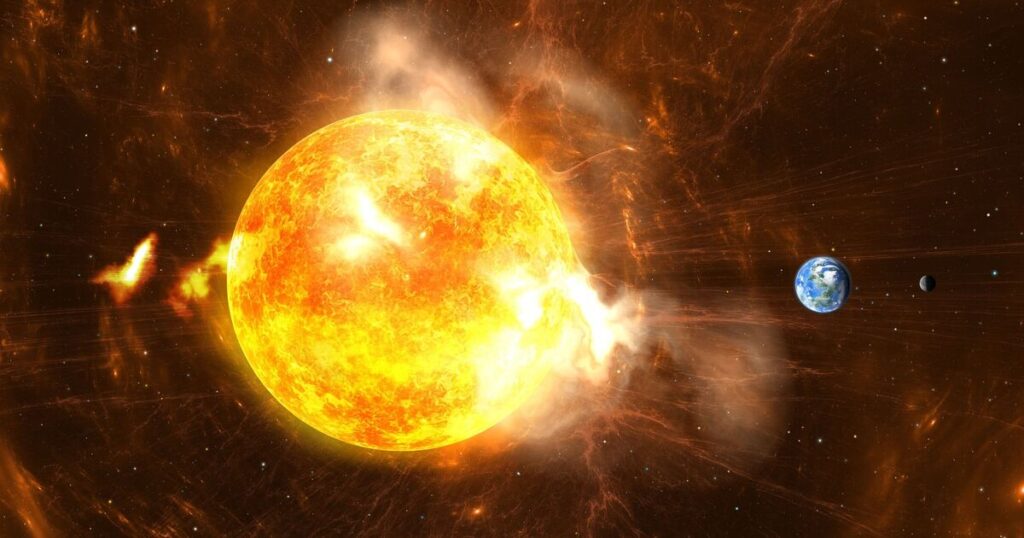
An ongoing severe solar storm has led to a “grid emergency” in New Zealand, and the Space Weather Prediction Centre, National Oceanic and Atmospheric Administration, has warned that the storm’s severity will increase.
The owner and operator of New Zealand’s National Grid, Transpower, has stated that it issued the emergency notice on Wednesday afternoon (November 12) after a “severe (G4) geomagnetic storm” impacted the South Island’s transmission lines. The move is designed to prevent damage to critical equipment should the solar storm intensify. This comes as it was warned on Tuesday that the Earth is set to be hit by a powerful surge of charged solar particles on Wednesday, with officials labelling the impending geomagnetic storm as the second-highest classification, G4, which is capable of causing widespread technological impacts.
The US Space Weather Prediction Center (SWPC) said some electrical grid systems may be temporarily shut down, spacecraft could experience increased drag or surface charging and high-frequency radio signals may be patchy or suffer blackouts for hours.
Mobile phone networks could also be affected, as solar activity can interfere with satellite signals, disrupt GPS timing or cause brief power outages at cell towers.
The strongest effects are expected at high latitudes, including much of Canada, Alaska, northern Europe, Scandinavia and parts of Russia. However, it could also reach regions in the northern US and central Europe.
New Zealand’s Transpower said: “Space weather is when the sun ejects plasma and other matter in Earth’s direction. These coronal mass ejections [CME] are rare, and most people won’t notice because our planet’s magnetic field shields us from the particles.
“However, these CMEs can cause geomagnetic storms on Earth and these storms can send unwanted currents through the long electricity circuits that we manage,” it added.
The last geomagnetic storm occurred on April 15, 2025 after two CMEs left the Sun two days earlier, also causing a severe G4 Storm with auroras sighted as far south as France.