
You may not have noticed, but the universe has an odd habit of humbling us without us realizing it. This scenario can be seen perfectly if you look up at the sky at night. Most of the objects we admire include failed stars that could not achieve what they were meant to be. And in this article, we will discuss one in particular that has piqued the interest of scientists.
Celestial object challenges the beliefs of scientists
Over the past decades, astronomers and scientists have believed they understand the fabric underlying the universe. They believe all of space worked on interplanetary mathematical principles; stars were supposed to ignite, planets orbit, and giant objects to remain stationary in the background.
However, every once in a while, a celestial object takes the liberty of being the odd one out. An oddity in the face of perfection. This was the case in a discovery that has left scientists confused. As you would see, the object does not behave like a star, nor a planet, nor anything scientists have seen before. This has made scientists wonder what belongs between these objects.
In addition, whenever scientists discover something new in space, the first unique property is its brightness. That wasn’t the case with this object. When observed through the telescope, this object was seen to have formed in a strange environment and had an exaggerated size. This discovery left astronomers genuinely confused.
NASA unmasks the mystery object: A potential failed star
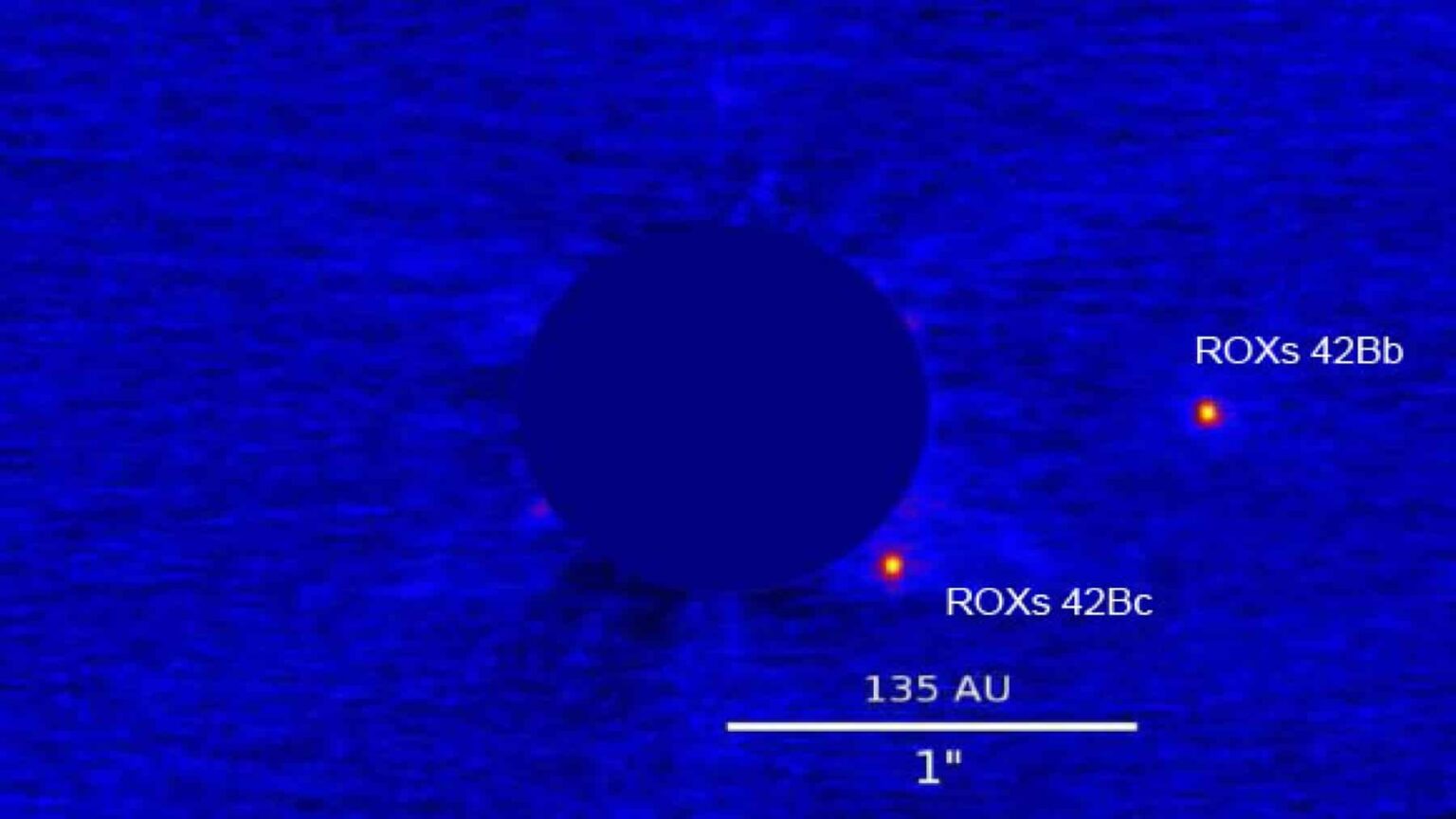
The object of this discovery is the ROXS 42B b. After NASA received telescopic images, they carried out a series of analyses until they finally uncovered the object as a substellar object. These are celestial objects that begin their life as a star, but never have enough energy in their core to trigger nuclear fusion.
Whenever stars fail like these, they become known as brown dwarfs. However, unlike most dwarfs, ROXS 42B b did not grow in isolation. Scientists reported it to have grown in proximity to its parent star. Upon all of these, ROXS 42B b was seen to be 28 times the size of Earth, and 9 times the size of Jupiter, just like this rare cosmic event, stunning scientists.
In addition, while scientists were still unsure of this object, they observed that it emitted a collapse of gases. Typically, a planet would emit small clumps of dust and rock on its surface. This forced NASA to carry out analysis until it found its chemical history and formation processes. The results of these showed the object to be a potential star that failed to ignite.
The silent start that refuses to shine
The entirety of this discovery has been one hell of an event. The object that has all the ingredients and potential to shine like any other star within our universe. Yet, it failed to do so. Even though it is easy to draw sentimental conclusions. It is important to realize something bigger. That the cosmos itself could alter the process of an upcoming star.
Why this failed star changes our understanding of the universe
There are many reasons why this discovery changes our knowledge of the universe. For one, if we discovered ROXS 42B b, there could be a thousand other sub-stellars like it. This suggests to scientists that the universe may be more chaotic than previously predicted.
However, experts have pointed out that this discovery expands and introduces scientists to fresh new questions. How many of these failed stars are there? Do they have moons revolving in their orbits? Most importantly, what factors had influenced the star away from his predestination? According to astronomers, the success of this research would help scientists understand the universe more clearly than before, just like this groundbreaking frozen young star discovery.