
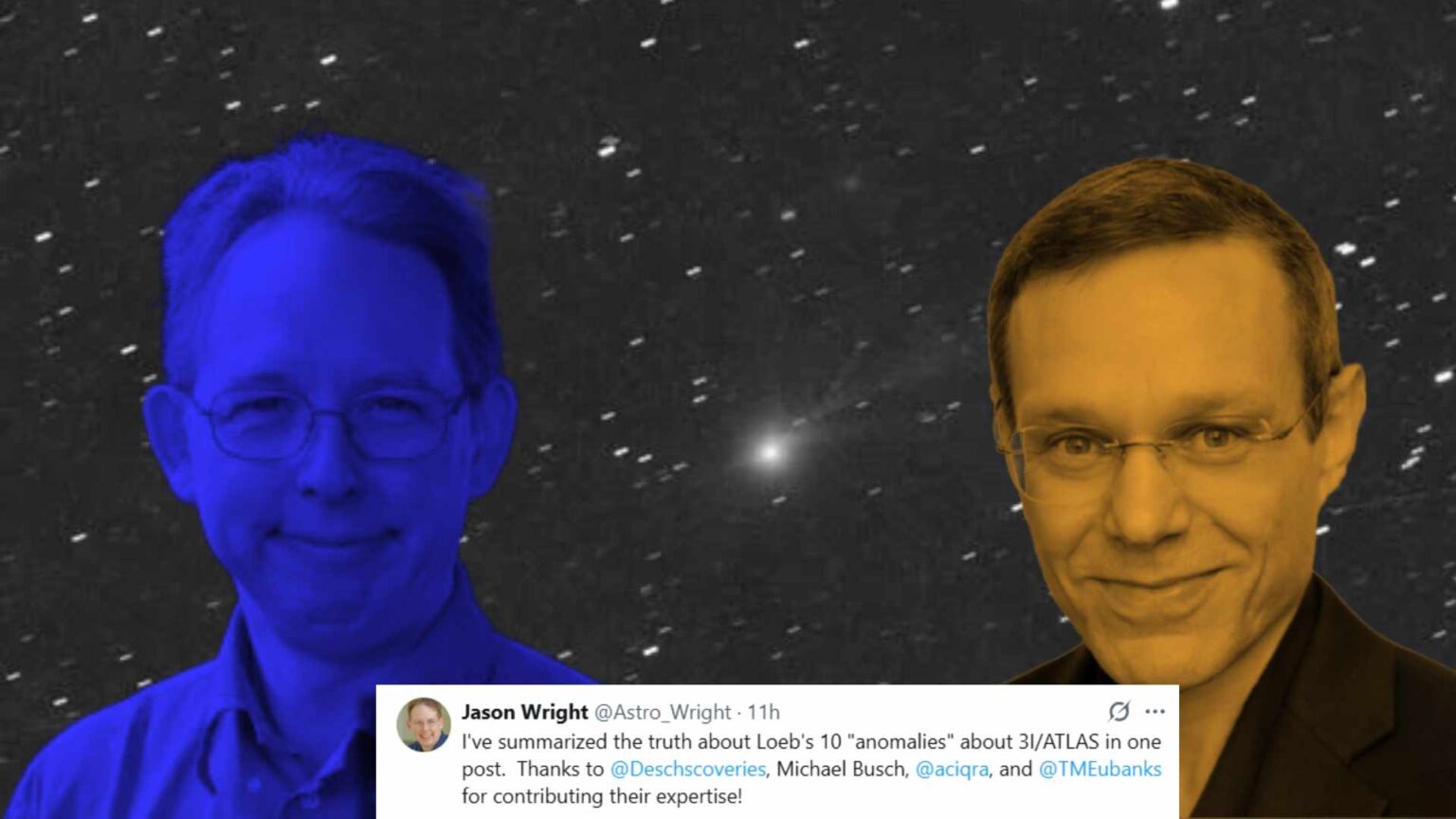
Professor of Astronomy and Astrophysics at Penn State University and a member of its Center for Exoplanets and Habitable Worlds, Jason Thomas Wright is also a project scientist for NEID, a NASA project, and a principal investigator of NExSS (NASA’s Nexus for Exoplanet System Science). A winner of SETI’s 2019 Drake Award, Prof. Wright took to his blog and dispelled the 10 anomalies documented by Harvard astrophysicist Prof. Avi Loeb regarding 3I/ATLAS. Prof. Loeb speculated through his meticulous study that at least 10 anomalous behaviors depicted in the interstellar object’s behavior indicate there might be something else going on here—probably an extraterrestrial intelligence driving a probe? Below produced verbatim from the scientist’s blog.
1. Its retrograde trajectory is aligned to within 5 degrees with the ecliptic plane of the planets around the Sun, with a likelihood of 0.2% (see here).
To paraphrase Einstein, his math is fine, but his statistics are atrocious. The best takedowns of this argument I know are by Hector Socas-Navarro. Basically, if someone had predicted ahead of time what the properties of a spacecraft would be like and it matched them then they’d be on to something. But Loeb chose specific aspects of the comet’s orbit to compute probabilities for after he knew what they were. That’s a classic fallacy and misuse of probability theory.
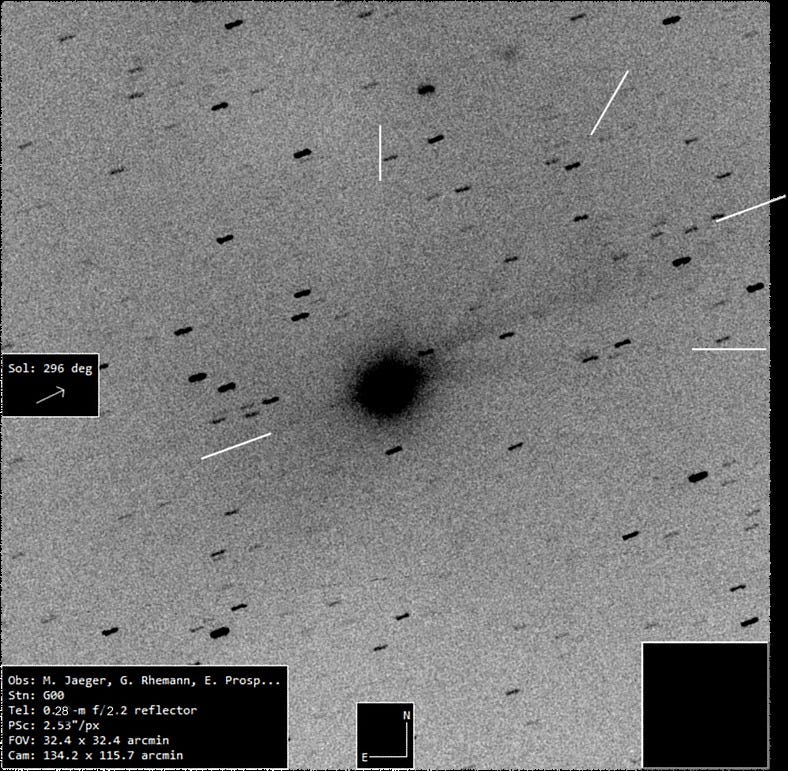
2. During July and August 2025, it displayed a sunward jet (anti-tail) that is not an optical illusion from geometric perspective, unlike familiar comets (see here).
It’s true that not many comets do this but it’s hardly unique. He also falsely claims he’s the first to explain why this might happen naturally, when in fact this has been understood for 50 years.
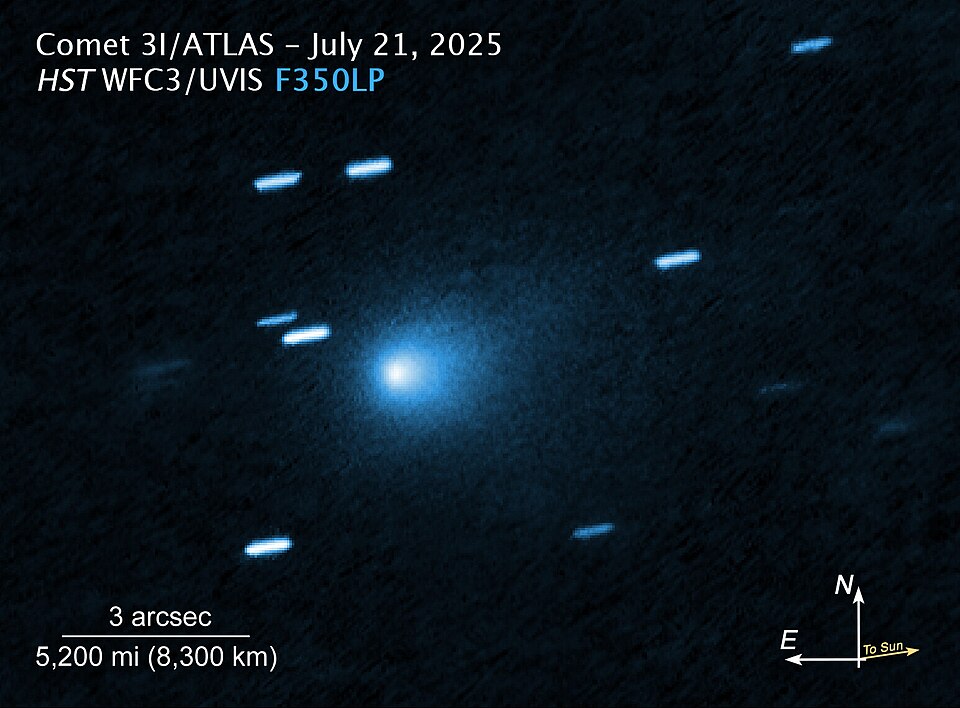
3. Its nucleus is about a million times more massive than 1I/`Oumuamua and a thousand times more massive than 2I/Borisov, while moving faster than both, altogether with a likelihood of less than 0.1% (see here and here).
This is simply incorrect. His assertion here is based on an erroneous calculation that the measurement of 3I/ATLAS’s nongravitational acceleration before perhelion could be measured to a precision of 10-10 AU/day2, when the actual precision is more like 10-7 AU/day2 (a thousand times larger).
This is especially frustrating because he regularly now cites papers quoting the correct number without critique, not acknowledging it contradicts his other claims. (In other words, his anomaly #10 below comes from data whose precision contradicts his calculation in anomaly #3—he can’t have it both ways!)
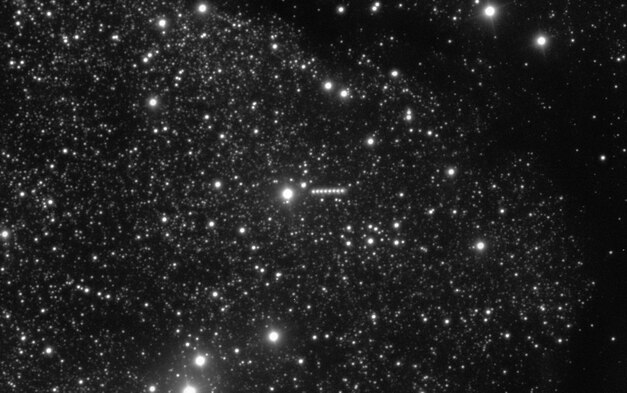
4. Its arrival time was fine-tuned to bring it within tens of millions of kilometers from Mars, Venus and Jupiter and be unobservable from Earth at perihelion, with a likelihood of 0.005% (see here).
Claiming the arrival was “fine tuned” is classic question begging. This is the same bad statistics from “anomaly” number 1, and Steve Desch has pointed out there is hardly anything surprising about a comet in the ecliptic passing by some of the planets. Loeb also calls it anomalous that it gets “close” (not that close really) to some planets, but also anomalous that it is not that close to others. Close, not close, both anomalous! With logic like this, every comet could be said to be anomalous.
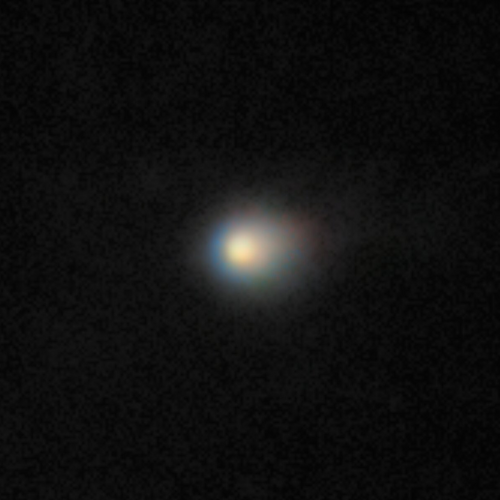
See Also: 3I/Atlas An Alien Craft? Prof Michio Kaku Says Interstellar Object May Be Extraterritorial Visitors
5. Its gas plume contains much more nickel than iron (as found in industrially-produced nickel alloys) and a nickel to cyanide ratio that is orders of magnitude larger than that of all known comets, including 2I/Borisov, with a likelihood below 1%.
This is a genuine anomaly in the sense that it’s an extreme value! But it’s also something very consistent with what we know about comets. There’s no “standard” Fe/Ni ratio or nickel to cyanide ratio in comets, they vary by a lot. We are seeing nickel in 3I/ATLAS at a much larger distance from the sun than we normally look for it, and some pretty standard chemistry can explain why it will have a large anomaly out there. We expect it to come more in line with Solar System comets as it heats up.
So this is hardly so weird that planetary scientists are baffled. There’s interesting chemistry going on here but nothing suggesting the thing is nickel plated.
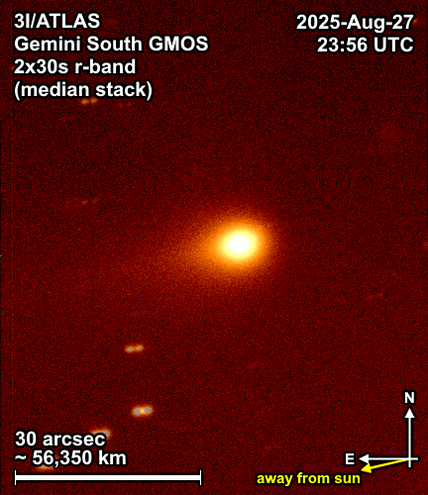
6. Its gas plume contains only 4% water by mass, a primary constituent of familiar comets (see here).
Yup! That’s weird. Not unheard of for comets though. 3I/ATLAS is outgassing all of the normal comet things to outgas (H2O, CO2, CO) just in a different ratio than we typically see, though not outside the boundaries of all comets. The fact that it’s outgassing these things at all strongly says “it’s a comet”.
Some comets are weird, and we expect this one to be weird.
7. It shows extreme negative polarization, unprecedented for all known comets, including 2I/Borisov, with a likelihood below 1% (see here).
Yup! That’s weird. It’s normal for comets and asteroids to show negative polarizaion, but it’s a bit stronger than we’ve ever seen before. Again, this is a very “comet” thing for 3I/ATLAS to do, it’s just more extreme than we’ve seen.
I don’t know why the grime evaporating off of an alien spaceship would be expected to have extreme negative polarization, though, so while it’s certainly an anomaly it’s not evidence for a spaceship!
8. It arrived from a direction coincident with the radio “Wow! Signal” to within 9 degrees, with a likelihood of 0.6% (see here).
This is ridiculous. 9 degrees from the Wow! Signal is a long way away! In other words it very definitely did not come from the direction of the Wow! Signal.
Also, for what it’s worth, it’s not as if we know aliens are out there in the direction of the Wow! Signal. The Wow! Signal failed the sky localization test when it was discovered, and I think most SETI practitioners believe it was some sort of instrumental glitch.
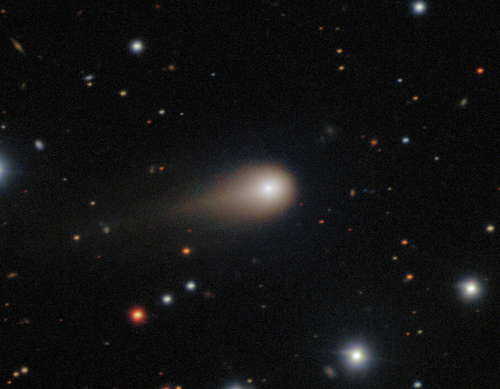
9. Near perihelion, it brightened faster than any known comet and was bluer than the Sun (see here).
Yup! This is an interesting anomaly. It did brighten very quickly for a comet. But, again: we expect it to brighten unusually because it’s coming in unusually fast (although this calculation tries to correct for that fact). Also: there’s no reason to think a spaceship would brighten quickly!
Also “bluer than the sun” is a weird way to express an anomaly. The light it’s reflecting depends on the composition of its gaseous coma. In this sense, lots of comets are “bluer than the Sun.” That’s not really anomalous.
10. It exhibits non-gravitational acceleration which requires massive evaporation of at least 13% of its mass (as calculated here), but preliminary post-perihelion images do not show evidence for it so far.
This is the one that will generate the most discussion among planetary scientists. The idea is that if it moves due to forces other than gravity by a lot compared to what we expect from comet outgassing, this could implicate thrusters, or if it moves too little (Loeb’s earlier argument), this would implicate a very high mass (too high to be from a population of interstellar objects moving around randomly, indicating it was directed here).
First of all, the non-grav acceleration of 3I/ATLAS is not well measured because the uncertainties probably don’t properly account for the fact that it’s hard to tell a precise position for a fuzzy comet. Lots of planetary scientists are skeptical of the statistical significance of the detection Avi’s hanging his hat on here. The true NGA is probably much smaller than this.
But even if it is correctly measured and his math here is correct (which is dubious, but I don’t have time for that here): losing 13% of its mass is hardly weird! It’s just would you would expect, in fact. Comets are made of ice, and lots of that ice will get lost when it comes near the sun!
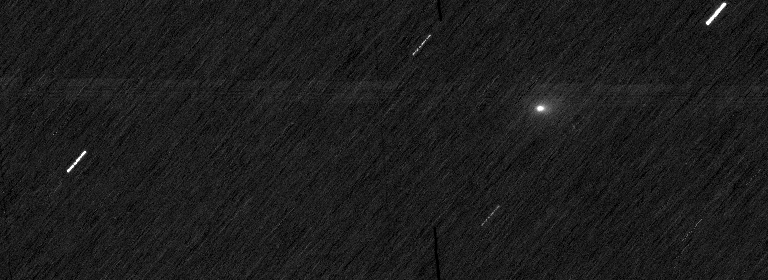
Prof Wright further summarizes
So of Loeb’s 10 anomalies, only 3 really have planetary scientists interested: the high nickel abundance, the extreme polarization, and the strange water abundance. All of these are the sorts of anomalies one expects from a new kind of comet. They weren’t exactly predicted ahead of time as far as I know, but neither did Avi predict (or even “post-dict”!) that there was some reason that an alien spacecraft would show them.
None of them are evidence it’s a spacecraft! There’s no reason spacecraft would do these things. There are lots of reasons comets from another solar system would.
I’ve summarized the truth about Loeb’s 10 “anomalies” about 3I/ATLAS in one post. Thanks to @Deschscoveries, Michael Busch, @aciqra, and @TMEubanks for contributing their expertise!https://t.co/psonqLVhd0
— Jason Wright (@Astro_Wright) November 10, 2025
?s=20
Images: Wiki
See Also: Avi Loeb Speculates 3I/ATLAS Could Be A Probe By Aliens Monitoring Us: ‘Maybe They’re Unhappy’