
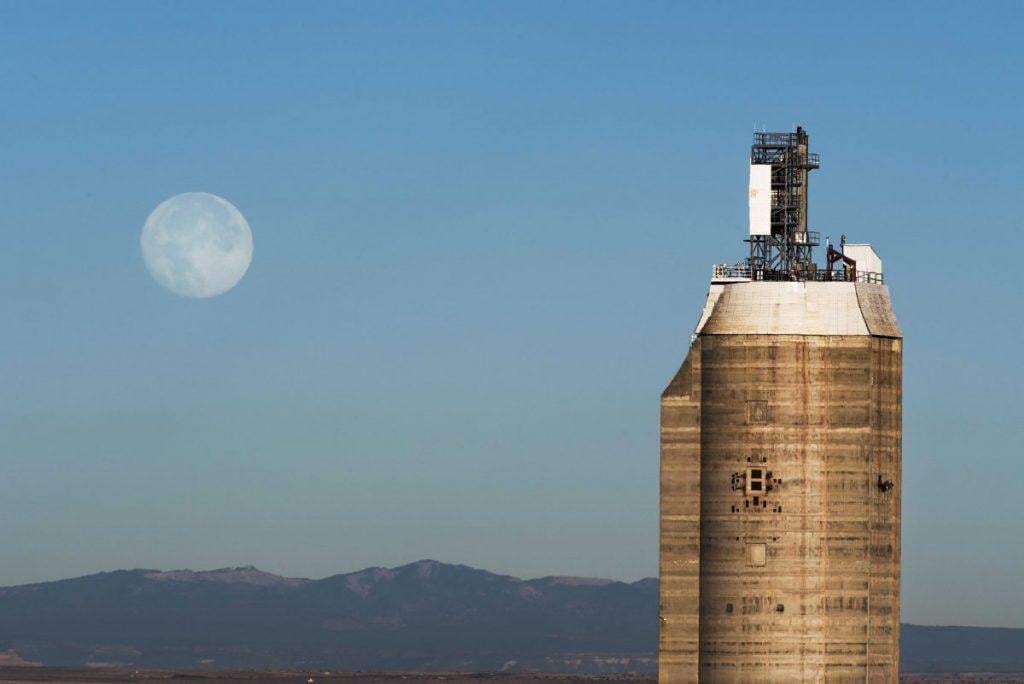

A Sandia National Laboratories scientist, John Sandusky, is exploring night time use of heliostats at the National Solar Thermal Test Facility ( https://energy.sandia.gov/programs/renewable-energy/concentrating-solar-thermal-technologies/ ) to discover and track space objects both near earth and near the moon. As he notes: “It may help the U.S. Space Force with its job of trying to find spacecraft, especially in the cislunar area. Orbits near the moon can be difficult to track from the ground”.
The heliostats, an array of large computer guided mirrors designed to track the Sun and focus its energy on a 200-ft tall central tower during the day, are not suitable for optical imaging. However, they are capable of collecting light signatures of stars, asteroids, and spacecraft. Sweeping the heliostats across the star field at a fixed rate allows detection of the difference in optical signatures between the background stars and nearer space objects with motion relative to the sidereal background.
So far only one of the 212 heliostat has been used in what is still a feasibility and characterization study, but experiments continue, with plans to incorporate more heliostats in the future.
https://www.sandia.gov/labnews/2025/07/24/asteroid-hunting-using-heliostats/ .
by SpookSkywatcher
1 Comment
This post provides a brief summary and links to an article on the night time use of solar energy heliostats for detection and tracking of spacecraft near the earth or moon. A relevant technical paper is at https://www.spiedigitallibrary.org/conference-proceedings-of-spie/13149/3028242/Prospect-for-cislunar-spacecraft-and-near-earth-asteroid-detection-using/10.1117/12.3028242.short , but only the abstract is free to read.