
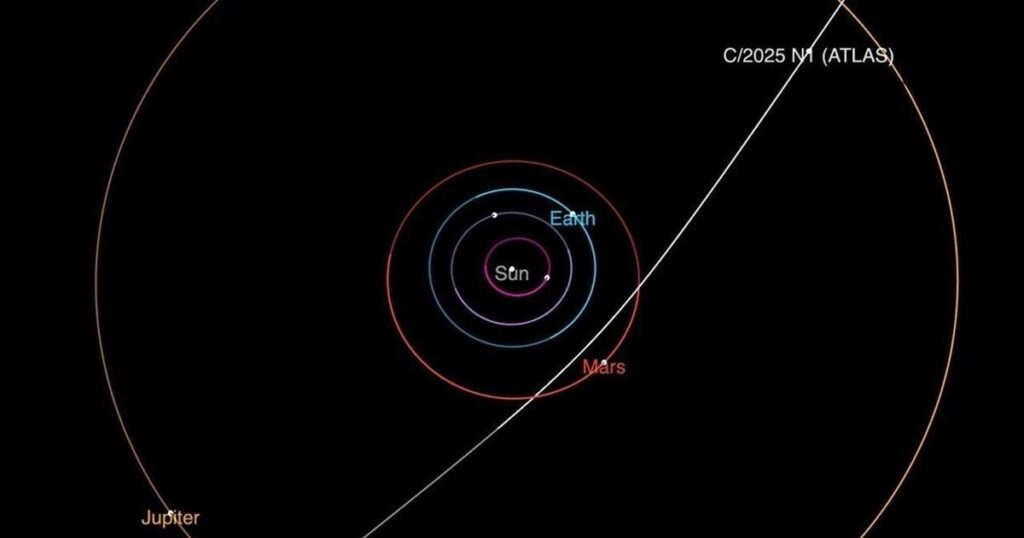
BILLINGS, Mont. – A newly discovered comet, 3I/ATLAS, is passing through our solar system. This galactic visitor is only the third interstellar comet ever found.
Dr. Mark Reiser, an astronomy professor from the University of Montana explained, “We probably treat that as a person or, you know, a critter, but we just mean a visitor as far as a rock, a comet, an icy body that was not made here. It did not form in our solar system.”
Unlike most comets, 3I/ATLAS follows a hyperbolic orbit, meaning it is just passing through and will not return.
Reiser said, “It actually will not come back around…the energy is such that it was actually too rapidly moving to ever have been bound to the sun on the path that it’s coming in at.”
Scientists are particularly interested in 3I/ATLAS’s icy makeup, which contains more carbon dioxide than most comets observed before. This suggests it formed under different conditions outside our solar system.
Reiser noted, “We don’t have the same balance maybe of ices that we might find in our solar system, depending on where these comets form. And so, it’s been a little bit atypical in that regard.”
He added, “I think it got people’s curiosity up quite a bit, because it’s possible that the chemistry that formed this or the location it formed – in its solar system, presumably – may have been a little bit different than the processes that have governed the formation of many of our icy bodies.”
Online speculation has suggested the object could be artificial or alien, but Reiser dismissed these ideas.
“The short of it is, is it’s behaving like a comet. And yeah, it’s had some atypical behaviors, like I said, with the balance of those ices and I believe it had a kind of a counter tail at first.” he said. “I don’t think we need to – to go outside those realms to explain what we’re seeing.”
Comet 3I/ATLAS is expected to make its closest approach to Earth in mid-December. It may not be visible without binoculars, but scientists say it offers a rare glimpse of materials from another solar system, reminding us of the vast universe we are part of.