
Update 08 November 2025
Interstellar comet 3I/ATLAS set a new first in its class on 4th November. The MeerKAT radio telescope detected a natural signal coming from the comet in the 1600 MHz range. Moreover, the natural signal had notches at 1665 MHz and 1667 MHz, which occur due to OH absorbtion. The detection is the first time a radio spectrum of an interstellar object has been obtained.
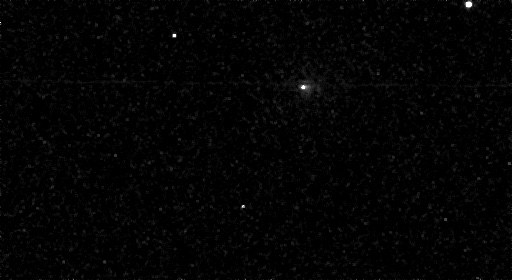
Astronomers have been left stunned by the sudden surge in brightness from comet 3I/ATLAS, a rare interstellar traveller now making a close pass around the Sun. In a matter of weeks, it has transformed from a faint object into a dazzling spectacle, brightening far more rapidly than experts had anticipated.
Ordinarily, a comet’s glow strengthens slowly as the Sun’s heat causes its frozen surface to vaporise. But 3I/ATLAS is breaking the pattern. Data indicate its luminosity is increasing at nearly double the rate seen in most comets, hinting that powerful and unpredictable processes could be unfolding deep within its core.
Watching From Solar Spacecraft
Because the comet recently passed almost directly behind the Sun from Earth’s point of view, ground-based telescopes couldn’t track its progress. Instead, researchers turned to satellites built for solar observation, including NASA’s STEREO-A, ESA’s SOHO, and NOAA’s GOES-19.
Using these instruments, astronomers Qicheng Zhang of Lowell Observatory and Karl Battams of the US Naval Research Laboratory captured the comet’s rapid evolution as it moved from about twice Earth’s distance from the Sun to just 1.36 astronomical units.
Zhang described the change as “striking,” with data showing that 3I/ATLAS’s brightness increased steeply as it neared perihelion, its closest approach to the Sun on 29 October.
A Shift to Blue Light
Even more intriguing is the comet’s change in colour. Images reveal a distinctly bluish hue, a clue that gases, not just dust, are driving the brightening. This points to volatile materials such as cyanogen or ammonia being released as solar heat intensifies.
Earlier observations had shown the comet’s dust to be reddish, making this shift especially unusual and hinting at fresh material being exposed or new chemical reactions taking place on its surface.
What Might Be Powering the Surge
No one yet knows exactly what’s causing the outburst. Scientists suspect it could be tied to the comet’s composition — perhaps containing unusually volatile ices — or to stresses from its high-speed entry into the inner Solar System.
Another possibility is that the object’s long journey through interstellar space has altered its outer layers, setting the stage for the explosive brightening seen now.
As 3I/ATLAS emerges from behind the Sun in November and December, astronomers on Earth will finally have a chance to observe this spectacular and mysterious traveller up close and perhaps uncover the secret behind its extraordinary glow.
 Published by Kerry Harrison
Kerry’s been writing professionally for over 14 years, after graduating with a First Class Honours Degree in Multimedia Journalism from Canterbury Christ Church University. She joined Orbital Today in 2022. She covers everything from UK launch updates to how the wider space ecosystem is evolving. She enjoys digging into the detail and explaining complex topics in a way that feels straightforward. Before writing about space, Kerry spent years working with cybersecurity companies. She’s written a lot about threat intelligence, data protection, and how cyber and space are increasingly overlapping, whether that’s satellite security or national defence. With a strong background in tech writing, she’s used to making tricky, technical subjects more approachable. That mix of innovation, complexity, and real-world impact is what keeps her interested in the space sector.