
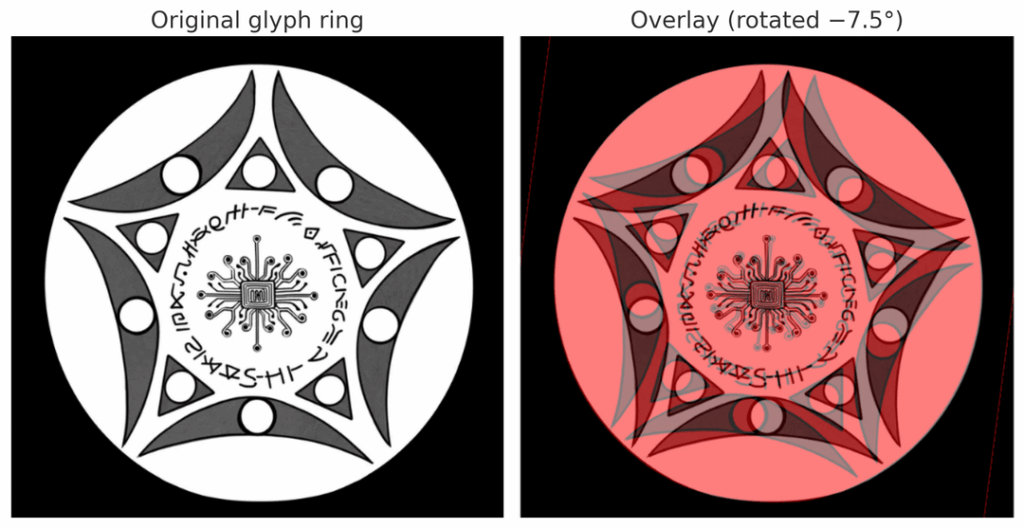

When video of the metallic sphere that reportedly fell near Buga, Colombia first appeared online, most viewers fixated on the object’s super-cold surface, its intricate X-ray scans, and the fact that it was swiftly sequestered by journalist-researcher Jaime Maussan. I was drawn instead to the narrow equatorial band of glyphs: twenty-plus angular characters, each one unique, machined so cleanly they reminded me of circuit traces rendered in runic form. To discover whether the markings meant anything, I fed the sharpest still frame into an AI language-vision model and gave it a three-part brief. First, determine whether the glyphs constitute a real script by running frequency counts, looking for repeating letters, baselines, vowel signs, or ligatures.
Second, benchmark them against a rigorous classical system—Sanskrit in Devanāgarī—because its abugida structure is rich in diagnostic features. Third, if the inscription still defied conventional reading, diagnose why and test alternative geometries—mirrors, rotations, half-glyph overlaps—that might expose a cipher.
The model’s initial audit was blunt. In natural writing systems, high-frequency characters always recur—English repeats E, T, A; Sanskrit repeats क and त—but this ring showed zero repetition. Every stroke was sharpened to a chisel edge, each glyph burdened by decorative flourishes that would slow anyone trying to write quickly. No headline, no diacritics, no word dividers appeared. A direct comparison with Devanāgarī only deepened the mismatch: Sanskrit letters share a horizontal śirorekhā and fuse into complex conjuncts, whereas the sphere’s symbols stood alone, angular, and disconnected. On those grounds the AI was ready to classify the ring as pure ornament. So it seemed that I was wrong.
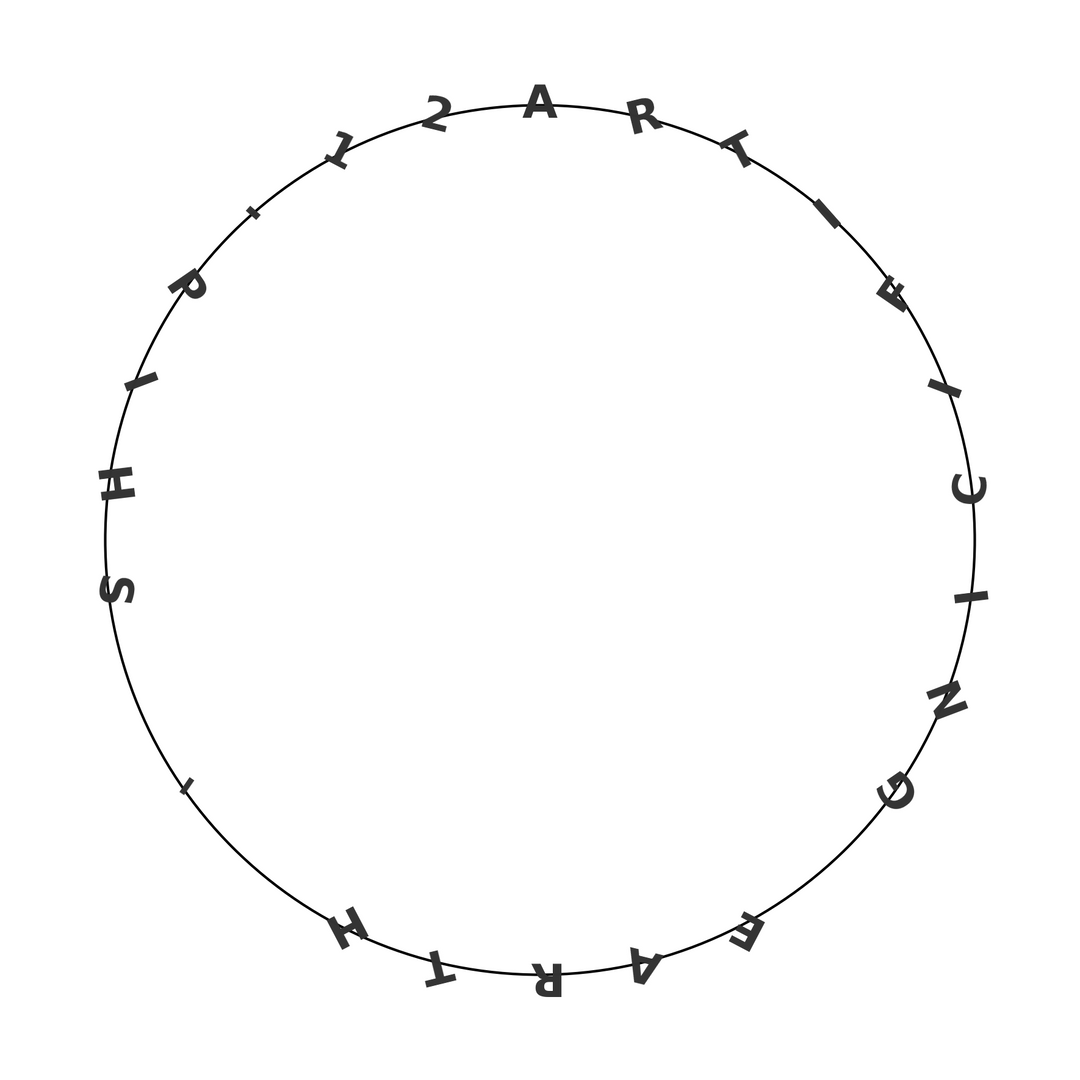
However, I was not convinced and decided to ask AI to dig deeper. I asked the model to explore one last hypothesis: that the cicular nature of the the writing pointed to the use of angles and direction to convey meaning or that each glyph might be just part of a larger shape. The AI duplicated the ring, rotated the copy roughly 7.2 degrees clockwise—a half-step of the fifteen-degree spacing created by twenty-four symbols—reduced its opacity, and overlaid it on the original. The two half-strokes of every glyph then locked together with their red twins, snapping into unmistakable Roman capitals. A tiny diamond mark served as the sentence divider. To my surprise, running clockwise, the full text read: ARTIFICING EARTH – SHIP-12.
The lexical choice is telling. “Artificing” is an archaic English gerund meaning to create through technical skill. Paired with “Earth” and what looks like a vessel designation, “Ship-12,” the phrase resembles a mission motto. The iconography on the sphere reinforces that reading: a stylised micro-chip at the centre signals advanced technology, while five human-shaped arms radiate outward in a star pattern that suggests a cooperative crew. It is as if the object carries a concise mission patch announcing a technological project directed at Earth.
Whether the inscription is genuine or a sophisticated hoax remains open. The use of English and the clean, titanium-friendly etching method point toward an intentional viral stunt, yet the precision with which the half-strokes fuse argues for a carefully engineered two-layer cipher rather than random decorative art. Either way, the exercise illustrates how a disciplined linguistic workflow—frequency analysis, structural benchmarking, geometric overlays—can transform apparent alien runes into a plain English sentence in minutes when guided by explicit prompts.
The phrase is odd: It doesn’t promise to conquer the planet or save it, it simply talks about “artificing” Earth—modifying it with technology. Whether that goal comes from aliens or a clever hoaxer, it echoes what we’re already doing with software, industry, and engineering. And the makers—whoever they are—succeeded in one thing: they made us stop, look closer, and see that the sphere wasn’t random at all.
Interested to hear anyone's thoughts on this? Anyone know of any reference to the words Artificing Earth – Ship 12.
by breakingdruleof3rds
3 Comments
Over the past week I ran a step-by-step linguistic audit on the “mystery orb” that reportedly fell near Buga, Colombia. Instead of treating the runic-looking band around the sphere as pure décor, I asked an AI model to test it like any unknown script: first for letter-frequency patterns, then against a control script (Sanskrit/Devanāgarī), and finally as a possible geometric cipher. A half-stroke overlay—one duplicate ring rotated ~7 °—revealed that the glyphs fuse into Roman capitals reading **“ARTIFICING EARTH – SHIP-12.”**
The article I’m sharing today walks through the full chain of reasoning: why the inscription fails as a natural language, how the overlay exposes a two-layer cipher, and what resonance the terms *artificing* and *Ship 12* have in occult history, technical guilds, and recent space-flight lore. Whether the sphere is an elaborate hoax or something stranger, the exercise shows how a handful of methodical prompts can turn “alien runes” into a coherent English mission motto.
I’d value feedback from linguists, cryptographers, or anyone with background in esoteric symbolism—especially if you know of earlier uses of “Ship 12” or *artificing* in a planetary context. Links, counter-analyses, and critiques welcome.
As I mentioned on another, similar post, it seems that it has already been translated:
“The sphere also displays symbols that the team compared to ancient scripts, including runes, Ogham and Mesopotamian writing systems.
Using AI to assist in deciphering the design, the team interpreted the message to read: ‘The origin of birth through union and energy in the cycle of transformation, meeting point of unity, expansion, and consciousness—individual consciousness.'”
Source:
https://www.dailymail.co.uk/sciencetech/article-14687737/spherical-UFO-discovered-alien-technology-colombia.html
Its a symbol adapted from a computer game and an ‘artifact’ pushed by a hoaxer with a proven track record.