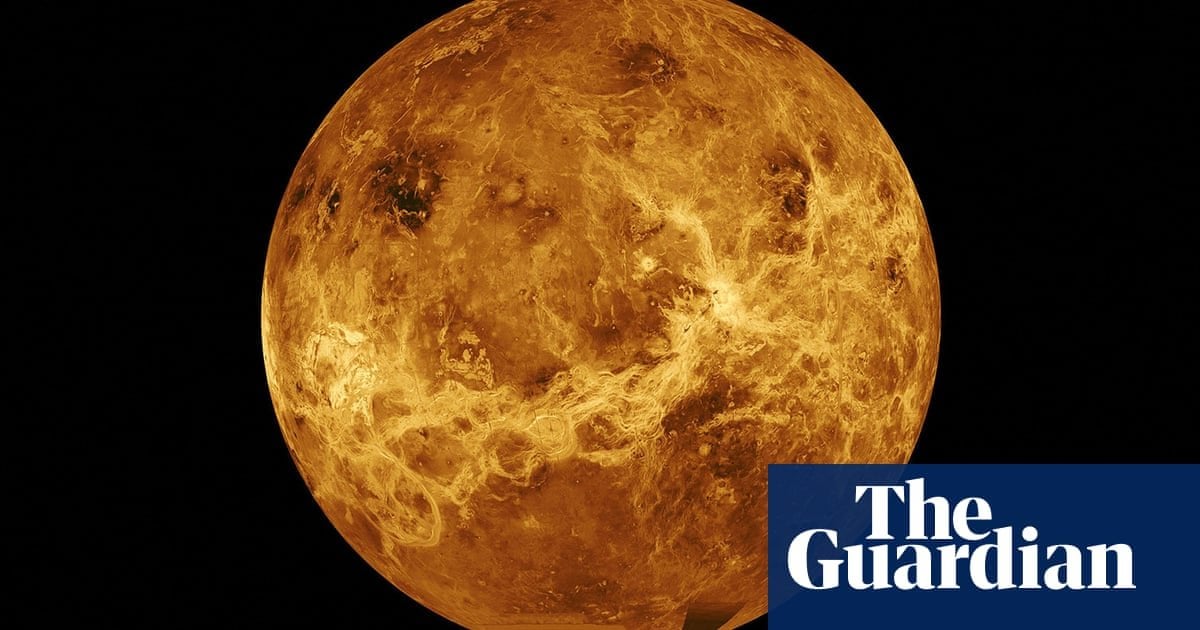
Signs of two gases in clouds of Venus could indicate life, scientists say | Separate teams find evidence of phosphine and ammonia, potential biomarkers on planet whose surface reaches 450C
Signs of two gases in clouds of Venus could indicate life, scientists say | Separate teams find evidence of phosphine and ammonia, potential biomarkers on planet whose surface reaches 450C
Oh fly me away to the clouds of Venus where the microbes play, they smell like badger’s guts and have a year that is shorter than their day, up there in the clouds of Venus I’ll sniff the penguin poo air and take in the view, just don’t fall overboard when you use the loo, it’s a long way down and not too comfy.
If the discovery of alien life happens at a conference in Hull it will at least explain some of the people I’ve met there.
Larkson9999 on
At least they acknowledge this hypothesis has already been debunked.
To save people a click, the supposition that life may be on Venus, the scientists aren’t claiming that. It’s either something about the atmosphere we don’t know about Venus (of which we already have a lot of unknowns) or micro-organisms are producing the gas as waste.
Really seems more likely that we just don’t know why phosphene is there.
Aquabloke on
NASA needs to hurry up with HAVOC. Atmospheric probes should be able to function for at least months if not permanently if properly built. And we still lack so much knowledge of the most earthlike planet in the solar system. And together with Mars the most likely to contain life.
wrightmf on
Ohhhh so THIS is why NASA just streamed Missy Elliot to Venus… trying to tell the inhabitants that we come in peace, or something.
I’ve heard of this before, and I advise that we be cautious. The findings of phosphine and ammonia are known to be produced by life on Earth, but assigning the gases in Venus’ atmosphere to extraterrestrial life is a very dubious proposition. The scientists in the article admit that these chemicals are far from “smoking guns,” not even robust evidence, of extraterrestrial life. As the OP’s title states, it *could* indicate life, and this is not the same thing as saying it does indicate life, only that it is a possibility. Although, I do not side with the position that life produced the gases.
Here’s my take on phosphine. The phosphine could be produced by volcanoes, **[Edit:** lightning (whether lightning happens commonly or not is up for debate), or high temperature and high pressure. It could be all of the above, as Venus does display all three,**]** but that’s disputed among scientists right now.
**[Edit:** Some scientists argue that the amount of phosphine in the atmosphere is too high for volcanoes to be responsible, but I don’t necessarily agree with this. It sounds like an argument based on Earth’s volcanoes, which are different from those on Venus. There is a definite lack of knowledge about the material under Venus’ surface which compose much of the planet, and we don’t know much about its geochemistry, so I could make the argument that volcanic processes on Venus allow it to release far more phosphine than volcanoes on Earth, and Venus is very geologically/volcanically active.
It contains about 85,000 volcanoes, maybe even hundreds of thousands of them (some sources say there could be over a million volcanoes). For comparison, Earth has about 1,500 volcanoes, Mars has less than 20 volcanoes, and Io has 400 volcanoes. Phosphine breaks down under UV light, so the constant presence of phosphine indicates a producer, which I can still say is not due to biological activity. Volcanoes, temperature, pressure, and lightning could all be contributing to the production of phosphine, building up the amount at night.**]**
Phosphine can be abiotically produced, so assuming only life can produce it is untrue, but I think scientists are aware of this. I think phosphine is either produced in the atmosphere or by geochemical processes producing phosphine that is released into the atmosphere.
**[Edit:** I also looked into the phosphine in Venus’ atmosphere detections. The initial study in 2020 claiming to have found phosphine in the clouds had scientists saying the amount was 20 ppb (parts per billion). However, NASA later used SOFIA (Stratospheric Observatory for Infrared Astronomy) to detect any phosphine on Venus, but they found none, suggesting that it was instead sulfur dioxide that was mistaken for phosphine because of the similar absorption line. NASA scientists also said that if there is phosphine on Venus, it would be a significantly lesser amount like 0.8 ppb. Here is what the Universities Space Research Association says:
>SOFIA, a far infrared telescope mounted in a 747 aircraft, recently concluded its science operations in September 2022. Over the course of three flights in November 2021, it looked for hints of phosphine in Venus’s sky. Thanks to its operation from Earth’s sky, SOFIA could perform observations not accessible from ground-based observatories. Its high spectral resolution also enabled it to be sensitive to phosphine at high altitudes in Venus’s atmosphere, about 45 to 70 miles (about 75 to 110 kilometers) above the ground — the same region as the original finding — with spatial coverage across Venus’s entire disk. SOFIA searched between about 45 and 70 miles (about 75 to 110 kilometers) above the ground — the same region as the original finding.
>
>The researchers didn’t see any sign of phosphine. According to their results, if there is any phosphine present in Venus’s atmosphere at all, it’s a maximum of about 0.8 parts phosphine per billion parts everything else, much smaller than the initial estimate.
However, I saw that some studies in 2023 claimed to have found phosphine again on Venus, and they say the amount is much lower at 3 ppb. So, either the phosphine amount is 0.8 ppb or 3 ppb. I’m not sure about this part. But it seems there is likely phosphine in the atmosphere, only just a small amount.**]**
The presence of ammonia is pretty interesting, but it doesn’t mean there is life there. We know that ammonia can be readily produced abiotically, so to say that it may mean life is quite a huge and unsubstantiated leap, in my opinion. I think it’s more than likely unknown chemistry. **[Edit:** Both phosphine (PH3) and ammonia (NH3) are extremely simple molecules, so they could be easily produced by Venus’ volcanoes. Hydrogen, nitrogen, and phosphorus are produced by volcanoes on Earth, so I think Venus’ volcanoes may be releasing more of these elements than Earth’s volcanoes.**]**
I say that the only way to really know is to go investigate it up close. However, I’m betting there isn’t life on Venus. Europa and Enceladus are far better candidates because they might have liquid water, but Venus has very little or none at all. I’m, of course, not arguing abiotic processes are responsible because we haven’t figured that out yet, but I do think it’s the most likely option since I prefer to make extraterrestrial life the final option if all others fail. I’m not against the idea of extraterrestrial life existing somewhere in the universe, I do think, however, that Venus is just not a place for life.
Boogerhead1 on
Venus atmosphere moisture level is less than 0.002% which makes Death Valley look like the Amazon rain forest.
Sulfuric acid concentrate of those clouds is 75-99% and the toughest extremophiles on Earth which specifically evolved for millions of years to handle acidic conditions can only handle 15%
The clouds are barley more than a sparse haze at its thickest.
We know the planet is still volcaniclly active and the thick CO2 atmosphere combined with Sulfur and UV makes it a chemically active wonderland.
There is no life there, and everyone downvoting this needs to go back to middle school chemistry.
CapAvatar on
They always post these sensationalist headlines, the quietly retract or play them down later. Just another nothingburger.
Not_Associated8700 on
What would that say about a god, if life was found to be so different from what we know?
gnomekingdom on
I don’t want anything to do with any organism that has the Kal Jones to survive in a 450C environment.
Maleficent-Salad3197 on
Old story. Just a excuse for a atmospheric mission. Mars or bust.
CptMcDickButt69 on
Fuck, i want to believe so hard…but venus is just so damn extreme, it seems incredibly unlikely.
stardustr3v3ri3 on
I always found it hard to believe in aliens tbh. Not because “only WE’RE the intelligent species in the universe.” But moreso because a lot of things went right with Earth to foster a whole biosphere that I don’t think can easily be replicated.
That said, if Venus does have life, and this article isn’t for sure saying it is, it’s probably just bacteria or single-celled organisms

12 Comments
Oh fly me away to the clouds of Venus where the microbes play, they smell like badger’s guts and have a year that is shorter than their day, up there in the clouds of Venus I’ll sniff the penguin poo air and take in the view, just don’t fall overboard when you use the loo, it’s a long way down and not too comfy.
If the discovery of alien life happens at a conference in Hull it will at least explain some of the people I’ve met there.
At least they acknowledge this hypothesis has already been debunked.
To save people a click, the supposition that life may be on Venus, the scientists aren’t claiming that. It’s either something about the atmosphere we don’t know about Venus (of which we already have a lot of unknowns) or micro-organisms are producing the gas as waste.
Really seems more likely that we just don’t know why phosphene is there.
NASA needs to hurry up with HAVOC. Atmospheric probes should be able to function for at least months if not permanently if properly built. And we still lack so much knowledge of the most earthlike planet in the solar system. And together with Mars the most likely to contain life.
Ohhhh so THIS is why NASA just streamed Missy Elliot to Venus… trying to tell the inhabitants that we come in peace, or something.
[https://www.jpl.nasa.gov/news/nasa-transmits-hip-hop-song-to-deep-space-for-first-time](https://www.jpl.nasa.gov/news/nasa-transmits-hip-hop-song-to-deep-space-for-first-time)
I’ve heard of this before, and I advise that we be cautious. The findings of phosphine and ammonia are known to be produced by life on Earth, but assigning the gases in Venus’ atmosphere to extraterrestrial life is a very dubious proposition. The scientists in the article admit that these chemicals are far from “smoking guns,” not even robust evidence, of extraterrestrial life. As the OP’s title states, it *could* indicate life, and this is not the same thing as saying it does indicate life, only that it is a possibility. Although, I do not side with the position that life produced the gases.
Here’s my take on phosphine. The phosphine could be produced by volcanoes, **[Edit:** lightning (whether lightning happens commonly or not is up for debate), or high temperature and high pressure. It could be all of the above, as Venus does display all three,**]** but that’s disputed among scientists right now.
**[Edit:** Some scientists argue that the amount of phosphine in the atmosphere is too high for volcanoes to be responsible, but I don’t necessarily agree with this. It sounds like an argument based on Earth’s volcanoes, which are different from those on Venus. There is a definite lack of knowledge about the material under Venus’ surface which compose much of the planet, and we don’t know much about its geochemistry, so I could make the argument that volcanic processes on Venus allow it to release far more phosphine than volcanoes on Earth, and Venus is very geologically/volcanically active.
It contains about 85,000 volcanoes, maybe even hundreds of thousands of them (some sources say there could be over a million volcanoes). For comparison, Earth has about 1,500 volcanoes, Mars has less than 20 volcanoes, and Io has 400 volcanoes. Phosphine breaks down under UV light, so the constant presence of phosphine indicates a producer, which I can still say is not due to biological activity. Volcanoes, temperature, pressure, and lightning could all be contributing to the production of phosphine, building up the amount at night.**]**
Phosphine can be abiotically produced, so assuming only life can produce it is untrue, but I think scientists are aware of this. I think phosphine is either produced in the atmosphere or by geochemical processes producing phosphine that is released into the atmosphere.
**[Edit:** I also looked into the phosphine in Venus’ atmosphere detections. The initial study in 2020 claiming to have found phosphine in the clouds had scientists saying the amount was 20 ppb (parts per billion). However, NASA later used SOFIA (Stratospheric Observatory for Infrared Astronomy) to detect any phosphine on Venus, but they found none, suggesting that it was instead sulfur dioxide that was mistaken for phosphine because of the similar absorption line. NASA scientists also said that if there is phosphine on Venus, it would be a significantly lesser amount like 0.8 ppb. Here is what the Universities Space Research Association says:
>SOFIA, a far infrared telescope mounted in a 747 aircraft, recently concluded its science operations in September 2022. Over the course of three flights in November 2021, it looked for hints of phosphine in Venus’s sky. Thanks to its operation from Earth’s sky, SOFIA could perform observations not accessible from ground-based observatories. Its high spectral resolution also enabled it to be sensitive to phosphine at high altitudes in Venus’s atmosphere, about 45 to 70 miles (about 75 to 110 kilometers) above the ground — the same region as the original finding — with spatial coverage across Venus’s entire disk. SOFIA searched between about 45 and 70 miles (about 75 to 110 kilometers) above the ground — the same region as the original finding.
>
>The researchers didn’t see any sign of phosphine. According to their results, if there is any phosphine present in Venus’s atmosphere at all, it’s a maximum of about 0.8 parts phosphine per billion parts everything else, much smaller than the initial estimate.
[https://newsroom.usra.edu/no-phosphine-on-venus–according-to-observations-from-sofia](https://newsroom.usra.edu/no-phosphine-on-venus–according-to-observations-from-sofia)
However, I saw that some studies in 2023 claimed to have found phosphine again on Venus, and they say the amount is much lower at 3 ppb. So, either the phosphine amount is 0.8 ppb or 3 ppb. I’m not sure about this part. But it seems there is likely phosphine in the atmosphere, only just a small amount.**]**
The presence of ammonia is pretty interesting, but it doesn’t mean there is life there. We know that ammonia can be readily produced abiotically, so to say that it may mean life is quite a huge and unsubstantiated leap, in my opinion. I think it’s more than likely unknown chemistry. **[Edit:** Both phosphine (PH3) and ammonia (NH3) are extremely simple molecules, so they could be easily produced by Venus’ volcanoes. Hydrogen, nitrogen, and phosphorus are produced by volcanoes on Earth, so I think Venus’ volcanoes may be releasing more of these elements than Earth’s volcanoes.**]**
I say that the only way to really know is to go investigate it up close. However, I’m betting there isn’t life on Venus. Europa and Enceladus are far better candidates because they might have liquid water, but Venus has very little or none at all. I’m, of course, not arguing abiotic processes are responsible because we haven’t figured that out yet, but I do think it’s the most likely option since I prefer to make extraterrestrial life the final option if all others fail. I’m not against the idea of extraterrestrial life existing somewhere in the universe, I do think, however, that Venus is just not a place for life.
Venus atmosphere moisture level is less than 0.002% which makes Death Valley look like the Amazon rain forest.
Sulfuric acid concentrate of those clouds is 75-99% and the toughest extremophiles on Earth which specifically evolved for millions of years to handle acidic conditions can only handle 15%
The clouds are barley more than a sparse haze at its thickest.
We know the planet is still volcaniclly active and the thick CO2 atmosphere combined with Sulfur and UV makes it a chemically active wonderland.
There is no life there, and everyone downvoting this needs to go back to middle school chemistry.
They always post these sensationalist headlines, the quietly retract or play them down later. Just another nothingburger.
What would that say about a god, if life was found to be so different from what we know?
I don’t want anything to do with any organism that has the Kal Jones to survive in a 450C environment.
Old story. Just a excuse for a atmospheric mission. Mars or bust.
Fuck, i want to believe so hard…but venus is just so damn extreme, it seems incredibly unlikely.
I always found it hard to believe in aliens tbh. Not because “only WE’RE the intelligent species in the universe.” But moreso because a lot of things went right with Earth to foster a whole biosphere that I don’t think can easily be replicated.
That said, if Venus does have life, and this article isn’t for sure saying it is, it’s probably just bacteria or single-celled organisms