
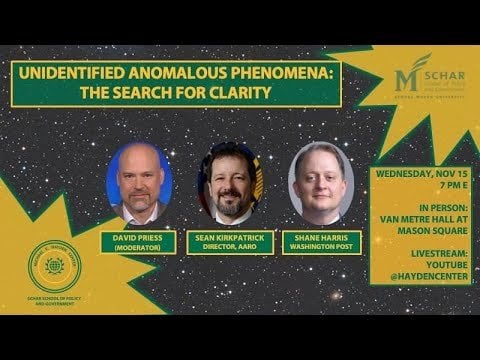
The following emerged out of a breakdown and analysis I conducted of the Hayden Centre discussion with outgoing AARO director Dr Sean Kirkpatrick: “UAP: THE SEARCH FOR CLARITY” [https://www.youtube.com/watch?v=1dcVi\_3NTF0](https://www.youtube.com/watch?v=1dcVi_3NTF0)
I found this to be an interesting and wide-ranging discussion that contains a lot of useful information for interested UAP researchers. For example, Dr Kirkpatrick states that that while many UAP sightings have prosaic explanations (23:55) that 2-4% are “genuinely unusual” (28:55) He also says that the circular drone-like objects being reported around the world in his view, are examples of emerging next generation drone technology (53:00) and that this could represent a serious national security situation. He also says that there is very likely life out there (69:00)
Towards the end of the discussion (52:00 onwards) there emerges an interesting thread that I want to talk about here today; We need to be able to take in a range of evidence beyond testimony and footage and sensor information, we need to ‘open up a hypothetical range academically’ in the field of UAP research so we can identify the alien once we see it, and prove that it is so.
In ‘The Search For Clarity’ Dr Kirkpatrick says that right now, there is no academically constructed, peer-reviewed set of definitions to identify something as truly extra-terrestrial if we actually see it or find it. He suggests that we need to be getting the academic community to generate, through peer-reviewed research, a set of technological signatures, characteristics, and other sets of criteria to establish what is ‘extra-terrestrial’ when we do observe or detect, or encounter it…We need to agree on definitions of what evidence of an extra terrestrial source might actually look like to establish certainty when we encounter anomalous phenomena; If we see something truly strange, truly alien in the sky, right now, all we can say is it ’isn’t something’…We can say “it’s not a bird” but we don’t have the language developed to say *what it actually is…*
I think this work has already started: I am thinking about the ‘five observables’ set up at TTSA [https://tothestars.media/en-au/blogs/press-and-news/five-characteristics-unique-to-uaps](https://tothestars.media/en-au/blogs/press-and-news/five-characteristics-unique-to-uaps) and the some of the reports generated out of the work of AAWSAP: [https://www.theblackvault.com/documentarchive/the-advanced-aerospace-weapon-system-applications-program-aawsap-documentation/](https://www.theblackvault.com/documentarchive/the-advanced-aerospace-weapon-system-applications-program-aawsap-documentation/) and work of Dr Gary Nolan and the SOL foundation [https://www.youtube.com/watch?v=7UW1jyN2o8A](https://www.youtube.com/watch?v=7UW1jyN2o8A) This work could definitely be seen as a genuine starting point to generate this set of definitions and criteria.
For me, this type of discussion raises a lot of interesting questions about what we do when we counter the truly unknown, beyond the range of our knowledge and understanding, beyond our familiar terms and definitions and categories. These types of questions used to be asked by mystics and philosophers, and poets; now it is time for the scientific community to have a turn, and I am excited to see the results…
I would be very interested to hear your thoughts on this matter.
Have a great day…
by B6TM6N