
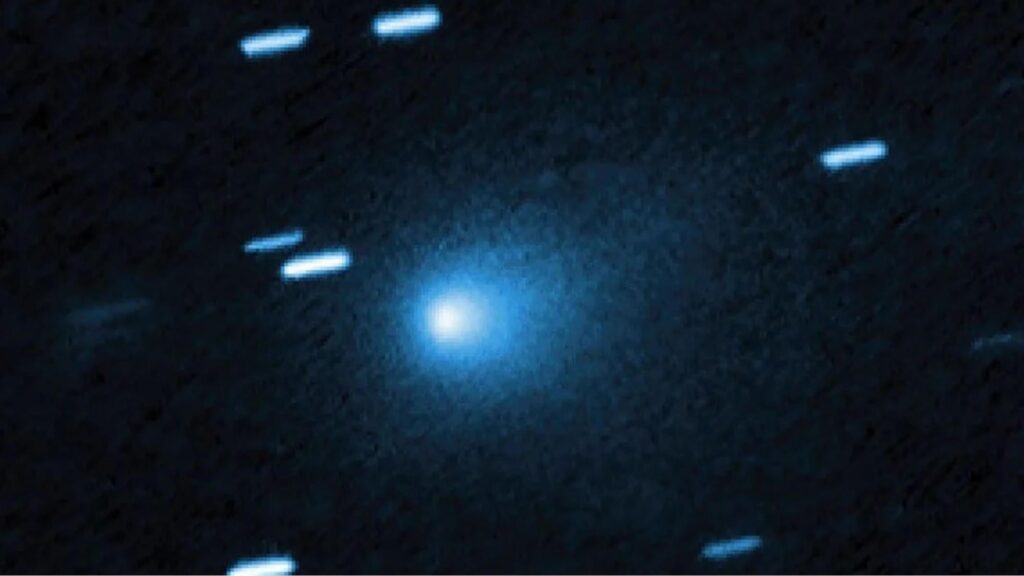

Astronomers are piecing together a clearer picture of interstellar comet 3I/ATLAS, in terms of its age and chemical makeup. New observations from the James Webb Space Telescope (JWST) imply that it formed in a very different environment from comets born near the Sun.
The most unique finding is 3I/ATLAS’ chemistry. Webb’s Near-Infrared Spectrograph revealed that the water vapor spewing from 3I/ATLAS contains an exceptionally high concentration of deuterium, or heavy hydrogen. Measuring roughly 30 times higher than levels found in local comets, this extreme ratio proves the object spent its formative years trapped in a deeply frozen state below minus 400 degrees Fahrenheit.
 Webb was used to map specific chemical contents of comet 3I/ATLAS (Credit: NASA/ESA/CSA/STScI/Cordiner)
For this heavy water ice to survive completely unaltered, the comet must have been cast into the deep chill of interstellar space almost immediately after its birth, never experiencing the long-term stellar warmth that would have reprocessed its chemistry. Meanwhile, the comet’s carbon composition provides a deeper revelation about its age. Observations showed an extreme scarcity of carbon-13 relative to the more common carbon-12. Because galaxies gradually become enriched with carbon-13 over time as successive generations of stars live and die, this pristine ratio places the comet’s birth at an 10 to 12 billion years ago.
This lines up with a period astronomers call cosmic noon, an era when star formation across the universe was at its absolute peak. For comparison, our own sun and planets formed a mere 4.5 billion years ago, meaning 3I/ATLAS was already ancient when Earth was nothing more than scattered dust.
Its trajectory further corroborates the comet’s antiquity. Orbital modeling suggests the comet arrived at a steep angle tracing back to the Milky Way’s thick disk, a region known to house the galaxy’s oldest star populations. Though scientists cannot pin down the exact star system it left behind (and no, it’s not from an alien homeworld), the icy relic was likely flung into exile during a violent planetary birth, drifting for eons across space.
Astro-chemist Martin Cordiner of NASA’s Goddard Space Flight Center emphasized the significance of the discovery as a “unique opportunity to study an ancient object from the distant galaxy, probably pre-dating our Sun and solar system.”
3I/ATLAS is now racing toward the outer edges of our solar system, expected to pass Pluto by 2029 and exit for good by 2035.