
Agency
22/06/2026
43 views
1 likes
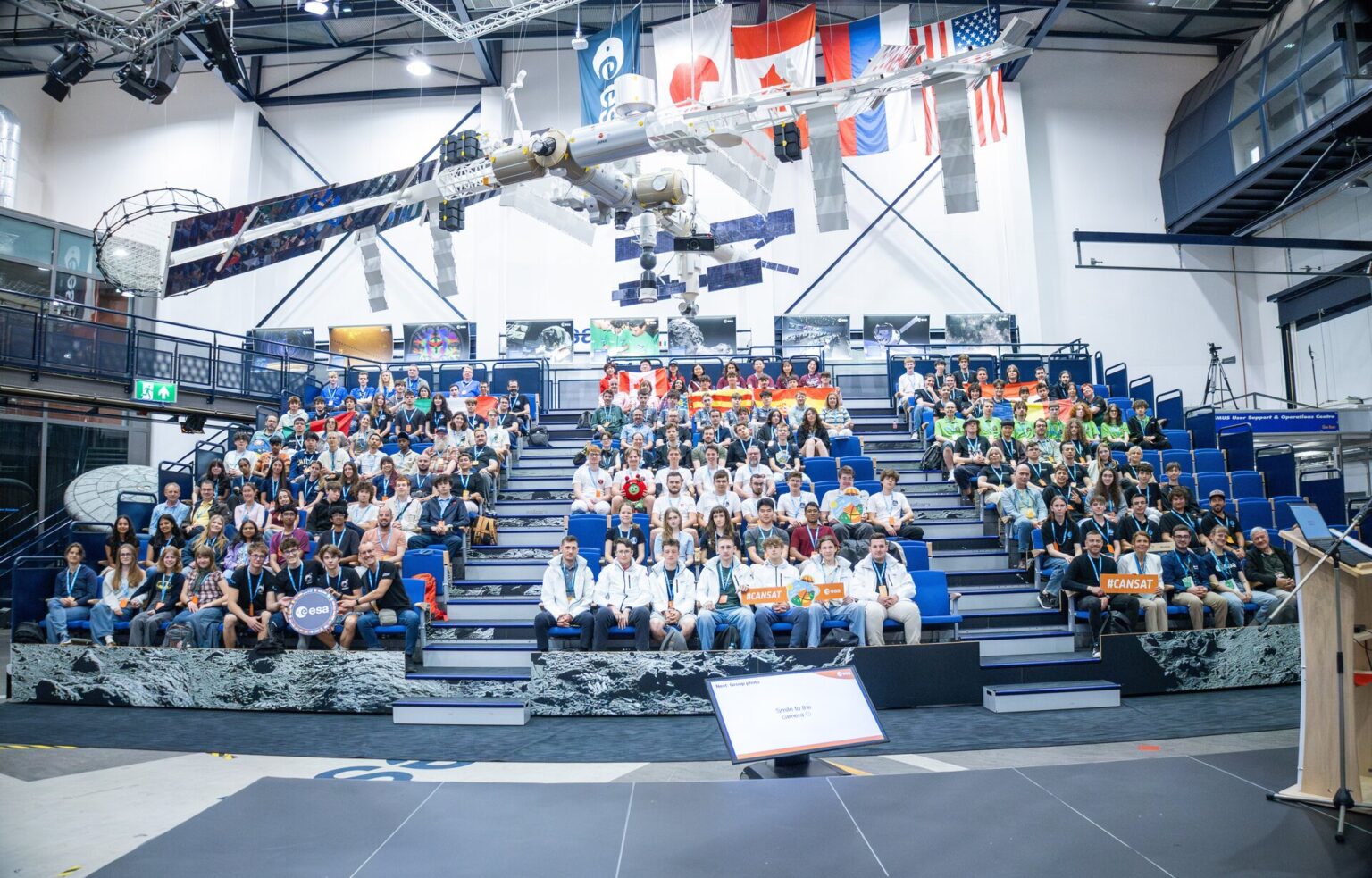
From 17–19 June 2026, the winning teams from the 26 national CanSat competitions, led by national ESEROs and other national partners, gathered at ESA’s European Space Research and Technology Centre (ESTEC) for the CanSat – Space Engineer for a Day event. Around 170 students and teachers from 26 countries took part in this three-day learning and celebration event, gaining a unique insight into space engineering disciplines and the wide range of space careers at ESA.
CanSat is an interdisciplinary school project coordinated by ESA and implemented by the European Space Education Resource Offices (ESEROs) and other national organisers. In the project, upper secondary school students design, build and launch a satellite the size of a soft drink can. The Space Engineer for a Day event rewards national winners by immersing them in the world of space engineering through hands-on activities, collaborative engineering challenges and interaction with ESA experts.
Giving students their first hands-on experience of a real space project
A CanSat is a simulation of a real satellite, built to match the size and shape of a soft drink can
Designing a CanSat starts with a simple but demanding challenge: selecting mission objectives, designing the CanSat and fitting the essential systems of a satellite into the volume of a soft drink can. Working in teams of three to six students aged 14–19, guided by a teacher or mentor, students design, build, integrate, test, and launch a microsatellite that has to complete a mandatory mission, to measure temperature and pressure, as well as the team’s own selected secondary mission.
This process mirrors real space engineering practice. Students balance mission objectives, technical constraints and creativity while integrating subsystems such as power, sensors and communications into a minimal volume. Once completed, the testing begins and finally the CanSat is launched to an altitude of around one kilometre or deployed from a drone, platform or balloon to carry out its mission.
The national victory to the CanSat – Space Engineer for a Day event at ESA ESTEC
Students at ESA ESTEC’s Erasmus Innovation Centre
The teams earned their invitation to the event at ESTEC by winning their national CanSat competitions, held during the current 2025–2026 school year. In 2026, competitions were organised in 22 ESA Member States, as well as Canada, Lithuania, Slovakia, and Malta, and were coordinated by ESEROs, national space bodies and other national education partners.
The ESA CanSat Space Engineer for a Day event is intentionally non-competitive, placing the emphasis on learning, collaboration and inspiration. It provides students and their mentors with a tangible experience of how classroom STEM learning connects to real-world engineering and space missions.
Experiencing ESA from the inside
Students attending CanSat Space Engineer for a Day 2026 event
Students arrived on 17 June for the opening ceremony and social activities, giving teams the opportunity to meet peers from across Europe and Canada. During the opening ceremony, each team had the opportunity to introduce themselves and present their CanSat project.
On the following day, 18 June, participants spent the day at ESA ESTEC, listening to expert talks on the European space programme and on how space missions are conceived and developed. One of the keynote sessions was delivered by Daniel Wischert, Systems Engineer and Team Leader in ESA’s Concurrent Design Facility (CDF), who introduced systems thinking and collaboration in space engineering.
The main activities took place at ESA ESTEC’s Erasmus Innovation Centre, where students were surrounded by space hardware models and interactive exhibits. Guided by ESA experts, they explored how engineering, science and technology come together in modern space missions.
Sharing missions like real researchers
Sharing mission objectives, design choices and results at the poster session
A highlight of the second day was the poster session, where each national team presented its CanSat mission in detail to fellow students and ESA experts. Using professional-style posters, teams explained their mission objectives, design choices and results, mirroring how researchers and engineers communicate their work at professional conferences.
This session encouraged peer learning, discussion and reflection, while also strengthening students’ communication skills. It offered them direct feedback and inspiration from ESA experts and young professionals.
“This event brings people together and encourages teamwork,” said one of the students.
Designing a space mission together: concurrent engineering
Students working together in teams to design a fictional space mission at ESA ESTEC
In the afternoon, students took part in a packed interactive programme. They had the opportunity to visit ESA ESTEC facilities and discover fascinating space exhibits, such as the Columbus module, through a Scavenger Hunt that challenged their logical and critical thinking skills.
The students also took part in a concurrent engineering challenge, working together in teams to design a fictional space mission. Assigned to different technical disciplines, they collaborated in real time to define mission parameters and develop a coherent spacecraft concept. This approach was inspired by ESA’s Concurrent Design methodology, used in the development of ESA space missions. The challenge was led by Massimo Bandecchi, founder of ESA’s Concurrent Design Facility and former ESA Head of Systems Engineering and the CDF for 20 years.
Through this activity, students experienced how complex engineering decisions are made collaboratively, and how communication and compromise are essential to successful mission design. Each group presented the outcomes of their feasibility study on the last day of the event.
“It was such a great opportunity for them to experience real-world engineering design in an authentic way,” said one of the teachers about the activity. “They were just doing it all on their own. It was independent, and they actually produced a really nice final product.”
Exploring space missions, inspiring future space careers
Exploring space careers at ESA ESTEC during CanSat – Space Engineer for a Day 2026 event
The event concluded with a space careers role‑play activity on 19 June. Students were first introduced to a range of space careers through a panel of ESA experts, where students were given questions to ask the experts to Guess the Space Pro and determine which panellist had which role at ESA. The students then took on different professional roles and worked in groups to respond to a binary question related to lunar exploration, applying the perspectives and responsibilities of their assigned careers. Professional roles the students acted as included lunar scientists, navigation engineers, space lawyers, project managers, science communicators, spacecraft engineers, and budget controllers, giving them a wide variety of careers in the space sector to consider for their future.
This interactive format helped students understand the wide range of technical roles involved in space missions, extending beyond engineering and science, to include operations, communication and coordination. It also encouraged them to reflect on future study choices and possible career pathways.
Inspiring students and teachers alike
Students at ESA ESTEC during CanSat Space Engineer for a Day 2026 event
After three days of learning, collaboration, discovery and hands-on engineering, the students returned home with renewed motivation to pursue STEM studies and careers. Teachers also gained inspiration for applying project-based learning and experienced how international collaboration and authentic engineering challenges can engage young people with science and technology.
“It’s such a fun experience,” shared one of the students. “It’s so rewarding for all of us to learn so much more about space.”
About CanSat
CanSat is an interdisciplinary education initiative coordinated by ESA, implemented by the 22 ESEROs and by other national organisers across ESA Associate Members and Canada. Aimed at upper secondary school students, it supports the teaching and learning of curriculum subjects such as physics, technology and programming through a practical, team-based space project. National and regional competitions are held each year, with the national winning teams invited to take part in the dedicated event at ESA ESTEC.
Like