
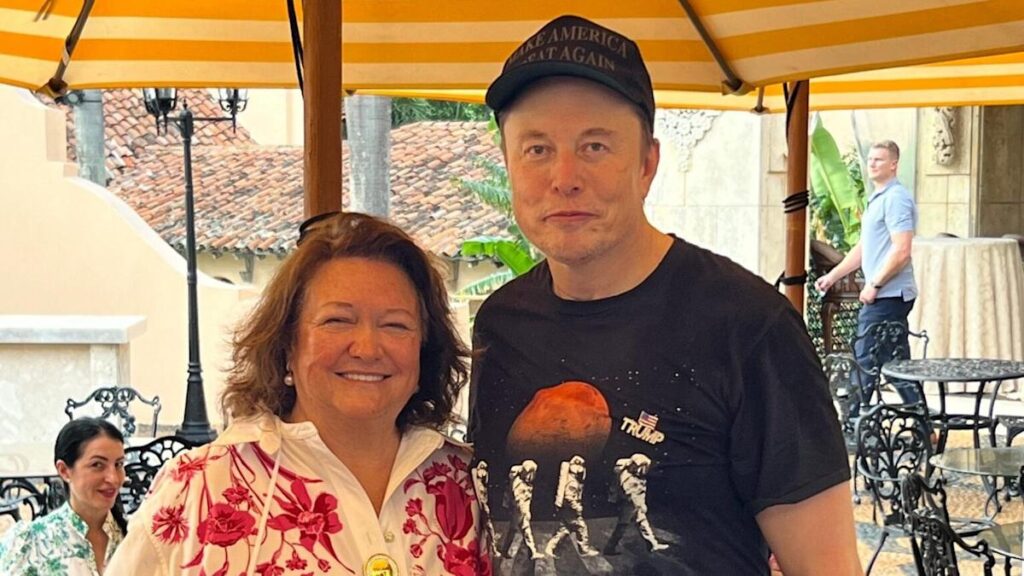
Australian mining tycoon Gina Rinehart has staked her claim in Elon Musk’s company SpaceX, reportedly laying down $1.4 billion to buy into its historic stock market debut.
The Wall Street Journal revealed (1) that SpaceX now represents the largest share of Rinehart’s portfolio outside of the iron ore business she oversees as executive chairman of Hancock Prospecting.
Must Read
Rinehart expressed her admiration for Musk’s achievements in a press release on her decision.
“Elon has done what very few people in history have done,” the release reads (2). “He has not just imagined the future, he has built companies capable of delivering it, and helped to keep American technology at the forefront.”
She added that she sees Hancock Prospecting as having a place in that future through “mutually beneficial arrangements” with SpaceX.
Here’s a look at what those arrangements might be.
From mining in Australia to mining in space
As Mining.com reports, Rinehart’s company is a player in the much-coveted rare earth elements (REEs) sector (3).
SpaceX needs (4) these strategic minerals for rocket and satellite propulsion, sensors, optics and electronics.
Rinehart is still a relatively small player in the sector compared to companies based in China, the world’s top producer of rare earth elements.
However, she has been steadily expanding (5) her strategic minerals empire to include Australia’s Lynas Rare Earths (6) [ASX:LYC], MP Materials (7) [NYSE:MP] in the U.S. and Arafura Rare Earths in Brazil.
And she believes she has an advantage on the global market. China used rare earth elements as a bargaining chip (8) in trade negotiations with President Donald Trump. Rinehart would be only too happy to supply critical minerals to the U.S. and other Western nations.
Meanwhile, SpaceX has something Rinehart is interested in: an ambition to mine the moon, asteroids, Mars and beyond.
NASA has already announced plans to set up facilities to process lunar water, energy and soil (called regolith (9)). SpaceX could transport samples back to earth.
As Mining.com notes, scientists believe asteroids and regolith contain platinum, nickel and iron (10). Anna Brady-Estevez, a chemical and environmental engineer, says regolith may also contain rare earth elements and Helium-3, used for medical imaging (MRIs) and cooling quantum computers.
Story Continues
Brady-Estevez is just as interested as Rinehart in the possibilities as founder of American DeepTech — an investment firm with an interest in funding lunar ventures and the infrastructure needed to support them.
“My best guess is (lunar resource extraction) will be far more valuable than terrestrial resource production,” Brady-Estevez told Moneywise.
“When you think about the tens of trillions in Saudi Arabia and Venezuela and then think about all the different resources off-planet in the moon, asteroids and other bodies, it’s several multiples higher,” she speculated.
Read More: About 1 in 5 Americans over 50 has zero retirement savings. Here’s why it’s not too late
Betting on the space economy
Bloomberg reports (11) that Rinehart has also invested millions in U.S. aerospace and defense manufacturers Northrop Grumman [NYSE:NOC] and [NYSE: LMT]. These companies are directly involved in the aerospace industry.
Northrop Grumman is working (12) with the U.S. government and commercial partners on contracts to service satellites and refuel space vehicles in orbit. The company also builds spacecraft.
Lockheed Martin is actively engaged in human (13) space exploration — including sharing Elon Musk’s ambition to mine (14) the moon and to reach Mars.
Rinehart is clearly not the only one betting on space. Late last year, the World Economic Forum predicted (15) that the global space economy would be worth $1.8 trillion by 2035.
That prediction seems almost quaint, given that SpaceX alone is valued (16) at more than that since its IPO — enough, by our count, to send the $4.1-billion Artemis II rocket to the moon 430 times.
That kind of money makes mining on the moon sound a little more down to earth. But as Mining.com warns (3), there are a number of logistical and legal obstacles in the way.
One is the United Nations’ Outer Space Treaty (17), which forbids any nation from claiming sovereignty over celestial bodies. And while it’s one thing to mine resources in space, it’s another to claim ownership of the end products for commercial reasons.
For now, Rinehart, 72, is keeping her eyes on the skies for the future of mining.
You May Also Like
Join 250,000+ readers and get Moneywise’s best stories and exclusive interviews first — clear insights curated and delivered weekly. Subscribe now.
Article Sources
We rely only on vetted sources and credible third-party reporting. For details, see our ethics and guidelines.
The Wall Street Journal (1); Hancock Prospecting (2); Mining.com (3), (6), (7), (10); SFA Oxford (4); Bloomberg (5), (11); The Washington Post (8); NASA (9); Northrop Grumman (12); Lockheed Martin (13), (14); World Economic Forum (15); The Guardian (16); United Nations Office for Outer Space Affairs (17)
This article originally appeared on Moneywise.com under the title: Here’s why the richest person in Australia just bought a stake in SpaceX worth $1.4 billion
This article provides information only and should not be construed as advice. It is provided without warranty of any kind.